
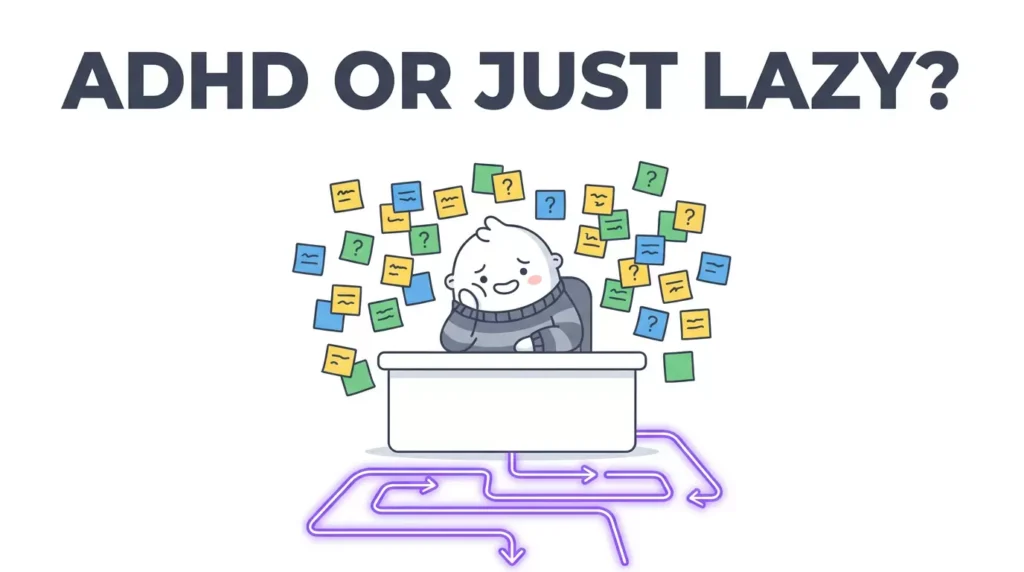
Do you often feel like your brain is running 50 browser tabs at once, but none of them are actually loading? Do you start your workday with high motivation, only to find yourself three hours later trapped in a loop of digital distraction, severe brain fog, and mounting guilt?
You aren’t alone. And more importantly, you aren’t just “lazy” or “unmotivated.” What you are experiencing might be the subtle, heavily masked symptoms of Adult ADHD and Executive Dysfunction.
Unlike childhood ADHD, which is often characterized by physical hyperactivity, adult ADHD creates an internal chaos—a constant, exhausting struggle with focus, task initiation, and emotional regulation. Let’s decode the 7 hidden signs that indicate your nervous system is fighting a silent battle.
1. The “Paralysis” of Starting Tasks
The hardest part for an ADHD mind isn’t doing the work—it’s the friction of starting. You know exactly what you need to do, yet you stare at the screen for 45 minutes, physically unable to force your hands to type. Clinicians call this Task Initiation Paralysis, and it happens because your prefrontal cortex lacks the necessary dopamine spike to bridge the gap between intention and action.
2. Time Blindness: The 5-Minute Illusion
To an adult with executive dysfunction, time does not flow linearly. It only exists in two distinct states: NOW and NOT NOW. This perceptual deficit leads to chronic lateness, drastically underestimating how long a task will take, or hyper-fixating on a minor detail for six hours straight while urgent responsibilities burn to the ground.
3. The 2 PM Cognitive Crash (Brain Fog)
You wake up exhausted, feel mentally sluggish by mid-afternoon, and constantly forget why you walked into a room. This “Brain Fog” isn’t just poor sleep; it’s a signature symptom of dopamine dysregulation. Your brain burns premium cognitive fuel just to perform basic administrative tasks, leaving you with an empty tank by 2 PM.
Stop Guessing. Map Your Brain.
Are these symptoms destroying your daily productivity? Don’t let executive dysfunction steal your potential. Take our 3-minute clinical assessment to decode your cognitive profile and uncover your true baseline.
4. Rejection Sensitive Dysphoria (RSD)
Does a subtle critique from a boss or a slightly delayed text reply from a partner send you into a spiral of anxiety? Rejection Sensitive Dysphoria (RSD) is an extreme emotional sensitivity triggered by perceived rejection. In the ADHD brain, the executive brakes fail to inhibit intense amygdala responses, making emotional pain feel physically unbearable.
5. The Cluttered Desk Coping Mechanism (Object Permanence)
If a bill, a document, or a task isn’t directly in your line of sight, it effectively ceases to exist in your working memory. This is why adult ADHD workspaces are often covered in chaotic piles of paper—it is a subconscious coping mechanism to avoid forgetting critical life details.
6. Doomscrolling for Dopamine
Your brain is constantly starved for stimulation. When you scroll through short-form videos for hours when you should be sleeping, you aren’t “relaxing”—you are self-medicating. Your brain is desperately mining for micro-hits of dopamine to achieve a baseline level of neurochemical satisfaction.
7. The Burnout of “Masking”
Perhaps the most exhausting symptom is pretending you don’t have any symptoms at all. You spend enormous amounts of mental energy mimicking neurotypical behavior, suppressing your urge to fidget, and carefully monitoring your conversational rhythm. By the time you get home, the “mask” comes off, and you collapse in complete executive fatigue.
The Verdict: What Should You Do Next?
Living with unrecognized executive dysfunction is like driving a high-performance sports car with the parking brake permanently engaged. The sheer friction burns out your engine. However, identifying these patterns is the definitive first step toward reclaiming your focus.
You don’t just need a new planner or a generic productivity app. You need a tailored neuro-biological blueprint that works with your brain’s unique chemistry, not against it. It’s time to lift the fog, silence the inner critic, and step into your true cognitive potential.