
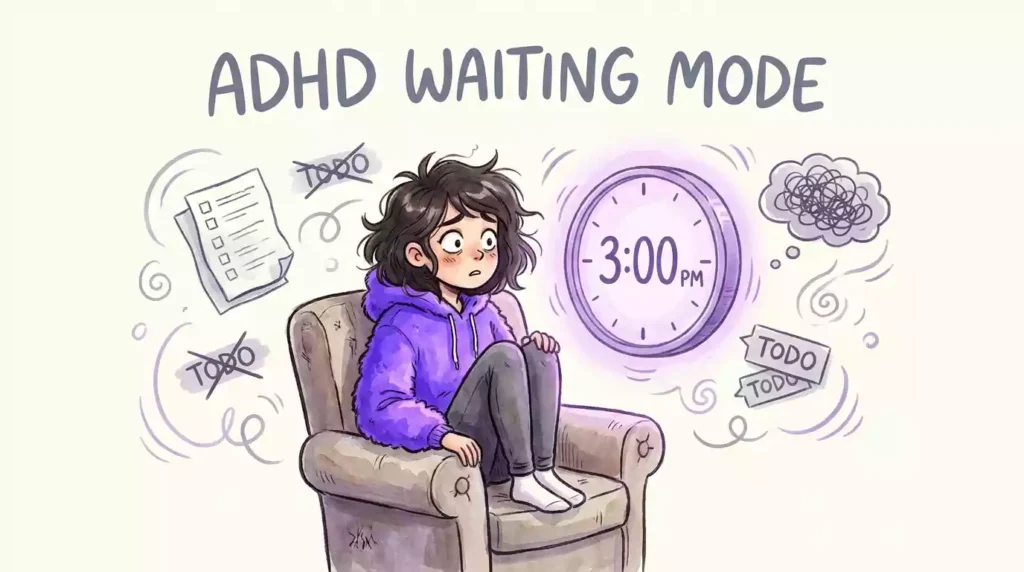
Have you ever found yourself stuck on the couch at 2:00 PM, unable to start anything because you have a meeting at 4:00 PM? Your brain feels hijacked by the clock. You can’t relax, you can’t work, and you can’t do anything except wait. This experience has a name: ADHD waiting mode. It’s not laziness, and it’s not poor time management—it’s a distinct cognitive pattern that affects many people with ADHD. In this guide, you’ll learn exactly what waiting mode is, why your brain gets stuck, and how to break free with practical, ADHD-friendly strategies. Plus, you can take a quick self-check below to see how much waiting mode is affecting your life.
What Is ADHD Waiting Mode?
ADHD waiting mode is a state of cognitive paralysis that occurs when a person has an upcoming event—like an appointment, meeting, or social commitment—and their brain refuses to engage in anything else before that event. Even if the event is hours away, the person feels trapped in a mental waiting room. They might sit on the couch scrolling their phone, pace around the house, or repeatedly check the clock. The time between now and the event becomes a black hole where productivity and relaxation both feel impossible.
This phenomenon is closely linked to time blindness, a common ADHD trait where the brain struggles to perceive the passage of time accurately. For someone with ADHD, a 2:00 PM appointment can feel like it’s “right now” from the moment they wake up. The brain goes into hypervigilant anticipation mode, making it nearly impossible to start a task that might cause them to lose track of time. Waiting mode is not a choice—it’s a neurological response to uncertainty and executive dysfunction.
Quick definition: Waiting mode is when your brain locks onto a future event and refuses to let you do anything else until that event happens. It often leads to hours of wasted time, frustration, and a deep sense of guilt.
The Neuroscience Behind Waiting Mode
To understand why waiting mode happens, it helps to look at how the ADHD brain processes time and tasks. The prefrontal cortex—the brain’s “executive center”—is responsible for planning, initiating tasks, and shifting attention. In ADHD brains, this region often has lower baseline activity and reduced dopamine signaling. Dopamine is the neurotransmitter that drives motivation, reward, and task engagement. When dopamine levels are low, starting a new task feels like pushing a boulder uphill.
Waiting mode is essentially a task initiation failure caused by anticipatory anxiety. The brain knows an event is coming, but it can’t accurately gauge how much time is available. Instead of saying, “I have two hours, so I can work on my report,” the brain says, “The appointment is coming! Don’t start anything! Stay alert!” This triggers a stress response that locks attention onto the future event and blocks engagement with the present moment.
Additionally, people with ADHD often experience difficulty with task switching. Starting a task requires transitioning from one cognitive state to another. If you’re already in “waiting mode,” your brain is primed for the upcoming event, and shifting to a different task feels overwhelming. The result is a frustrating loop: you can’t start anything, but you also can’t relax.
Key Signs You’re Stuck in Waiting Mode
Waiting mode can look different from person to person, but certain signs are remarkably consistent. If you recognize yourself in the table below, you may be dealing with this hidden ADHD symptom.
| Symptom | What It Looks Like | Why It Happens |
|---|---|---|
| ⏰ Clock checking | You look at the time every few minutes, even though you know the event is hours away. | Time blindness makes you distrust your internal clock. |
| 🧊 Mental paralysis | You sit frozen, unable to choose any activity. | Task initiation requires executive function that is temporarily offline. |
| 😰 Low-grade anxiety | Butterflies in your stomach or a constant sense of dread. | Anticipatory stress keeps your nervous system on high alert. |
| 📵 Doomscrolling | You scroll social media or play simple games to pass time. | Low-dopamine activities feel safe and require no commitment. |
| 🚫 Task avoidance | You avoid starting anything meaningful, even things you enjoy. | Switching from waiting to doing feels too costly. |
| 😔 Productivity guilt | You feel terrible about wasting time but still can’t start. | Shame and frustration compound the executive dysfunction. |
Waiting Mode vs. Procrastination: What’s the Difference?
At first glance, waiting mode looks a lot like procrastination. Both involve not doing things. But the internal experience is very different. Procrastination is often a deliberate—though unhelpful—choice to delay a task because it’s boring, unpleasant, or overwhelming. There’s usually a sense of “I’ll do it later.” Waiting mode, on the other hand, is not a choice. You want to do something, but your brain won’t let you. You are not avoiding a task; you are unable to initiate any task because your mental resources are locked onto a future event.
Another key difference is the trigger. Procrastination is triggered by the task itself—it’s too hard, too boring, or too anxiety-provoking. Waiting mode is triggered by the anticipation of an event. The task you want to do might be something you genuinely enjoy, like reading a book or working on a hobby. But the upcoming appointment creates a mental block that prevents you from engaging with anything else. This is why waiting mode feels so confusing and frustrating: you’re not lazy, you’re stuck.
Key takeaway: Procrastination says, “I don’t want to do this.” Waiting mode says, “I can’t do anything because of that thing later.” Understanding this difference is the first step toward breaking the cycle.
Why Waiting Mode Feels Impossible to Break
Waiting mode isn’t just a habit—it’s a self-reinforcing loop. The more you try to force yourself to start a task, the more resistance you feel. This is because the ADHD brain interprets the pressure as a threat. When you tell yourself, “I should be working right now,” your stress hormones rise, which further impairs executive function. The result is a downward spiral: guilt leads to stress, stress worsens paralysis, and paralysis leads to more guilt.
Another factor is hyperfocus on the clock. In waiting mode, time becomes both an enemy and an obsession. You might think, “If I start this now, I’ll only have 45 minutes before I need to get ready. That’s not enough time.” But then an hour passes while you wait. The irony is that you often waste more time waiting than the task would have taken. This happens because the ADHD brain struggles with time estimation—it overestimates the time needed to transition and underestimates the value of small pockets of time.
Finally, waiting mode is often tied to a fear of being late or forgetting. Many people with ADHD have experienced painful consequences from time blindness, like missing appointments or being chronically late. To compensate, the brain overcorrects by locking onto the event and refusing to let go. This hypervigilance feels protective, but it actually steals your day.
Mini ADHD Waiting Mode Self-Check
Quick Waiting Mode Self-Check
Answer these 7 questions to see how strongly waiting mode affects your daily life.
How to Break Free: 7 Practical Strategies
Breaking out of waiting mode isn’t about willpower—it’s about working with your brain instead of against it. These strategies are designed specifically for ADHD brains and focus on reducing the cognitive load of waiting mode.
- Use micro-commitments. Tell yourself you’ll only do a task for 5 minutes. This lowers the barrier to starting and often leads to more.
- Set external alarms. Use your phone to set a timer for 10 minutes before you need to leave. This externalizes time awareness and frees your brain from clock-watching.
- Create a “waiting mode” menu. Keep a list of low-stakes, easy-to-stop activities that you can do while waiting—like stretching, organizing a drawer, or listening to a podcast.
- Practice “body doubling.” Work alongside someone else, even virtually. Their presence can help your brain shift out of waiting mode.
- Use visual timers. A visual timer shows time passing in a concrete way, which can reduce time blindness and make the available window feel more real.
- Reframe the event. Instead of thinking “I can’t do anything until 4 PM,” try “I have two hours before 4 PM. What small thing can I do in 20 minutes?”
- Be compassionate with yourself. Shame fuels waiting mode. Remind yourself that this is a neurological pattern, not a moral failure.
Pro tip: Start with one strategy at a time. ADHD brains often struggle with all-or-nothing thinking. Pick the easiest strategy from the list and try it the next time you notice waiting mode creeping in.
When Waiting Mode Becomes a Bigger Problem
Occasional waiting mode is normal, especially for people with ADHD. But when it happens daily—or when it causes you to miss deadlines, avoid social events, or feel constantly anxious—it may be a sign that your ADHD symptoms need more support. Waiting mode is often a hidden symptom that doesn’t get discussed in typical ADHD checklists. Yet it can be one of the most disruptive parts of living with ADHD.
If you find that waiting mode is stealing hours from your day, affecting your relationships, or making you feel hopeless, it’s worth seeking a comprehensive evaluation. A full ADHD assessment can help you understand your unique symptom profile and connect you with effective treatment options. That’s why we created our free, in-depth ADHD test—to give you a clearer picture of what’s really going on.
Frequently Asked Questions
Is waiting mode a formal ADHD symptom?
Waiting mode is not listed as a formal diagnostic criterion for ADHD, but it is widely recognized by clinicians and ADHD coaches as a manifestation of executive dysfunction, time blindness, and task initiation difficulties—all core features of ADHD.
Can waiting mode happen without ADHD?
Yes, anyone can experience a mild version of waiting mode before a big event. However, the frequency, intensity, and daily disruption seen in waiting mode are much more common in people with ADHD or other executive function challenges.
How is waiting mode different from anxiety?
Waiting mode and anxiety often overlap, but waiting mode is specifically tied to the anticipation of an event and the inability to initiate other tasks. Anxiety may be present, but the core issue is cognitive paralysis, not just worry.
Will medication help with waiting mode?
For many people with ADHD, stimulant or non-stimulant medication can reduce waiting mode by improving executive function and dopamine signaling. However, medication works best when combined with behavioral strategies like the ones listed above.
Ready to understand your ADHD symptoms better? Our full free ADHD test goes deeper than any quick quiz—it evaluates multiple dimensions of ADHD, including waiting mode, time blindness, and executive dysfunction. Take the first step toward clarity today.