
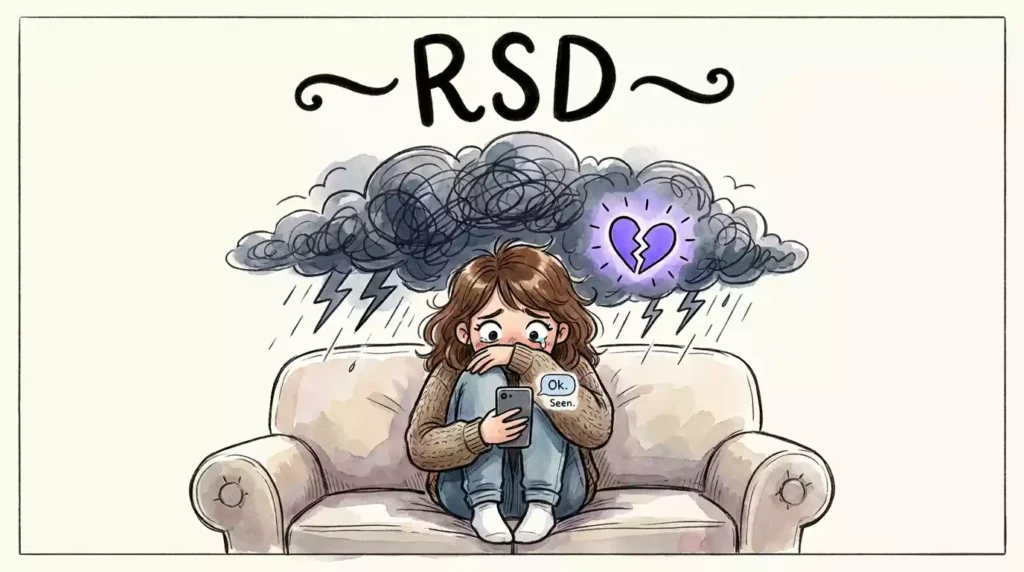
Have you ever felt a sudden, overwhelming wave of pain after a friend leaves your message on read—or after your boss says “Can we talk?”—even when you know, logically, you’re probably fine? If you have ADHD, that reaction has a name: Rejection Sensitive Dysphoria (RSD). In this guide, we’ll unpack why ADHD brains feel rejection so intensely, how to spot RSD in your daily life, and how a simple 7-question check-in can point you toward the support you deserve.
⚡ Key Takeaways
- RSD is an intense emotional response to perceived rejection or criticism.
- It is extremely common in adults with ADHD, though it isn’t a formal DSM-5 diagnosis.
- RSD can mimic anxiety or mood disorders, but it usually spikes instantly and fades once the trigger passes.
- Recognizing RSD is the first step toward emotional regulation and self-compassion.
- The free MindLucid ADHD test can help you see your symptoms in a broader ADHD context.
What Is Rejection Sensitive Dysphoria (RSD)?
Rejection Sensitive Dysphoria (RSD) is a term used to describe extreme emotional sensitivity and pain triggered by the perception of being rejected, criticized, or excluded by important people in your life. Unlike everyday disappointment, RSD feels like a sudden emotional injury—often described as a physical blow or a wave of shame that floods your body before you can think. For many people with ADHD, this response is not a choice; it’s a neurological reflex.
In fact, the word “dysphoria” comes from Greek and means “hard to bear.” That’s exactly how RSD feels: unbearable. The trigger doesn’t have to be real rejection. A delayed text, a slightly neutral tone, or a minor critique can activate the same brain circuits as a genuine threat. This is why RSD is so confusing—both to the person experiencing it and to the people who love them.
While RSD is not currently listed as an official diagnosis in the DSM-5, it is widely recognized by ADHD specialists, including Dr. William Dodson, who has written extensively about it. Some researchers suggest that RSD may be a core feature of ADHD’s emotional dysregulation, rather than a separate condition.
Why RSD Happens in the ADHD Brain
The ADHD brain has a unique relationship with dopamine, norepinephrine, and the prefrontal cortex—the part of the brain responsible for emotional regulation, impulse control, and perspective-taking. When a person with ADHD perceives rejection, the brain’s threat system (the amygdala) fires immediately, while the prefrontal cortex—which could say “Wait, this isn’t a real threat”—is slower to respond. The result is a lightning-fast, full-body emotional reaction that feels out of control.
Neuroimaging studies show that the same brain regions involved in physical pain also light up during social rejection. In ADHD, this response is often amplified because the brain already struggles to filter emotional input. You’re not weak; your brain is simply wired to feel rejection as a high-stakes event.
Common Signs You Might Have RSD
- A sudden, intense emotional crash after criticism or perceived rejection.
- Avoiding situations where you might fail, be judged, or disappoint someone.
- People-pleasing or over-apologizing to prevent rejection.
- Ruminating for hours or days over a minor social interaction.
- Physical symptoms like racing heart, nausea, or chest tightness after a social slight.
- Interpreting neutral feedback as harsh or dismissive.
- Quick rage or tearfulness that feels disproportionate to the event.
- Chronic self-criticism and a harsh inner voice.
- Relationship instability because small conflicts feel catastrophic.
- Reluctance to ask for help or set boundaries.
RSD vs. Social Anxiety vs. Mood Disorder
Because RSD can look like other conditions, it’s often misdiagnosed. The table below highlights key differences.
| Feature | RSD | Social Anxiety | Mood Disorder |
|---|---|---|---|
| Trigger | Perceived rejection, criticism, or exclusion | Fear of being negatively evaluated by others | Shifts in mood not always tied to immediate event |
| Speed of onset | Instant (seconds) | Gradual before/during social events | Can build over days/weeks |
| Duration | Intense but often short-lived once threat passes | Persistent worry, avoidance | Episodes last days to months |
| Physical symptoms | Chest tightness, nausea, feeling physically hurt | Sweating, trembling, blushing | Sleep/appetite changes, fatigue |
| Core fear | Being abandoned, criticized, or seen as inadequate | Embarrassment or humiliation | Not always specific to social threat |
| Response | Emotional outburst, withdrawal, or people-pleasing | Avoidance of social settings | Depressive or manic symptoms |
How RSD Affects Daily Life
Relationships
RSD can make relationships feel like a minefield. A partner’s neutral tone or a friend’s canceled plan can trigger a wave of panic, leading to arguments, withdrawal, or over-apologizing. Over time, this emotional volatility can strain even the strongest bonds. Understanding RSD can help you and your loved ones recognize that these reactions are not intentional—they’re neurological.
Work and School
At work, RSD may show up as fear of asking questions, avoiding performance reviews, or feeling devastated by constructive feedback. You might overwork to prove yourself or procrastinate to avoid the possibility of failure. This can limit career growth and create chronic stress.
Self-Esteem
RSD often creates a harsh inner critic. Because the emotional response is so intense, you may believe something is deeply wrong with you. This shame can fuel anxiety, depression, and social isolation. Naming RSD is a powerful act of self-compassion: it separates your worth from your brain’s reflexive response.
Physical Health
Chronic emotional stress takes a toll on the body. People with unmanaged RSD may experience headaches, muscle tension, digestive issues, and fatigue. Learning to regulate the stress response—through therapy, mindfulness, and sometimes ADHD medication—can improve both emotional and physical well-being.
Coping Strategies for RSD
You don’t have to white-knuckle your way through rejection sensitivity. These evidence-informed strategies can help.
- Name it to tame it: When you feel that sudden spike, label it: “This is RSD. My brain is overreacting.” Naming reduces intensity.
- Pause before responding: Create a 90-second rule. Breathe, step away, or text yourself before reacting. The surge often peaks quickly.
- Practice self-validation: Say, “It makes sense that I feel hurt. My brain is trying to protect me from rejection.” Compassion soothes the threat response.
- Reframe criticism as data: Feedback is not a verdict on your worth—it’s information. Ask yourself, “What’s useful here, and what’s my RSD talking?”
- Build a rejection emergency plan: List three people who can remind you of your value when you spiral. Save a voice memo or note you can read in hard moments.
- Consider therapy: CBT helps with thought patterns; DBT offers distress tolerance skills. Both can be powerful for RSD.
- Explore ADHD treatment: Stimulant and non-stimulant ADHD medications may improve emotional regulation for some people. Always talk to a qualified clinician.
FAQ: ADHD and RSD
Is RSD a formal diagnosis?
RSD is not currently a standalone diagnosis in the DSM-5. However, it is widely recognized by ADHD specialists as a common and disabling feature of ADHD. Many clinicians use the term to describe a specific pattern of emotional dysregulation.
Can you have RSD without ADHD?
Yes, rejection sensitivity can occur in other conditions or as a personality trait. However, the sudden, intense, and often physical quality of RSD is particularly associated with ADHD. If you experience this, an ADHD assessment can help clarify the root.
Is RSD treatable?
Absolutely. While there is no medication specifically approved for RSD, ADHD medications, therapy (especially CBT and DBT), and self-regulation strategies can significantly reduce its impact. Many people find that treating their ADHD improves RSD symptoms.
How is RSD different from social anxiety?
Social anxiety involves fear of being judged or embarrassed, often before social events. RSD is a reaction to perceived rejection—it can happen instantly and may not involve social anxiety. They can coexist, but the trigger and timing are different.
Will the MindLucid ADHD test tell me if I have RSD?
The full ADHD test at MindLucid is designed to screen for core ADHD symptoms, including emotional dysregulation patterns often linked to RSD. It’s a great starting point to understand your symptoms and decide whether to seek a professional evaluation.
Ready to Understand Your ADHD Brain?
You’ve spent enough time wondering if your reactions are “too much.” The truth is, your brain may simply be wired for intensity. Take the full free ADHD test at MindLucid to see how your focus, emotions, and daily habits fit together. It’s free, takes about 10 minutes, and you’ll get immediate results.