
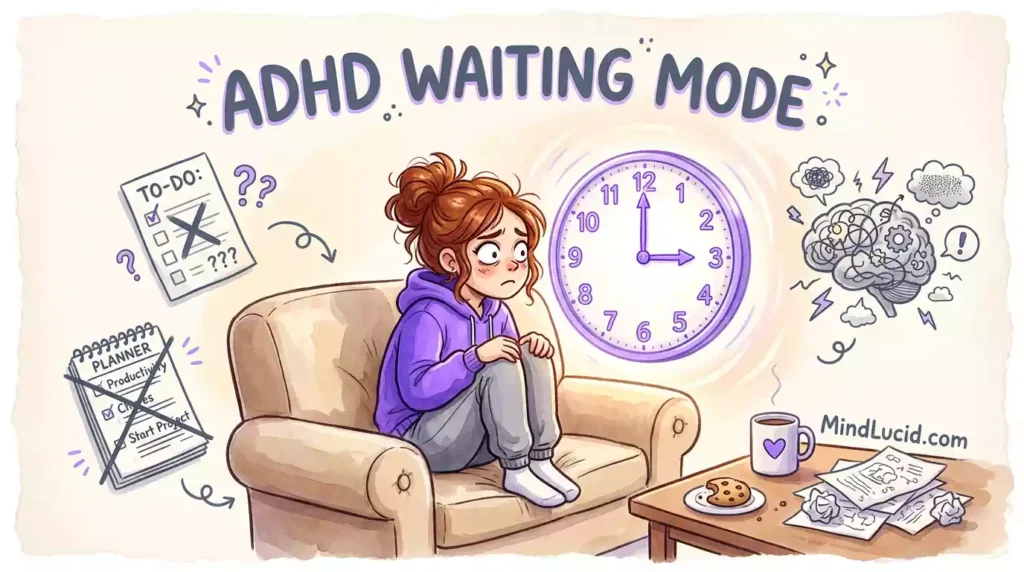
You have a dentist appointment at 3:00 PM. It is currently 9:00 AM. You have six full hours of completely uninterrupted free time. You could finish that project report, go to the gym, clean the kitchen, or answer your emails.
Instead, you sit on the edge of your bed, endlessly scrolling through your phone, unable to initiate a single productive task. Your heart rate is slightly elevated. You feel a creeping sense of guilt and impending doom. You keep checking the clock. 9:15 AM. 10:30 AM. 1:00 PM. The entire day evaporates into a state of suspended animation, and you haven’t accomplished a single thing.
You probably think you are just lazy, undisciplined, or terrible at time management. But if you are a high-achiever who frequently experiences this bizarre phenomenon, you are not lazy. You are experiencing ADHD Waiting Mode Paralysis.
In this comprehensive clinical breakdown, we are going to explore the neurobiology behind why a single afternoon appointment can hijack your entire morning, how executive dysfunction masks itself as procrastination, and most importantly, the science-backed protocols to break the freeze response and reclaim your cognitive clarity.
What is ADHD Waiting Mode Paralysis?
Waiting Mode Paralysis is an acute manifestation of Executive Dysfunction. It occurs when an impending event (a meeting, an appointment, a flight, or even a phone call) triggers a state of psychological and neurological “freeze” in the hours leading up to it.
For a neurotypical brain, a 3 PM meeting is just a single data point on a timeline. The brain acknowledges it, sets a mental alarm, and continues executing other tasks in the background. But for the ADHD brain, which struggles with Time Blindness and Working Memory Deficits, that 3 PM meeting is not a point on a timeline. It is a massive, glowing red threat dominating the entire prefrontal cortex.
The Neurobiology of the “Freeze”
To understand why you can’t just “do a quick task” before your appointment, we must look at dopamine and the amygdala.
Individuals with Adult ADHD have a baseline dysregulation of dopamine, the neurotransmitter responsible for task initiation and reward processing. Because your brain struggles to accurately measure how long a task will take (Time Blindness), attempting to start a new task before an appointment feels incredibly dangerous.
Your amygdala (the brain’s threat-detection center) sends a panic signal: “If we start working on this report now, we will lose track of time, miss the dopamine-driven deadline of the 3 PM meeting, and face catastrophic consequences!”
To protect you from this perceived threat, your nervous system triggers the Freeze Response. It cuts off access to the motor cortex. You are literally, biologically paralyzed by your own brain’s attempt to keep you safe and on time.
4 Hidden Signs You Are Trapped in Waiting Mode
Many high-functioning adults mistake waiting mode for standard procrastination. Here is how to tell the difference:
- The “Do Not Disturb” Illusion: You actively refuse to start small, 5-minute tasks (like emptying the dishwasher or replying to a text) because you feel like you “don’t have enough time,” even if the event is 4 hours away.
- Phantom Exhaustion: You feel physically and mentally drained during the waiting period, despite doing absolutely nothing. The cognitive load of holding the impending appointment in your working memory burns massive amounts of glucose.
- Clock-Checking Compulsion: You check the time obsessively, every 10 to 15 minutes, trapped in a loop of anxiety that the event is going to “sneak up” on you.
- Post-Event Collapse: Once the 3 PM appointment is over, instead of feeling liberated to finally do your work, your prefrontal cortex crashes. You are completely depleted from the sheer effort of waiting.
Is Your “Laziness” Actually Executive Dysfunction?
Stop blaming your willpower. Task paralysis, severe brain fog, and time blindness are neuro-biological friction points. Map your exact cognitive profile in under 3 minutes.
Waiting Mode vs. Normal Procrastination: The Key Difference
It is crucial to separate ADHD Waiting Mode from everyday procrastination. Procrastination is an avoidance of pain. Waiting Mode is an avoidance of transition.
When you procrastinate, you are actively choosing a more rewarding task (like playing a video game or watching Netflix) to avoid the discomfort of a boring task. You are enjoying the distraction.
In Waiting Mode, there is no joy. You are not having fun scrolling on your phone. You are in a state of high-arousal anxiety. You want to work, you are screaming at yourself internally to get up and do something productive, but the neurological parking brake is engaged. This distinction is vital because treating Waiting Mode with traditional “productivity hacks” (like making a to-do list) will only amplify your shame and anxiety.
3 Clinical Bio-Hacks to Break the Waiting Mode Paralysis
If you want to reclaim the lost hours of your day, you cannot rely on willpower. You must construct external scaffolding to bypass your prefrontal cortex’s faulty timing mechanisms. Here is the MindLucid 3-Step Protocol for breaking the freeze:
1. The “Visual Time Scaffolding” Technique
Because your internal clock is broken, you must externalize time. Do not use your phone’s digital clock. You need a physical, analog Time Timer (a clock that displays remaining time as a shrinking red disk). By placing a physical representation of time in your visual field, you relieve your working memory from the burden of constantly calculating “how much time is left.” This instantly lowers amygdala activation and reduces the freeze response.
2. The “Fake Transition” Protocol
Your brain is afraid of getting trapped in a new task. To bypass this, you must lower the barrier to entry so much that it registers as non-threatening. Tell yourself out loud: “I am not going to write the report. I am only going to open the laptop, type the title, and then I will immediately stop and go back to waiting.”
By engaging the motor cortex in a micro-action without the commitment of finishing, you trick the dopamine system into initiating momentum. Once the friction of starting is bypassed, the brain often continues the task naturally.
3. Anchor Tasks (Pre-Event Dopamine Dosing)
Instead of leaving the pre-appointment window blank, schedule one specific, highly stimulating, low-risk “Anchor Task.” This should be something physical or creative that does not require deep executive function—such as organizing your desk, going for a 15-minute brisk walk, or listening to a high-tempo podcast. This provides the brain with a controlled dopamine hit, breaking the static paralysis and putting you in a state of motion.
The Verdict: Reclaiming Your Cognitive Potential
Living with unrecognized executive dysfunction is exhausting. The cycle of Waiting Mode Paralysis not only steals your time but fundamentally erodes your self-trust. You begin to believe the narrative that you are unreliable and lazy.
But the truth is, you are operating a high-performance neurological engine without the proper user manual. Once you stop fighting your brain’s chemistry and start implementing strategic, neuro-divergent friendly protocols, the fog lifts. The paralysis breaks. And the sheer cognitive power you possess is finally unleashed.
If you recognized yourself in this article, it is time to stop guessing and start measuring. Understanding the exact nature of your executive load is the first step toward permanent cognitive clarity.