
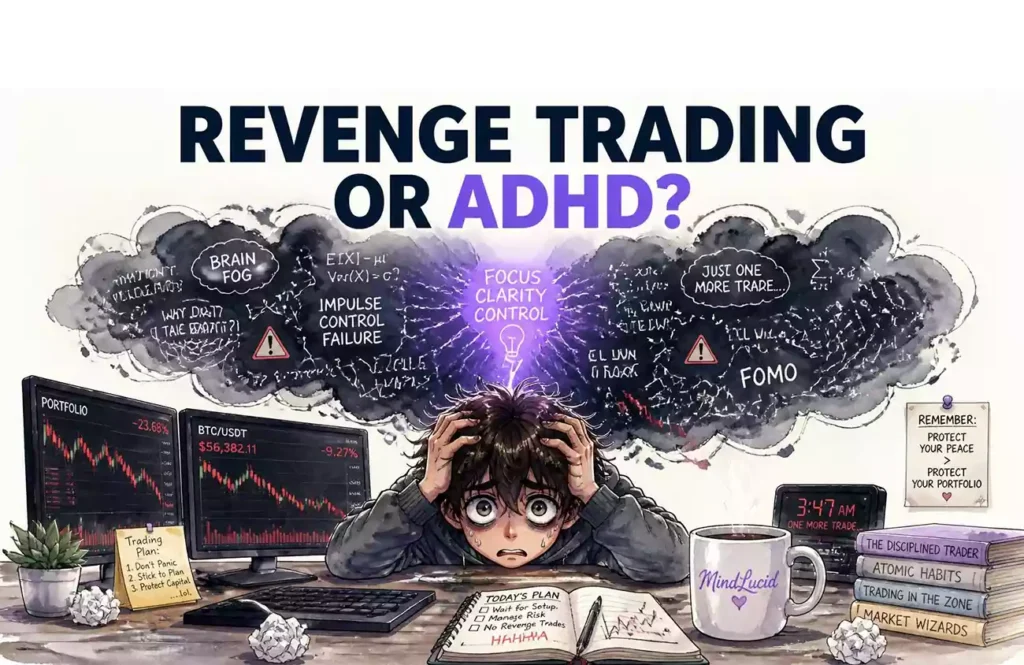
You check your portfolio at 3 AM. The market just wicked through your stop-loss, then rocketed in the direction you originally predicted. Your heart pounds. Your jaw clenches. Your finger hovers over the “Buy” button. One more trade. Just to get it back.
If this scene feels disturbingly familiar, you might be trapped in what behavioral finance experts call the “revenge trading” dopamine loop — a destructive cycle of impulsive trades, emotional spirals, and mounting losses. And if you have undiagnosed ADHD, this loop isn’t just a bad habit. It’s a neurochemical trap that’s quietly liquidating your crypto portfolio while you convince yourself you’re “about to turn it around.”
At MindLucid, we’ve seen this pattern hundreds of times. Traders come to us exhausted, confused, and financially bruised. They think they lack discipline. They think they’re bad at trading. The truth is far more nuanced — and far more actionable. Let’s dive deep into the neuroscience, the psychology, and the path forward.
What Is Revenge Trading, Really?
Revenge trading is the act of making impulsive, emotionally charged trades immediately after a loss, driven by an overwhelming urge to “get even” with the market. It’s not a calculated decision based on technical analysis, risk-reward ratios, or market conditions. It’s a raw, visceral reaction to the pain of losing money.
The term originated in institutional trading rooms, where seasoned professionals would watch junior traders blow up accounts after a single bad position. But in the world of 24/7 crypto markets, revenge trading has become an epidemic. Why? Because crypto never closes. There’s always another trade. There’s always another chance to “fix” what went wrong. And for the ADHD brain, this is a perfect storm.
The ADHD Connection: Revenge trading isn’t just about losing money. It’s about losing control. And control — specifically, the executive function that regulates impulse control, emotional regulation, and delayed gratification — is precisely what ADHD disrupts.
When you understand that revenge trading is a symptom of underlying neurodivergent patterns rather than a character flaw, everything changes. You stop blaming yourself for “lacking discipline” and start addressing the real issue: your brain is wired to seek immediate dopamine hits, and the crypto market is the most potent dopamine dispenser ever created.
The Neuroscience: ADHD, Dopamine, and the Trading Trap
To understand why undiagnosed ADHD is so dangerous for crypto traders, we need to look at what’s happening inside your brain. The dopamine system is your brain’s reward pathway — it’s what makes you feel good when you eat, exercise, socialize, or win. But ADHD brains have a dopamine deficiency. Your baseline dopamine levels are lower than neurotypical brains.
This creates a constant, gnawing need for stimulation. Your brain is perpetually under-stimulated, so it seeks out high-intensity, high-reward activities to compensate. Enter crypto trading — a high-stakes, high-volatility, 24/7 dopamine factory that provides:
⚡ Instant Feedback: Every trade resolves in minutes or hours, delivering rapid dopamine hits that ADHD brains crave.
🎰 Variable Rewards: The unpredictable nature of crypto price action triggers the same neurological mechanisms as slot machines — intermittent reinforcement that’s deeply addictive.
🔔 Constant Stimulation: Price alerts, news feeds, social media chatter, and chart patterns create a sensory-rich environment that ADHD brains find irresistibly engaging.
🚀 Asymmetric Upside: The possibility of a 10x gain in weeks — even if statistically rare — provides an anticipatory dopamine surge that’s hard to resist.
Now, combine this with what happens when you lose. The loss triggers a dopamine crash — a sudden drop in your brain’s reward chemicals. For someone with ADHD, this crash is more severe because you were already operating from a deficit. Your brain screams: “Fix this. Now.”
The result? You enter the revenge trading loop.
The Revenge Trading Loop: A Step-by-Step Breakdown
Here’s how the cycle unfolds for someone with undiagnosed ADHD. Understanding each stage is crucial for breaking free.
Stage 1: The Initial Loss
You take a position based on your analysis. Maybe it’s a solid setup, maybe it’s impulsive — but either way, the trade goes against you. Your stop-loss triggers, or you panic-sell at a loss. The dopamine drop hits hard.
Stage 2: The Emotional Surge
Your ADHD brain interprets this loss as a personal failure, not a statistical inevitability. Emotional dysregulation — a core ADHD trait — means you feel the pain of this loss more intensely than a neurotypical trader would. Anger, frustration, shame, and anxiety flood your system.
Stage 3: The Impulsive Counter-Trade
Your executive function — already compromised by ADHD — completely abandons ship. You stop thinking about risk management, position sizing, or market context. You just want to feel better, and the fastest way to feel better is to win back what you lost. You enter a trade without proper analysis.
Stage 4: The Escalation
If the revenge trade wins, you get a massive dopamine spike — reinforcing the behavior. You feel brilliant. You feel invincible. This is the danger zone. If the revenge trade loses, you’re even deeper in the hole, and the urge to “get it back” intensifies. Either way, you escalate: bigger positions, more leverage, riskier assets.
Stage 5: The Financial Devastation
By this point, you’ve likely blown through your initial stop-loss, your position sizing rules, and possibly your entire risk budget. The losses compound. Your portfolio — once a source of potential wealth — is now a source of shame and anxiety.
Is Your ADHD Quietly Blowing Up Your Portfolio?
If you recognize yourself in this revenge trading loop — if you’ve made impulsive trades you immediately regretted, if you’ve found yourself trading at 3 AM to “win it back,” if your losses feel emotionally devastating but your wins feel hollow — you may be dealing with undiagnosed ADHD. Understanding your brain is the first step to protecting your capital.
Take our comprehensive, scientifically-informed ADHD assessment and discover whether your trading struggles have a neurological foundation — not a discipline problem.
Warning Signs: Is ADHD Sabotaging Your Crypto Trading?
Not every impulsive trader has ADHD, and not everyone with ADHD revenge-trades. But the overlap is significant enough that every crypto trader should be aware of the warning signs. Here’s a comparison of how ADHD traits manifest in trading behavior:
| ADHD Trait | How It Shows Up in Your Trading | The Financial Consequence |
|---|---|---|
| Impulsivity | Entering trades without waiting for confirmation signals; clicking “Buy” before fully analyzing the setup | Frequent small losses that accumulate into significant drawdowns |
| Emotional Dysregulation | Intense anger or despair after losses; euphoria after wins that leads to overconfidence | Revenge trading after losses; doubling down on winning positions without profit-taking |
| Hyperfocus | Obsessively watching charts for hours, unable to step away even when exhausted or when trades are going well | Burnout; impaired judgment from sleep deprivation; missed exit signals |
| Executive Dysfunction | Difficulty following a trading plan; abandoning risk management rules under stress; inability to maintain consistent journaling | No consistent risk management; catastrophic losses from unhedged exposure |
| Novelty Seeking | Constantly jumping to new coins, new strategies, new indicators; getting bored with a working system | No edge is ever developed; strategy-hopping prevents long-term profitability |
| Time Blindness | Losing track of time while trading; trading through meals, sleep, and important life events | Neglecting other income sources; trading while impaired; relationship strain |
| Rejection Sensitivity | Taking losses as personal attacks; feeling the need to “prove” yourself by winning back losses | Revenge trading cycles; increasing position sizes to “show the market” |
Critical Distinction: Having one or two of these traits occasionally doesn’t mean you have ADHD. But if multiple traits consistently disrupt your trading and your daily life — and if they’ve been present since childhood — you should seriously consider a professional assessment.
The Financial Toll: What ADHD Revenge Trading Actually Costs
Let’s talk about the real-world impact. This isn’t just theory — it’s your money disappearing in real time.
Here’s a sobering thought: the average revenge trade carries 2-3x the position size of a trader’s normal entries. That means a single emotional decision can wipe out weeks of disciplined trading. And because ADHD makes it difficult to learn from past mistakes through delayed consequences, the pattern repeats.
💡 A Real Scenario: You start with $10,000. You lose 5% ($500) on a normal trade. Annoyed, you revenge-trade with 3x size and lose 8% ($2,400). Now you’re down $2,900 — nearly 29% of your account — from two trades. To recover from a 29% loss, you need a 41% gain. The math gets brutal fast.
This is the quiet liquidation that undiagnosed ADHD creates. It doesn’t happen in one dramatic blowup (though those happen too). It happens in a thousand small, emotionally-driven decisions that compound into devastating losses.
Breaking the Loop: Strategies for the ADHD Trader
The good news? You can break free. But the path forward looks different for ADHD brains than for neurotypical ones. Generic advice like “just be more disciplined” won’t work — you’ve probably already tried that. Here’s what actually helps:
1. Get Assessed — The Most Important Step
You can’t fix a problem you don’t know you have. If you’ve read this far and recognized yourself in these patterns, getting an ADHD assessment is the single most impactful thing you can do. A proper diagnosis opens the door to treatment options (medication, therapy, coaching) that directly address the neurological roots of revenge trading.
2. Implement External Guardrails
ADHD brains struggle with internal regulation, so create external systems that compensate:
🛡️ Trading Platform Limits: Set maximum position sizes, daily loss limits, and cooldown periods on your exchange. Most major platforms (Binance, Coinbase, Bybit) offer these features.
⏰ Time-Blocked Trading Windows: Trade only during specific hours (e.g., 9-11 AM and 2-4 PM). Outside those windows, log out and remove the app from your phone.
📊 Automated Risk Management: Use stop-losses, take-profits, and trailing stops on every trade. Make risk management automatic, not a decision you have to make each time.
📝 Mandatory Journaling: Before every trade, write down your entry reason, position size, and exit plan. If you can’t fill out the journal, you don’t take the trade.
3. The 24-Hour Cooling Rule
After any losing trade, impose a mandatory 24-hour trading ban on yourself. This gives your ADHD brain time to process the emotion and return to baseline. The urge to revenge trade will pass — but only if you create the space for it to.
4. Reduce Your Stimulation Baseline
Your ADHD brain craves stimulation, and trading provides it in overwhelming quantities. If trading is your only source of dopamine, you’re setting yourself up for addiction. Build other sources of stimulation into your life: exercise, creative projects, social connection, learning new skills.
5. Consider Professional Support
Therapy — especially Cognitive Behavioral Therapy (CBT) adapted for ADHD — can help you identify the emotional triggers that lead to revenge trading. An ADHD coach can help you build the systems and routines that support consistent, disciplined trading.
The bottom line: Breaking the revenge trading loop isn’t about willpower. It’s about understanding your brain and building systems that work with your neurodivergence, not against it.
Frequently Asked Questions
For many people with ADHD, medication (stimulants like methylphenidate or amphetamines, or non-stimulants like atomoxetine) can significantly improve impulse control and emotional regulation. By boosting baseline dopamine levels, medication reduces the brain’s desperate need for external stimulation — which directly reduces the urge to revenge trade. However, medication is not a cure-all; it works best when combined with behavioral strategies and professional support.
Look at the pattern of your losses, not just the losses themselves. If your losing trades follow a consistent emotional pattern — losses followed by impulsive revenge trades, position sizes that balloon after losing streaks, trades made at odd hours despite knowing better — that points to ADHD-related impulsivity. If your losses stem from a consistently applied but unprofitable strategy, that’s a strategy problem. The two can coexist, but ADHD-related trading losses have a distinctive emotional signature.
No — ADHD is a neurodevelopmental condition that begins in childhood. However, many adults with ADHD are never diagnosed because they developed coping mechanisms that masked their symptoms. The 24/7, high-stakes, low-barrier nature of crypto trading can expose previously hidden ADHD traits. Additionally, the stress of significant losses can overwhelm coping mechanisms that worked in less demanding contexts.
They share significant overlap — both involve impulsive, dopamine-driven behavior with financial consequences. However, revenge trading is specifically triggered by a perceived loss or injustice (the market “took” your money), while gambling addiction is more generalized. That said, for ADHD brains, crypto trading can absolutely become a gambling-like addiction, especially if you’re trading without a systematic strategy and relying on short-term price movements for emotional payoff.
Not necessarily. Many successful traders have ADHD — the condition can actually provide advantages in pattern recognition, creative problem-solving, and the ability to hyperfocus on market analysis. The key is managing the impulsive aspects of ADHD through medication (if appropriate), systems, and professional support. If you’re currently in a destructive trading cycle, taking a break while you address the underlying ADHD is wise. You can always return with better tools.
A well-designed online ADHD assessment — like the one at MindLucid — can be an excellent screening tool that indicates whether you should pursue a professional evaluation. However, it’s not a substitute for a formal diagnosis from a qualified healthcare provider. Online tests evaluate symptom patterns and severity, but only a professional can rule out other conditions (anxiety, depression, sleep disorders) that can mimic ADHD symptoms.
The Path Forward: Understanding Your Brain, Reclaiming Your Portfolio
If you’ve made it this far, you’re probably recognizing patterns in yourself that you’ve been struggling to name. Maybe you’ve been telling yourself you just need more discipline. Maybe you’ve been blaming the market, or your luck, or your timing. The truth — the liberating, terrifying, empowering truth — is that your brain may be working against you in ways you’ve never understood.
Undiagnosed ADHD doesn’t just affect your trading. It affects your sleep, your relationships, your career, your self-esteem. It makes you feel like you’re constantly underachieving, constantly behind, constantly fighting a battle that everyone else seems to win effortlessly. And when you’re trading crypto — where the stakes are high, the feedback is instant, and the dopamine is abundant — these patterns become dangerously amplified.
🔑 The key insight: Your revenge trading isn’t a character flaw. It’s a symptom. And symptoms can be treated.
The first step is assessment. Understanding your brain is the foundation upon which every other strategy — medication, therapy, coaching, systems — is built. You can’t fix what you don’t know is broken.
At MindLucid, we’ve designed our ADHD assessment to be thorough, scientifically-informed, and genuinely useful. It’s not a gimmick. It’s a tool for self-understanding. It takes about 15-20 minutes, and the insights you gain could be the difference between continuing to hemorrhage capital and finally building the disciplined, profitable trading practice you’ve been chasing.
Don’t let your brain’s wiring keep liquidating your portfolio. Take the first step toward understanding your ADHD — and start trading with clarity, not chaos.