
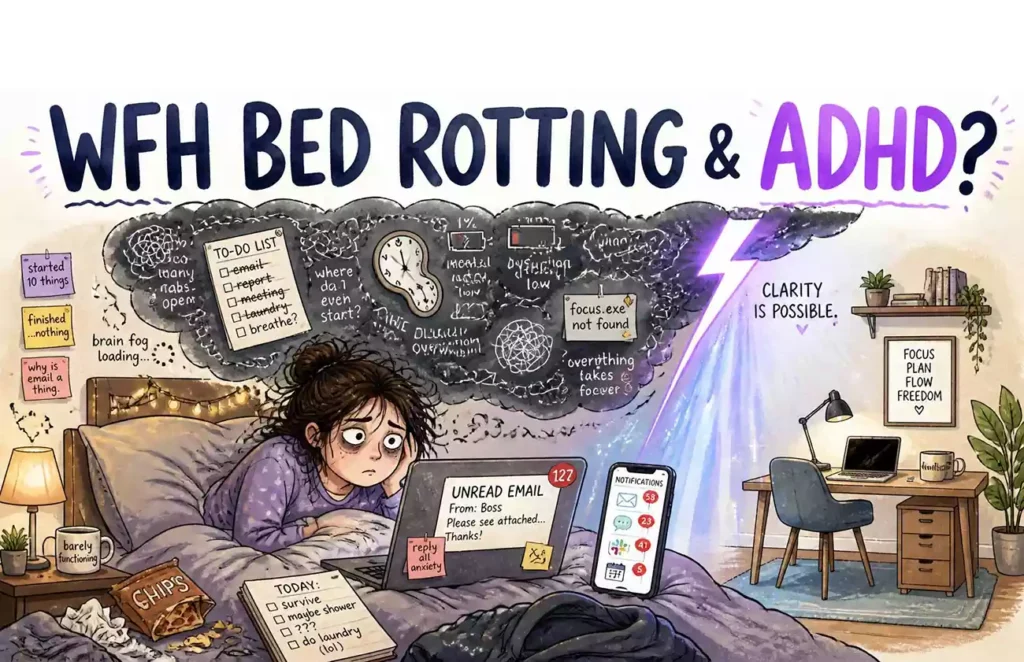
You wake up at 7:30 AM with every intention of starting your workday early. You grab your laptop, settle back into bed for “just five more minutes” of scrolling, and suddenly—it’s 2:47 PM. The laptop sits unopened beside you, your phone battery is at 4%, and the crushing weight of another lost day settles onto your chest like concrete. If this scenario feels disturbingly familiar, you’re not alone—and you’re not lazy. You may be caught in what researchers and mental health professionals are now calling “WFH bed rotting”—a neurological trap that disproportionately ensnares high-functioning professionals with ADHD.
The term “bed rotting” emerged from social media as a semi-ironic description of prolonged, passive time spent in bed without sleeping. But beneath the viral aesthetic lies a genuine and increasingly prevalent phenomenon in the remote work era—one that is devastatingly amplified by the unique neurobiology of attention-deficit/hyperactivity disorder. For the smart, capable, and ambitious adult who has spent years compensating for their ADHD symptoms, the WFH bedroom can become a neurological black hole that quietly dismantles executive function, self-esteem, and career momentum. This article will peel back the layers of this modern trap, explain the science behind why your brain keeps falling into it, and guide you toward reclaiming the focus and agency you know you’re capable of.
What Exactly Is “Bed Rotting” in the Context of ADHD?
Bed rotting, in its clinical-adjacent definition, refers to extended periods of time spent in bed during waking hours—typically scrolling on a phone, staring at a ceiling, or engaging in low-effort passive consumption—without the intention of actually sleeping or recovering from illness. It differs from intentional rest in one critical way: it produces guilt, shame, and a sense of lost time, rather than restoration or rejuvenation. For neurotypical individuals, bed rotting is often a chosen, occasional indulgence. For adults with ADHD, however, it becomes something far more insidious—a behavioral loop fueled by executive dysfunction, dopamine starvation, and avoidance that the brain struggles to interrupt once initiated.
When you combine ADHD’s characteristic difficulties with task initiation, time blindness, and reward processing with the unstructured, boundary-less environment of working from home, the bed transforms from a place of rest into a neurological trap. The very architecture of remote work—no physical separation between sleep and work spaces, no external schedule, no coworker observation, no environmental cues—removes the scaffolding that ADHD brains critically depend on to function. High-functioning professionals with ADHD have often spent their entire careers relying on environmental structure—commutes, office hours, visual accountability, and the physical act of “going to work.” Strip all of that away, and the brain’s vulnerable executive function system is left exposed and easily hijacked by the siren call of the mattress.
Key Insight: Bed rotting in ADHD is not about laziness or poor character—it’s about a brain that struggles to self-initiate action without external triggers. The bed becomes a default state, not a choice, when the neurological systems responsible for “getting started” are depleted or under-stimulated.
The Neuroscience Behind the Trap
Dopamine Deficiency and the Search for Stimulation
At the core of ADHD neurobiology lies a well-documented dysregulation in the brain’s dopamine system. Dopamine—often oversimplified as the “pleasure chemical”—is actually the neurotransmitter of anticipation, motivation, and reward prediction. It’s what drives you to initiate a task because your brain expects the task to produce a rewarding outcome. In ADHD brains, baseline dopamine levels in key regions like the prefrontal cortex and striatum are significantly lower than in neurotypical brains. This creates what neuroscientists call a “reward deficiency state”—the brain is chronically under-stimulated and constantly seeking sources of quick, accessible dopamine to compensate.
Enter the smartphone. A phone in bed is a dopamine slot machine—every scroll, every notification, every auto-playing video delivers micro-hits of reward prediction that the ADHD brain craves. The bed itself becomes associated with this effortless dopamine delivery system. Meanwhile, the work tasks awaiting on your laptop represent delayed, uncertain, and effortful rewards—the exact opposite of what a dopamine-starved brain is willing to engage with. This is why you can lie in bed for hours scrolling through content you don’t even care about while your important work project remains untouched. Your brain isn’t choosing “lazy”—it’s choosing immediate neurochemical relief over long-term reward, and it’s doing so automatically, beneath conscious awareness.
⚡ The Default Mode Network Connection
Another critical piece of the neurological puzzle involves the brain’s default mode network (DMN)—a set of brain regions that becomes active when you’re not focused on an external task. In neurotypical brains, the DMN quiets down when attention shifts to a task. In ADHD brains, however, the DMN is notoriously overactive and resistant to suppression, which means mind-wandering, rumination, and self-referential thinking are constantly competing with focused attention. Bed rotting provides the perfect environment for DMN dominance: no external demands, no structured activity, just an endless loop of internally-generated thoughts and passive digital consumption. The longer you stay in bed, the harder it becomes to transition out of this state—the DMN has effectively taken the wheel.
- Overactive DMN → difficulty suppressing internal chatter
- Reduced task-positive network activation → trouble engaging external focus
- Weak transition signals → inability to shift from rest state to work state
- Time blindness → hours feel like minutes in the bed-rotting state
Executive Function Collapse in the Remote Environment
Executive functions—the cognitive processes that allow you to plan, prioritize, initiate, sustain effort, and regulate emotions—are the primary casualties of ADHD. These functions are housed primarily in the prefrontal cortex, which is structurally and functionally different in ADHD brains. Under normal circumstances, the external environment acts as a compensatory scaffold: the commute signals “work mode,” the office environment provides visual and social cues for focus, and the physical act of sitting at a desk in a professional setting triggers context-dependent behavioral scripts.
Remote work systematically removes every one of these scaffolds. Your bed becomes your office, your phone becomes your coworker, and the line between “resting” and “working” dissolves into a gray fog of context collapse. For a high-functioning ADHD professional who has relied on environmental structure their entire career, this is akin to removing a wheelchair ramp from a building and expecting the person who needs it to simply “try harder” to climb the stairs. The failure is not in the person—it’s in the environmental design that no longer supports their neurological needs.
The High-Functioning Paradox: Why Smart Professionals Are Especially Vulnerable
There’s a cruel irony at play when it comes to high-functioning ADHD and bed rotting. The very traits that make these professionals successful—intelligence, ambition, perfectionism, and a lifetime of compensatory strategy development—also make them uniquely susceptible to this particular trap. Here’s why:
High-functioning professionals with ADHD have spent years—often decades—building elaborate compensatory systems to manage their symptoms. These systems are almost always externally anchored: strict morning routines, commutes that function as psychological transitions, office environments that provide accountability through visibility, and social pressure that activates the ADHD brain’s need for external motivation. When these anchors are removed, the compensation collapses. The brain, suddenly without its scaffolding, reverts to its default mode of least resistance—and in a bedroom with a phone, that default is bed rotting.
Moreover, the perfectionism that often accompanies high-functioning ADHD creates a vicious feedback loop. The professional knows they should be working, feels overwhelming shame about not working, and that shame itself becomes another barrier to task initiation. The emotional weight of “I should have started hours ago” makes starting feel even more impossible. The bed becomes both the escape from and the punishment for this internal conflict—a place where the brain can temporarily numb the anxiety of not performing while simultaneously reinforcing the pattern that creates more anxiety.
Critical Realization: Your intelligence and capability are not in question. The system you’re working within was designed without consideration for neurodivergent brains. The problem isn’t you—it’s the mismatch between your neurological needs and your environment.
Signs You’re Stuck in the Bed Rotting Cycle
Recognizing the pattern is the first step toward breaking it. Below is a comprehensive comparison of intentional rest versus ADHD bed rotting—understanding the difference is critical for self-awareness and intervention.
| Feature | Intentional Rest | ADHD Bed Rotting |
|---|---|---|
| Emotional Aftermath | Refreshed, restored, grateful | Guilty, ashamed, anxious, frustrated |
| Time Awareness | Bounded, intentional (e.g., “I’ll rest for 45 min”) | Time blindness—hours vanish without awareness |
| Physical Sensation | Relaxation, comfort | Restlessness, physical stagnation, body aches |
| Decision-Making | Conscious choice to rest | Automatic, passive drift into bed |
| After the Rest | Ability to return to tasks | Increased difficulty transitioning to work |
| Phone Usage | Minimal or purposeful | Compulsive scrolling, app-hopping |
| Self-Talk | Positive, self-compassionate | Self-critical, rumination, catastrophizing |
| Frequency | Occasional, intentional | Chronic, daily pattern |
The Dopamine Feedback Loop: How One Day Becomes Every Day
Understanding why bed rotting is so difficult to escape requires examining the self-reinforcing neurological loop that perpetuates it. This isn’t simply a matter of “bad habits”—it’s a neurochemical cycle that strengthens with each repetition.
🔄 The Bed Rotting Cycle Explained
- Trigger: Waking up with a vague, overwhelming sense of work demands + no external structure to initiate action
- Avoidance: Brain seeks immediate dopamine relief from the discomfort of task anticipation → phone, bed, passive consumption
- Temporary Relief: Dopamine hit from scrolling temporarily masks anxiety and executive dysfunction
- Escalation: Each scroll depletes remaining dopamine, making work initiation feel even more impossible
- Shame Spiral: Awareness of lost time triggers intense guilt and self-criticism, further taxing executive function
- Coping Mechanism: The shame itself becomes another trigger for avoidance → back to the phone for more relief
- Neurological Habituation: The brain strengthens the bed → dopamine association, making the loop faster and more automatic each day
The most insidious aspect of this cycle is that it compounds silently. Each day of bed rotting makes the next day more likely, as the brain’s associations between the bed, the phone, and dopamine delivery strengthen. Simultaneously, the accumulated backlog of unfinished work creates even more anxiety, which makes avoidance even more appealing. Before long, a professional who was once a high performer may find themselves spending entire workdays in bed, watching their career, relationships, and self-concept erode while feeling utterly powerless to stop the spiral.
Are You Trapped in the Bed Rotting Cycle?
You’ve been fighting this alone for too long. The exhaustion, the shame, the feeling of watching yourself from outside your own body as another day slips away—it’s not a character flaw. It’s your brain sending you a signal. The first step toward breaking the cycle is understanding exactly how your unique brain works. Take our comprehensive ADHD assessment to gain clarity, insight, and a personalized starting point for reclaiming your focus and your life.
The Neurological Consequences of Chronic Bed Rotting
Prolonged bed rotting is not just a productivity issue—it has measurable effects on brain function and mental health. Understanding the stakes can provide the motivation needed to interrupt the cycle.
Cognitive Deterioration
Extended periods of bed rotting lead to decreased cognitive stimulation, which in turn reduces neuroplasticity—the brain’s ability to form and reorganize synaptic connections. For ADHD brains that already struggle with working memory, sustained attention, and cognitive flexibility, this additional cognitive decline is particularly damaging. The less you engage in cognitively demanding tasks, the more your executive function systems atrophy, creating a downward spiral where returning to complex work becomes genuinely harder over time.
Emotional Dysregulation Amplification
ADHD is characterized by emotional dysregulation—difficulty modulating emotional responses to match the situation. Bed rotting amplifies this in two directions. First, the guilt and shame of unproductive time trigger intense negative emotions that feel overwhelming and unmanageable. Second, the numbing effect of passive scrolling creates emotional flatness, making it difficult to access the positive emotions (interest, curiosity, satisfaction) that normally drive engagement with work. This emotional whiplash further destabilizes the ADHD brain’s already-fragile regulatory systems.
Circadian Rhythm Disruption
When bed becomes associated with waking activity rather than sleep, the brain’s contextual cues for sleep onset become confused. ADHD brains are already at higher risk for circadian rhythm disorders, including delayed sleep phase syndrome. Bed rotting exacerbates this by weakening the neural association between “bed” and “sleep,” making it harder to fall asleep at night and harder to wake up in the morning. The result is a sleep-wake cycle that becomes progressively more chaotic, further draining executive function reserves.
Frequently Asked Questions
Breaking Free: Neurological Reset Strategies
Recovery from chronic bed rotting is not about “trying harder” or “having more discipline.” It’s about rebuilding the environmental and behavioral scaffolding that your ADHD brain needs to function. The following strategies are grounded in neuroscience and executive function research.
1. Recreate Environmental Boundaries
Your brain needs contextual cues to distinguish between “rest mode” and “work mode.” If you work from home, create a dedicated workspace that is physically separate from your bedroom—even if it’s a small desk in a corner of your living room or a kitchen table that you designate as your “office.” If space is limited, use a visual divider (a curtain, bookshelf, or even a simple chair placed between your bed and your workspace) to create a psychological boundary. The key is that your brain learns: bed = rest, desk = work—and these associations are not interchangeable.
2. Implement a Transition Ritual
Commutes served as critical psychological transitions between home and work modes. Replace this with a deliberate, consistent ritual that signals to your brain that work is starting. This could be: brewing a specific type of tea, listening to a particular playlist, doing three minutes of stretching, putting on “work clothes” (even if it’s just changing from pajamas to a different comfortable outfit), or stepping outside for a brief walk around the block before re-entering your home as if you’re “arriving” at work. Consistency is key—the ritual needs to become a conditioned cue for work mode.
3. Leverage External Accountability
ADHD brains respond powerfully to external accountability because it activates the social motivation systems that compensate for internal motivation deficits. Schedule virtual co-working sessions with colleagues or friends, use body doubling platforms where you work alongside others on camera, or simply tell someone what you’re going to accomplish today and ask them to check in with you later. The act of being observed, even virtually, can provide the motivational trigger that your brain needs to initiate and sustain work.
4. Engineer Dopamine-Friendly Work Environments
Work tasks in a quiet, solitary home environment are dopamine deserts for ADHD brains. You can combat this by injecting controlled sources of stimulation into your work environment: background music with a steady beat, a fidget tool, a standing desk or balance board, natural light, plants, or even a reward system where you earn small, immediate rewards for completing work segments. The goal is to make work feel neurochemically engaging rather than depriving.
Pro Tip: Use the “5-Minute Rule” when you feel the pull toward bed. Tell yourself you only need to work for 5 minutes—not an hour, not the whole day. Once you’ve started, the Zeigarnik effect (the brain’s tendency to want to complete unfinished tasks) often takes over and momentum builds naturally.
5. Manage Your Phone Like the Dopamine Weapon It Is
Your smartphone is the primary facilitator of bed rotting. The solution isn’t willpower—it’s structural barriers. Keep your phone outside the bedroom overnight and during work hours. Use app blockers or focus modes that lock out social media and entertainment apps during designated work periods. Consider switching your phone to grayscale mode—the reduction in visual stimulation can significantly decrease the dopamine pull. Better yet, invest in a physical alarm clock and leave your phone in another room entirely. The goal is to make access to the dopamine source frictionful rather than frictionless.
The Road to Reclamation
Bed rotting in the context of ADHD and remote work is not a moral failing—it’s a predictable neurological response to an environment that strips away the very supports your brain requires to function. The professionals who struggle most with this pattern are often the ones who care most deeply about their work, their performance, and their impact. The shame they feel is not evidence of weakness but of unrecognized neurological needs that have gone unaddressed for too long.
Understanding the neuroscience behind bed rotting is the first step toward liberation. When you recognize that your brain’s dopamine system, executive function networks, and default mode network are all working exactly as they would be expected to under the circumstances—and that these circumstances are modifiable—the path forward becomes clearer. You don’t need to become a different person. You need to redesign your environment, your routines, and your self-understanding to align with the brain you actually have, not the brain you think you should have.
If you see yourself in this article—if the bed has become a trap you can’t seem to escape, if your professional identity feels increasingly at odds with your daily reality, if the gap between who you know you are and how you actually function keeps widening—it’s time to get answers. You deserve clarity. You deserve strategies that actually work for your brain. And most importantly, you deserve to stop fighting yourself and start understanding yourself.