
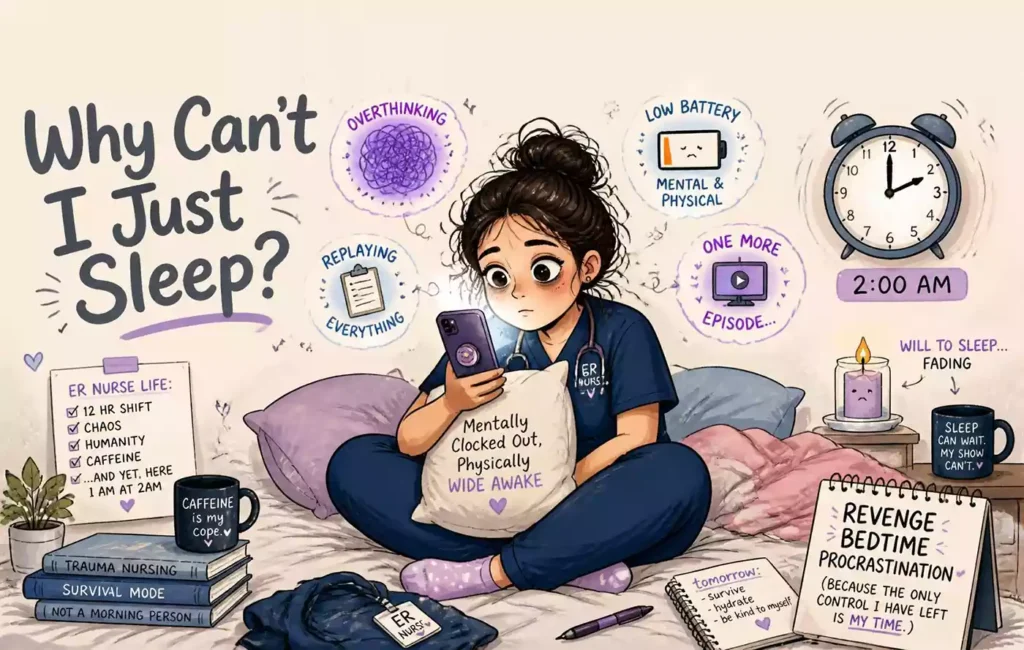
It’s 3:17 a.m. Your shift ended at 11:30 p.m., but here you are — scrolling through your phone, watching one more episode, or staring at the ceiling — knowing full well your alarm is set for six hours from now. You’re exhausted, yet wired. You’re not lazy. You’re not undisciplined. You’re caught in a neurological perfect storm known as revenge bedtime procrastination, and for ER nurses with ADHD, it’s not just a bad habit — it’s a survival response gone rogue.
What Is Revenge Bedtime Procrastination?
Revenge bedtime procrastination (RBP) is a behavioral pattern where individuals deliberately delay sleep despite feeling exhausted, often to reclaim a sense of personal time and control that was lost during the day. The term, originally coined in China as bàofùxìng áoyè — literally “retaliatory staying up late” — gained global recognition during the pandemic, but its roots run far deeper for shift workers in high-stress environments.
For most people, RBP manifests as an occasional late-night binge-watching session. But for emergency room nurses — and especially those living with ADHD — it’s a chronic, deeply ingrained cycle that compounds shift after shift. After 12 hours of triage, trauma codes, medication administration, and emotional labor, the brain desperately craves something it didn’t get during the shift: autonomy. The night becomes a contested territory where nurses reclaim hours they feel were stolen by the hospital, the patients, and the endless charting.
The irony is brutal. The very act of reclaiming time through sleep deprivation makes the next shift harder, the emotional regulation worse, and the ADHD symptoms more pronounced. It’s a self-perpetuating loop that leaves healthcare workers feeling simultaneously defiant and defeated.
The ER Nurse’s Unique Sleep Paradox
Emergency department nurses operate in one of the most cognitively demanding environments in healthcare. The job requires constant vigilance, rapid task-switching, emotional regulation under pressure, and split-second clinical judgment. Every shift demands a level of executive function that would exhaust even the most neurotypical brain — and for nurses with ADHD, the cognitive load is exponentially heavier.
After a 12-hour shift, several factors converge to make sleep nearly impossible:
Cognitive Arousal
The brain doesn’t simply shut off when the shift ends. After hours of high-alert functioning — responding to codes, interpreting lab values, de-escalating agitated patients, and communicating with physicians — the nervous system remains in a state of sympathetic arousal. For neurotypical individuals, this arousal typically subsides within an hour or two. For ADHD brains, which already struggle with regulation of the default mode network, the transition from “on” to “off” can take three to four hours or longer.
Task-Switching Residue
ADHD is characterized by difficulties with task-switching and cognitive flexibility. After a shift that demands hundreds of micro-transitions — from one patient to another, from one clinical task to the next — the ADHD brain accumulates what researchers call “attentional residue.” Each unfinished mental task lingers like an open browser tab, consuming cognitive resources even after the shift ends. By the time the nurse gets home, their brain is a tangled web of half-processed thoughts, unresolved emotions, and lingering clinical details.
Emotional Exhaustion
Emergency nursing is emotionally taxing. Nurses witness trauma, death, grief, and human suffering on a daily basis. For individuals with ADHD — who often experience emotions more intensely and struggle with emotional regulation — this emotional labor takes a disproportionate toll. The result is a state of exhaustion that paradoxically makes sleep more difficult, not less. The brain, overwhelmed by unprocessed emotional input, resists the vulnerability of sleep.
Key Insight: For ER nurses with ADHD, bedtime isn’t just a transition — it’s a confrontation. Sleep requires surrendering control, and after a shift spent managing chaos, surrendering control feels almost physically impossible. The ADHD brain interprets this loss of control as a threat, triggering a fight-or-flight response that keeps the nurse awake long after their body has signaled it’s time to rest.
ADHD and Sleep: A Neurological Tug-of-War
The relationship between ADHD and sleep is bidirectional and complex. Research consistently shows that individuals with ADHD experience significantly higher rates of sleep disorders, including insomnia, delayed sleep phase syndrome, restless legs syndrome, and sleep-disordered breathing. But the connection goes deeper than comorbidity — sleep disruption actively worsens ADHD symptoms, which in turn makes sleep more difficult, creating a vicious cycle that’s especially brutal for shift workers.
Dopamine Dysregulation
At the neurological level, ADHD is characterized by differences in dopamine signaling. The ADHD brain doesn’t process dopamine — the neurotransmitter associated with motivation, reward, and pleasure — in the same way as neurotypical brains. This creates a constant undercurrent of seeking stimulation, novelty, and reward. At 11 p.m. after a grueling shift, when the brain finally has unstructured time, it seeks the dopamine it’s been craving all day. The phone becomes a dopamine dispenser. Social media, streaming, gaming, or even just mindless scrolling — each provides a small hit of novelty that the ADHD brain finds irresistible.
This is the revenge in revenge bedtime procrastination. The nurse isn’t just staying up to watch TikTok — they’re reclaiming a neurological need that went unmet during the shift. The ADHD brain is essentially saying, “You took 12 hours of my focus, my energy, and my emotional regulation. Now I’m taking these hours back.”
Delayed Sleep Phase and Circadian Disruption
Many individuals with ADHD have a naturally delayed circadian rhythm — their internal clock runs later than the societal norm. This means their natural sleep window might be from 2 a.m. to 10 a.m., rather than 11 p.m. to 7 a.m. When you combine this biological tendency with the irregular shift patterns common in emergency nursing, the result is a circadian system that’s perpetually out of sync.
ER nurses often work rotating shifts or night shifts, which means their sleep schedule changes from week to week. For the ADHD brain, which already struggles with routine and consistency, this irregularity is devastating. The body never knows when to expect sleep, and the brain never learns to associate a particular time with rest.
| ADHD Sleep Disruptor | How It Manifests | ER Shift Amplifier |
|---|---|---|
| Delayed sleep phase | Natural sleep window occurs 2-4 hours later than typical | Night shifts reinforce delayed sleep patterns |
| Hyperarousal | Difficulty winding down; mind races at bedtime | Shift-end adrenaline keeps the brain in high-alert mode |
| Dopamine seeking | Craving stimulation and novelty at night | Post-shift free time becomes dopamine binge time |
| Poor time perception | “Time blindness” makes it hard to track hours | 12-hour shifts distort time awareness further |
| Executive dysfunction | Difficulty planning and executing bedtime routines | Shift fatigue depletes executive function reserves |
| Emotional dysregulation | Rumination and anxiety at night | Clinical stress amplifies emotional intensity |
🎯 Is Your ADHD Driving Your Sleep Deprivation?
If you’re an ER nurse — or any healthcare professional — who finds yourself trapped in the revenge bedtime procrastination cycle, your struggles with sleep may be rooted in undiagnosed or unmanaged ADHD. You’ve been blaming yourself long enough. It’s time to understand what’s really going on in your brain.
Why the Night Shift Makes Everything Worse
Night shifts represent a unique physiological challenge for all healthcare workers, but for nurses with ADHD, they’re particularly destructive. The human body is designed to sleep at night and be awake during the day. This circadian rhythm is regulated by a complex interplay of hormones, including melatonin and cortisol, which are synchronized to the light-dark cycle.
When a nurse works the night shift, they’re fighting against millions of years of evolutionary programming. The body’s internal clock, known as the suprachiasmatic nucleus (SCN) in the hypothalamus, continues to signal “nighttime” even when the nurse is actively working. Melatonin levels rise, promoting sleepiness, while cortisol levels — which should naturally dip at night — remain elevated due to the demands of the job.
For the ADHD brain, this circadian disruption is even more destabilizing. Research suggests that individuals with ADHD already have altered melatonin secretion patterns and a less robust circadian rhythm. When you add night shift work on top of this pre-existing vulnerability, the result is a sleep system that’s fundamentally broken.
The after-effects of a night shift are often described as a “sleep hangover” — a state of cognitive fog, irritability, and profound fatigue that doesn’t resolve with daytime sleep. For the ADHD nurse, this fog compounds the executive function deficits they already experience, making everything from medication administration to patient communication more difficult and more error-prone.
The Vicious Cycle: Sleep Debt, Executive Dysfunction, and Burnout
Revenge bedtime procrastination doesn’t exist in a vacuum. It’s part of a larger, self-reinforcing cycle that can lead to severe professional and personal consequences. When an ER nurse with ADHD consistently sacrifices sleep to reclaim personal time, several downstream effects emerge:
- Accumulating Sleep Debt: Chronic sleep restriction leads to a sleep debt that the body can never fully repay. This debt impairs working memory, attention, and decision-making — all critical skills in the emergency department.
- Worsening ADHD Symptoms: Sleep deprivation mimics and exacerbates ADHD symptoms. Inattention, impulsivity, and emotional reactivity all spike when the brain is sleep-deprived, making an already challenging job even harder.
- Increased Risk of Medical Errors: Studies have shown that sleep-deprived healthcare workers are significantly more likely to make medication errors, documentation mistakes, and clinical judgment lapses. For nurses with ADHD, this risk is compounded.
- Emotional Burnout: The combination of chronic sleep loss, high-stress work, and unmanaged ADHD symptoms often leads to emotional exhaustion, depersonalization, and a reduced sense of personal accomplishment — the classic triad of burnout.
- Physical Health Decline: Long-term sleep deprivation is linked to cardiovascular disease, metabolic disorders, weakened immune function, and mental health conditions like anxiety and depression.
Did You Know? Research indicates that nurses with untreated ADHD are at a 2-3 times higher risk of experiencing clinical burnout compared to their neurotypical colleagues. The sleep disruption caused by revenge bedtime procrastination is a major contributing factor.
Breaking the Revenge Bedtime Cycle
Breaking free from revenge bedtime procrastination requires more than willpower. It demands a fundamental reframe of how we understand the behavior and a willingness to address the root causes — not just the symptoms. For ER nurses with ADHD, this means acknowledging that the drive to stay up late isn’t a character flaw; it’s a neurological need for autonomy, stimulation, and emotional processing.
Strategy 1: Redefine “Rest”
Many nurses with ADHD resist going to bed because they equate sleep with lost time. The solution isn’t to force earlier bedtimes, but to redefine what rest means. Rest doesn’t have to mean sleep. It can mean lying down with a podcast, doing gentle stretches, or sitting quietly with a cup of herbal tea. By expanding the definition of rest, nurses can begin to satisfy the brain’s need for downtime without triggering the resistance that comes with the word “bedtime.”
Strategy 2: Create a “Dopamine Landing Pad”
The transition from a high-stimulation shift to the quiet of a bedroom is jarring for the ADHD brain. Instead of expecting yourself to go from 100 to 0 in an hour, create a gradual descent. Design a 30- to 60-minute wind-down routine that includes low-effort, high-comfort activities — like listening to an audiobook, doing a jigsaw puzzle, or watching a familiar show you’ve seen before. The key is to provide enough stimulation to satisfy the brain without triggering the hyperarousal that prevents sleep.
Strategy 3: Schedule “You Time” — Before the Shift, Not After
Revenge bedtime procrastination is often driven by a sense of having no personal time. The solution isn’t to steal time from sleep — it’s to reclaim time elsewhere. If possible, schedule 30 to 60 minutes of genuine personal time before your shift, when your brain is fresh and you’re not operating from a place of exhaustion. This might mean waking up slightly earlier, but it prevents the desperate “I need time for myself” feeling that fuels late-night scrolling.
Strategy 4: Seek Professional Support
For nurses with ADHD, the sleep disruption caused by revenge bedtime procrastination is often intertwined with unmanaged ADHD symptoms. If you’re struggling with sleep, focus, emotional regulation, or executive function, a comprehensive ADHD assessment can provide clarity and open the door to effective treatment — whether that’s medication, therapy, coaching, or a combination of approaches.
Frequently Asked Questions
Is revenge bedtime procrastination a sign of ADHD?
Revenge bedtime procrastination isn’t exclusively an ADHD phenomenon, but it’s significantly more common and more severe among individuals with ADHD. The combination of dopamine seeking, time blindness, executive dysfunction, and emotional dysregulation makes the ADHD brain particularly vulnerable to staying up late to reclaim personal time. If you find that your sleep delay is chronic, feels uncontrollable, and is accompanied by other ADHD symptoms like difficulty focusing, impulsivity, and emotional reactivity, it may be worth exploring an ADHD assessment.
Why do night shift nurses with ADHD struggle more with sleep?
Night shift work disrupts the circadian rhythm in all workers, but for nurses with ADHD, the impact is compounded by pre-existing differences in melatonin regulation and dopamine signaling. The ADHD brain already has a tendency toward delayed sleep phase and hyperarousal, and night shifts push these tendencies to their extreme. Additionally, the cognitive demands of night shift work — which require the brain to maintain alertness at a time when it naturally wants to sleep — deplete the executive function reserves that ADHD individuals rely on to regulate their behavior.
Can medication for ADHD help with revenge bedtime procrastination?
In many cases, yes. When ADHD is properly treated — whether with stimulant or non-stimulant medications — the underlying dopamine dysregulation and executive dysfunction that drive revenge bedtime procrastination can improve. However, medication timing is crucial; taking stimulants too late in the day can worsen sleep onset. A comprehensive treatment plan that includes medication management, sleep hygiene strategies, and possibly cognitive behavioral therapy for insomnia (CBT-I) is often the most effective approach.
What are the first steps to break the cycle?
Start by acknowledging that your late-night scrolling isn’t a moral failing — it’s your brain trying to meet an unmet need. Identify what that need is: Is it autonomy? Stimulation? Emotional processing? Then, experiment with small changes. Try a 20-minute “dopamine wind-down” before bed. Or shift 15 minutes of personal time to before your shift. The goal isn’t perfection; it’s gradual, sustainable change.
When to Consider an ADHD Assessment
If you’re an ER nurse who has been struggling with revenge bedtime procrastination for months or years, it’s time to ask yourself some deeper questions. Are you also experiencing:
- Difficulty staying focused during charting or shift handoffs?
- A sense of restlessness or feeling “on edge” even during downtime?
- Chronic disorganization in your personal life, despite being highly organized at work?
- Emotional reactions that feel disproportionate to the situation?
- A history of being told you’re “too sensitive,” “too talkative,” or “all over the place”?
If these resonate, you may be living with undiagnosed ADHD. Many healthcare professionals — especially women and those with inattentive-type ADHD — go undiagnosed for years, masking their symptoms through sheer determination and overwork. But the cost is high: chronic sleep deprivation, burnout, and a diminished quality of life.
You Deserve Rest — and Answers
Revenge bedtime procrastination isn’t a character flaw. It’s a signal that something deeper is going on. If you’re an ER nurse with ADHD — or suspect you might be — understanding your brain is the first step toward healing. Our comprehensive ADHD test is designed to help you identify patterns that may have been overlooked for years.