
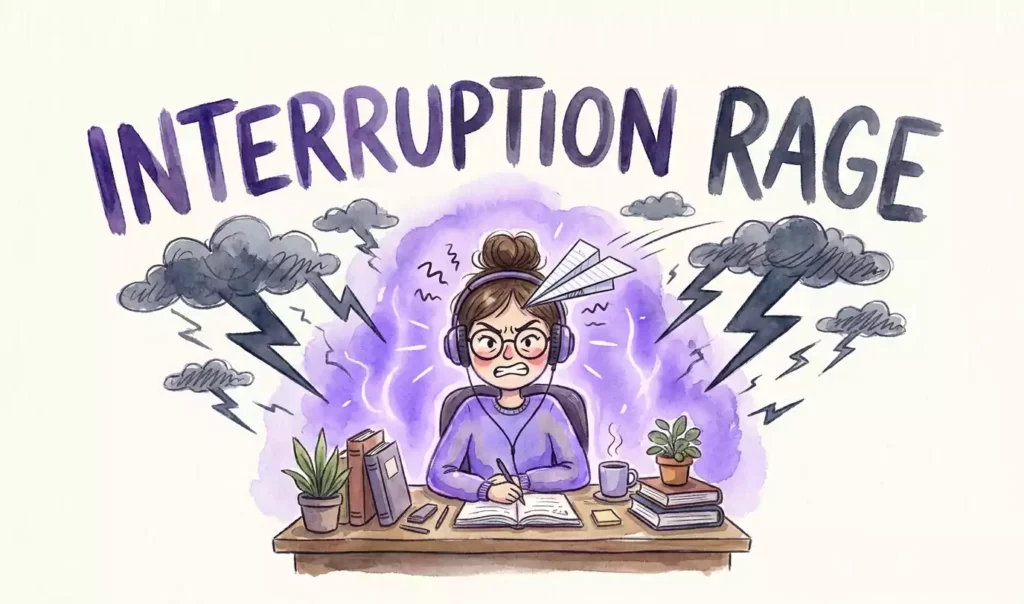
You’re deep in a task. Maybe you’re writing an email, editing a design, or finally organizing that drawer you’ve been avoiding for weeks. The focus is flowing, and you’re in the zone. Then someone walks in and asks a simple question. Or your phone buzzes. Or a notification pings. And suddenly, a wave of frustration crashes over you so fast and so intensely that it almost takes your breath away. Your chest tightens. Your jaw clenches. You snap at the person—or if no one’s around, you mutter under your breath. You feel like you’ve been yanked out of something precious, and the anger feels disproportionate to what just happened. If this sounds familiar, you’re not broken. You’re not overreacting. There’s a reason this happens, and it has a lot to do with how the ADHD brain manages focus, attention, and transitions.
What Is Interruption Rage?
“Interruption rage” is a term that many people with ADHD use to describe the intense, often sudden anger or frustration that flares up when their focus is broken. It’s not just mild annoyance. It’s a visceral, almost physical reaction that can feel completely out of proportion to the trigger. A simple “Hey, can I ask you something?” can feel like someone slammed a door in your face. The sound of a message notification while you’re concentrating can make your skin crawl. And the worst part? You often know—even in the moment—that your reaction is bigger than the situation calls for. But that knowledge doesn’t stop the feeling from washing over you.
This experience is not about being a “angry person.” It’s about what happens in an ADHD brain when a state of deep focus—often called hyperfocus—is abruptly disrupted. Understanding this distinction is the first step toward managing it with self-compassion instead of self-criticism.
Why the ADHD Brain Reacts Differently to Interruptions
To understand interruption rage, you need to understand what focus actually looks like in an ADHD brain. For many people with ADHD, attention doesn’t work like a dimmer switch that you can smoothly adjust. It works more like a light switch that’s either all the way on or all the way off—and sometimes it flips on when you least expect it and refuses to turn off when you need it to.
When someone with ADHD enters a state of deep concentration—especially on something they find genuinely interesting or urgent—their brain can lock onto that task with remarkable intensity. This is often called hyperfocus. During hyperfocus, the brain is flooded with the neurochemicals that support sustained attention. Time seems to disappear. The outside world fades away. The task becomes the entire universe.
And then—interruption.
That sudden break isn’t just a minor inconvenience. For the ADHD brain, it’s like having the rug pulled out from under you. All that focused energy, all that carefully maintained attention, gets scattered in an instant. The brain has to rapidly shift gears, and for someone with ADHD, task-switching is notoriously difficult and energy-draining. It’s not like pausing a video and pressing play again. It’s more like having to rebuild a complex structure from scratch every single time.
This difficulty with transitions—even tiny, unexpected ones—is a well-documented challenge for people with attention differences. The frustration that follows isn’t a character flaw. It’s the brain’s natural response to having its resources abruptly redirected without warning.
💡 Key insight: Interruption rage is often less about the interruption itself and more about the cost of re-engaging. The person with ADHD knows—consciously or not—that getting back to where they were will take significant time and energy. That awareness fuels the frustration.
Common Trigger Scenarios and What’s Happening Underneath
Interruption rage can flare up in countless everyday situations. The trigger might seem tiny, but the internal experience is anything but. Here’s a look at some common scenarios and what’s actually going on beneath the surface:
| Trigger Scenario | What Happens Internally | Why It Feels So Intense |
|---|---|---|
| Someone asks a quick question while you’re working | Your brain has to abandon its current focus entirely and process new input | The “quick question” demands a full context switch, which drains mental energy |
| A phone notification buzzes during deep focus | Your attention is pulled away instantly by an external stimulus | The brain’s natural alertness to novelty overrides the focused state |
| A family member starts talking while you’re reading | You’re forced to process competing streams of information simultaneously | Divided attention feels chaotic and overwhelming for the ADHD brain |
| You’re in a meeting and someone derails the agenda | Your mental map of the conversation is disrupted | Reconstructing context after a tangent is exhausting and frustrating |
| You’re about to finish a task and someone adds a new request | The finish line you were racing toward suddenly moves | The sense of accomplishment is delayed, which feels deeply discouraging |
| You’re working with headphones on and someone taps your shoulder | Physical touch adds another layer of sensory disruption | The body’s startle response combines with the mental disruption |
Notice a pattern? In every case, the interruption isn’t just a small blip. It’s a significant event for the ADHD brain—one that requires substantial cognitive resources to navigate. The rage that flares up is the emotional expression of that cognitive strain.
What It Feels Like From the Inside
If you’ve never experienced interruption rage, it can be hard to understand why someone would react so strongly to something so small. But from the inside, the experience is intense and multifaceted. People describe it in striking ways:
“It’s like someone unplugged my brain while I was using it.”
The sudden loss of focus feels almost physically jarring. There’s a sense of disorientation, like waking up from a vivid dream to find the world has moved on without you.
“Every fiber of my being wants to scream, even though I know it’s not a big deal.”
The emotional reaction is so immediate and powerful that it can feel overwhelming. There’s often a split between what you know logically and what you feel viscerally.
“It’s not the person I’m angry at—it’s the feeling of being pulled apart.”
The frustration is often directed at the situation rather than the person causing the interruption. This can lead to guilt and confusion after the anger passes.
“Getting back to where I was feels impossible. That’s the real rage.”
The knowledge that re-engaging will take enormous effort—sometimes more than the original task required—is deeply demoralizing.
The emotional intensity of interruption rage can be alarming, especially if you pride yourself on being calm or patient. You might find yourself apologizing repeatedly, wondering why you “lost it” over something so minor. But the reaction makes sense when you understand the neurological reality of attention disruption for someone with ADHD.
🔄 The Transition Tax
Every time an ADHD brain has to switch tasks, there’s a cost. Researchers sometimes call this the “switching cost”—the mental energy required to disengage from one activity and engage with another. For most people, this cost is relatively small. For someone with ADHD, it can be substantially higher. When you multiply that cost across dozens of interruptions throughout the day, the cumulative drain is enormous. Interruption rage is often the visible tip of that iceberg—the moment when the accumulated frustration finally spills over.
✨ Is Your Focus Struggling More Than It Should?
If interruption rage, difficulty switching tasks, or feelings of being constantly overwhelmed by distractions sound familiar, you might be dealing with attention patterns that deserve a closer look. Many people live with undiagnosed ADHD for years, blaming themselves for struggles that are actually rooted in brain wiring. You don’t have to keep guessing. Our comprehensive ADHD assessment can help you understand your attention patterns better and give you clarity about what’s really going on. It’s free, takes just a few minutes, and the insights could change how you see yourself.
Practical Strategies for Managing Interruption Rage
Interruption rage doesn’t have to rule your life. While you can’t completely eliminate interruptions, you can reduce their frequency and soften their impact. The goal isn’t to never feel frustrated—it’s to build systems that protect your focus and give you tools to recover more quickly when disruptions happen.
Signal Your Focus
Use headphones, a “focus” sign, or a status indicator to let others know when you’re in deep work. Visual cues are powerful. A simple door sign or desk flag can prevent many interruptions before they happen.
Silence Notifications
Turn off non-essential notifications during focus periods. Use your phone’s focus mode or do-not-disturb settings. The fewer digital interruptions you receive, the less often your brain has to shift gears unexpectedly.
Create Focus Blocks
Schedule dedicated time for deep work and communicate those blocks to the people around you. When others know your focus hours, they’re more likely to hold questions until you’re available.
Practice the Pause
When you feel interruption rage rising, take one slow breath before responding. Even a single breath can create space between the trigger and your reaction, giving you a moment to choose how you want to respond.
Externalize the Interruption
Keep a “parking lot” notepad nearby. When someone interrupts with a request, jot it down and say, “I’ll get to this during my next break.” This acknowledges the person without abandoning your current focus.
Build Transition Rituals
When you do have to switch tasks, use a quick ritual—stand up, stretch, take a sip of water—to mark the transition. This helps your brain register the shift more smoothly.
💡 Remember: The goal of these strategies isn’t perfection. It’s progress over time. Some days will be harder than others, and that’s okay. Every interruption you handle with a bit more grace is a win.
Frequently Asked Questions About Interruption Rage
Final Thoughts: Understanding Yourself Is the First Step
Interruption rage is real. It’s not a personality flaw, a lack of patience, or a sign that you’re a difficult person. It’s a natural response to the unique way an ADHD brain processes focus and transitions. When you’re deep in concentration, your brain is doing something remarkable—it’s channeling all its resources into one activity. An interruption doesn’t just break that focus; it shatters it.
The frustration you feel is your brain’s way of saying, “I was working hard to stay on track, and now I have to start over.” That’s not weakness. That’s effort meeting resistance. And the more you understand this pattern, the better equipped you are to work with it rather than against it.
If you’ve been struggling with interruption rage, difficulty maintaining focus, or other attention-related challenges, you don’t have to figure it out alone. Understanding your attention patterns is the first step toward building systems that actually work for your brain. Our comprehensive ADHD assessment is designed to help you gain clarity about your unique cognitive style—so you can stop fighting yourself and start working with your strengths.
Take the first step today. Your focus matters, and so do you.