
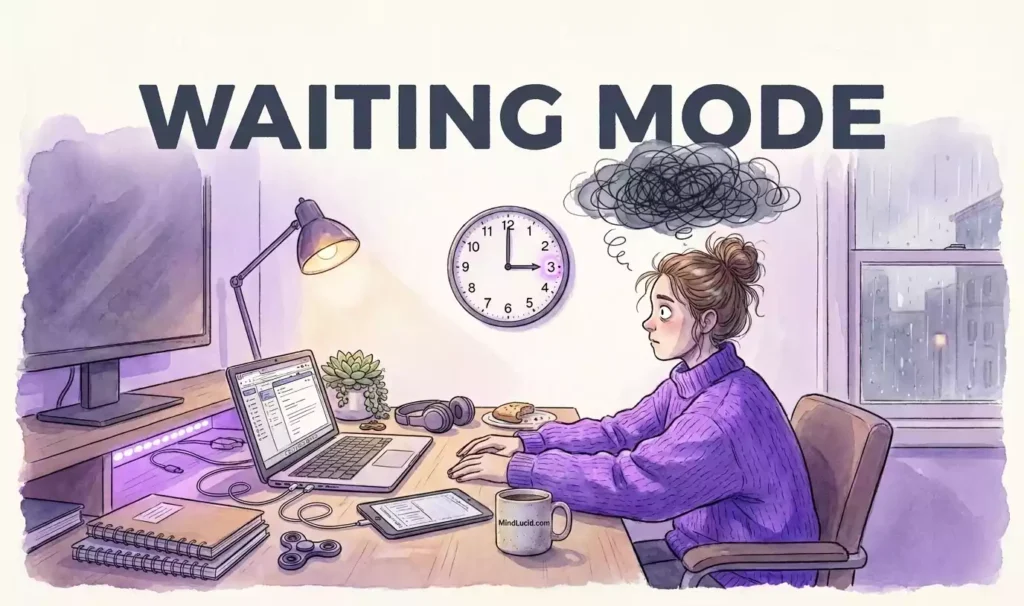
It’s 9:00 AM. You have one appointment today — at 3:00 PM. Six hours away. Six whole hours of potential. Yet instead of using that time productively, you find yourself frozen. You can’t start anything substantial. You can’t truly relax either. Your brain is stuck in an uncomfortable limbo: fully aware that you have time, yet completely unable to use it. Sound painfully familiar? Welcome to ADHD waiting mode — one of the most frustrating, invisible, and exhausting experiences that comes with attention-deficit differences.
What Is ADHD Waiting Mode?
ADHD waiting mode is that strange mental state where the simple knowledge of a future obligation — an appointment, a phone call, a meeting, even a friend coming over — hijacks your entire present moment. Your brain decides that because something is happening later, nothing else can happen now. It’s not laziness. It’s not poor time management in the traditional sense. It’s a neurological freeze response tied to how the ADHD brain processes time, transitions, and dopamine.
Think of it like this: most people’s brains treat a 3 PM appointment as a small dot on their mental timeline — noticeable, but not consuming. The ADHD brain, on the other hand, treats that same appointment as a giant, glowing, all-consuming wall that blocks the entire day. The hours before it don’t feel like usable time. They feel like waiting time. And waiting, for the ADHD brain, is actively painful.
The Brain Science Behind the Freeze
Why does a 3 PM appointment feel like it’s happening right now when it’s only 9:00 AM? The answer lies in how the ADHD brain processes time, dopamine, and executive function — three systems that work differently when attention regulation is involved.
🧠 Time Blindness
People with ADHD often experience what researchers and clinicians describe as time blindness — a reduced ability to perceive the passage of time accurately. The ADHD brain struggles to hold onto “future me” as a real concept. So when you have a 3 PM appointment, your brain doesn’t just file it away as “later.” Instead, it treats it as an imminent threat that requires constant vigilance. Your brain’s alarm system stays on high alert, even though logically you know you have hours.
⚡ The Dopamine Paradox
Dopamine is the neurotransmitter most associated with motivation, reward, and the ability to initiate action. In ADHD brains, dopamine regulation works differently — there’s often less available dopamine in key neural pathways. This creates a paradox: you need stimulation to feel motivated, but the waiting itself is under-stimulating, so you can’t generate the motivation to do anything else. The appointment sits in your mind like an unfinished task, and unfinished tasks drain dopamine. It’s a self-reinforcing loop of paralysis.
🔒 Transition Anxiety
Transitions are notoriously difficult for the ADHD brain. Switching from one activity to another requires executive function — the brain’s “management system.” When you know you’ll need to transition at 3 PM, your brain pre-emptively refuses to commit to any other activity, because committing would require another transition later. It’s like your brain says: “Why start something we’ll just have to stop?”
Common Triggers of ADHD Waiting Mode
Not every appointment triggers waiting mode. Some people find it flares up with specific types of commitments. Here are the most common triggers reported by ADHD adults:
- One-time appointments — Doctor visits, meetings, interviews. Anything that feels “important” or “unusual” is more likely to trigger the freeze.
- Events with social pressure — Meeting a friend, attending a party, or any social obligation where you feel you need to be “on.”
- Phone or video calls — Scheduled calls are notorious for triggering waiting mode because they require a specific, time-bound commitment with no buffer.
- Appointments early in the day — A 9 AM appointment can paralyze your evening before, as your brain refuses to settle.
- Appointments mid-afternoon — The “3 PM curse” — it splits your day into two awkward chunks, and the ADHD brain often decides neither chunk is usable.
- Multiple things in one day — Having two or more scattered commitments can make the entire day feel like “waiting time.”
- Things that require preparation — If you need to shower, dress up, or gather materials, waiting mode kicks in even harder because the “getting ready” phase feels like a task in itself.
Waiting Mode vs. Normal Waiting: The Difference
Everyone waits. But there’s a profound difference between typical waiting and ADHD waiting mode. The table below breaks down the key differences:
| Dimension | Typical Waiting | ADHD Waiting Mode |
|---|---|---|
| Ability to start tasks | Can start and stop tasks easily before the appointment | Feels completely unable to start anything “big” — frozen |
| Emotional state | Mild awareness, mostly neutral | Anxiety, restlessness, frustration, guilt |
| Time perception | Time passes naturally; appointment feels appropriately far away | Time feels both too slow and too fast; appointment feels imminent |
| Productivity | Uses the hours productively or relaxes without guilt | Scrolls social media, paces, or does “fake tasks” while feeling stuck |
| Transition ease | Transitions smoothly when the time comes | Even when the appointment starts, feels drained from the waiting period |
| Post-appointment recovery | Resumes normal activities quickly | Needs significant recovery time; may feel exhausted for hours |
Does This Sound Like Your Brain?
Waiting mode is just one piece of the ADHD puzzle. If you frequently find yourself frozen before appointments, losing hours to mental paralysis, or feeling like your brain works differently than others expect — you’re not broken, and you’re not alone. Understanding your cognitive patterns is the first step toward working with your brain instead of against it. Take our comprehensive ADHD assessment to get a clearer picture of your unique attention profile — it’s free, takes about 10 minutes, and is designed to give you actionable insights.
Dopamine Hacks to Break the Freeze
The goal isn’t to eliminate waiting mode entirely — for many ADHD brains, it’s a deeply ingrained pattern. The goal is to reduce its power over your day and reclaim some of those lost hours. Here are practical, dopamine-friendly strategies to break the freeze:
Time-Box the “Nothing” Time
Instead of fighting waiting mode, schedule it. Tell yourself: “From 9 AM to 11 AM, I’m officially in waiting mode. I can scroll, pace, or do nothing — guilt-free.” Paradoxically, giving yourself permission to do nothing often unlocks the ability to do something, because the pressure is removed. Set a timer, and when it goes off, try a micro-task.
Use “Micro-Commitments” Instead of Big Tasks
The ADHD brain struggles with large, undefined tasks — especially when waiting mode is active. Instead of “work on my project,” try “open my laptop and write one sentence.” The threshold is so low that your brain doesn’t perceive it as a threat. Each tiny win generates a small dopamine hit that can build momentum.
Create a “Waiting Mode Playlist”
Music can be a powerful dopamine trigger. Build a playlist specifically for waiting mode — upbeat, energizing tracks that you only listen to when you’re in this state. The music becomes a cue that says “we can still do things right now.” Over time, this conditions your brain to associate waiting periods with positive energy instead of paralysis.
Externalize the Appointment
ADHD waiting mode often thrives on mental load. Your brain is holding onto the appointment, constantly checking the clock, and maintaining vigilance. Write the appointment down, set a phone alarm for 30 minutes before it, and then tell yourself: “The alarm will handle this. I don’t need to keep track.” Externalizing the task frees up cognitive bandwidth.
Gamify the Waiting Hours
Turn the waiting period into a game. Give yourself points for every task you complete before the appointment — even tiny ones. “Made my bed? 10 points. Responded to one email? 25 points. Took a shower early? 50 points.” At the appointment time, you can “cash in” your points for something you enjoy. Gamification provides the dopamine reward structure that ADHD brains crave.
Body Doubling (Even Virtual)
Working alongside someone else — in person or via video call — is a well-known ADHD strategy. The presence of another person provides external accountability and reduces the feeling of being alone in the freeze. Even a silent “work with me” video on YouTube can trigger the same effect.
Prepare the Night Before
If a 3 PM appointment is going to eat your day, remove the “getting ready” burden from the equation. Lay out your clothes the night before. Pack your bag. Set out anything you need to bring. When the getting-ready process feels effortless, the mental barrier shrinks dramatically.
Reframe Waiting as “Bonus Time”
Language matters. Instead of thinking “I have to wait until 3 PM,” try “I have an unexpected pocket of time before 3 PM.” It sounds simple, but this reframe shifts the narrative from restriction to opportunity. Your brain is less likely to freeze when it perceives abundance rather than constraint.
Frequently Asked Questions
Is ADHD waiting mode an official symptom?
ADHD waiting mode isn’t a formal clinical term, but it’s widely recognized within the ADHD community as a real experience tied to executive dysfunction, time blindness, and difficulty with transitions — all of which are well-documented aspects of ADHD. Many clinicians and ADHD specialists acknowledge the pattern even though it doesn’t appear in diagnostic manuals as a standalone criterion.
Why do I feel exhausted even though I did nothing?
Because waiting mode is cognitively draining. Your brain is constantly monitoring the clock, suppressing the desire to start tasks, managing anxiety about being late, and fighting against the urge to do something meaningful. This internal conflict burns significant mental energy — even if you never left the couch. The exhaustion is real, even when the activity level is zero.
Can waiting mode happen with fun events too?
Absolutely. Waiting mode isn’t limited to dreaded appointments. Many people with ADHD experience it before exciting events — concerts, trips, dinner with friends. The anticipation itself becomes overwhelming, and the brain treats the upcoming event as so significant that it can’t engage with anything else. The emotional intensity, not just the negative association, is what triggers the freeze.
How can I explain waiting mode to people who don’t have ADHD?
Try this analogy: “Imagine you have an important exam in three hours. You can’t fully relax because you need to be ready, but you also can’t start anything deep because you’ll be interrupted. Now imagine feeling that way about a routine phone call or a casual coffee date. That’s waiting mode.” This helps others understand that it’s not about laziness — it’s about a brain that can’t compartmentalize future obligations the way neurotypical brains can.
Does waiting mode get better with age or practice?
For many people, awareness and strategy-building make a significant difference. Waiting mode may never fully disappear, but learning to recognize the pattern early, implementing external systems (alarms, body doubling, time-boxing), and being kind to yourself can dramatically reduce its impact. Some also find that certain life circumstances — like jobs with flexible schedules or reduced appointment load — naturally minimize the frequency of waiting mode episodes.
Breaking the Cycle Starts with Awareness
ADHD waiting mode is one of those experiences that’s hard to explain but instantly recognizable to anyone who’s lived it. It’s the 3 PM appointment that swallows your entire day. It’s the 9 AM meeting that ruins your evening before. It’s the phone call you could have made at 10 AM but waited until 4 PM to dial because your brain was “waiting.”
But here’s the crucial insight: waiting mode is not a character flaw. It’s a byproduct of how your brain processes time, motivation, and transitions. And while you may never completely eliminate it, you can absolutely learn to navigate it with more grace, less guilt, and better strategies.
The first step is recognizing the pattern when it happens. The second step is understanding that you’re not alone — millions of ADHD adults experience this exact phenomenon. The third step is getting a clearer picture of your own cognitive profile so you can build strategies that actually work for your brain.
Ready to Understand Your Brain Better?
If waiting mode resonates with you, there’s a good chance other ADHD patterns are affecting your daily life too — patterns you might not even recognize yet. Our comprehensive ADHD assessment takes about 10 minutes and gives you a detailed breakdown of your attention profile, including areas where your brain may be working differently. It’s completely free, no sign-up required, and designed to help you connect the dots.