
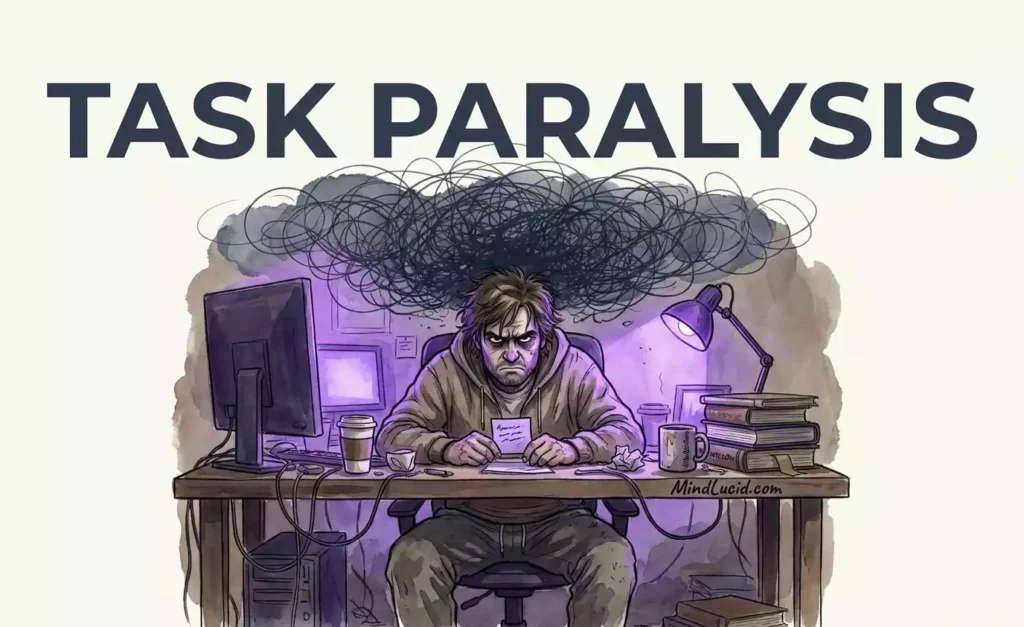
You sit down to send a quick email. It should take five minutes—you know exactly what to say. But first, you check one more notification. Then you remember that other thing you meant to do. You open a new tab. You scroll. You get up to make tea. Three weeks later, that email is still sitting in your drafts, and you’re exhausted from thinking about it every single day. If this sounds familiar, you’re not broken, and you’re not lazy. What you’re experiencing has a name: task paralysis.
What Is Task Paralysis?
Task paralysis is a pattern where someone genuinely wants to start a task—often one they know is simple, quick, or important—but finds themselves completely unable to begin. It’s not procrastination in the typical sense, where you choose to do something more enjoyable instead. With task paralysis, you’re not enjoying the alternative. You’re stuck in a loop of wanting to start, feeling frozen, and then feeling terrible about being frozen.
This experience is especially common among people with ADHD. The brain’s executive function system—responsible for planning, prioritizing, and initiating actions—works differently. When that system struggles, even small tasks can feel like enormous mountains. The gap between knowing what to do and actually doing it becomes a chasm.
🧠 The Brain Behind the Block
Think of your brain’s ability to start tasks like a car’s ignition system. In a typical brain, turning the key produces a smooth start. In an ADHD brain, the ignition sometimes doesn’t catch—the engine doesn’t turn over even though the battery is fully charged and you desperately want to drive.
This isn’t a character flaw. It’s a difference in how certain neural pathways handle activation energy. The threshold for “enough motivation to start” is often much higher. What looks like a five-minute task to someone else might require the same mental activation energy as a five-hour project.
The Task Paralysis Cycle
Understanding the cycle is the first step toward breaking it. Here’s how the pattern typically unfolds:
| Stage | What Happens | What It Feels Like |
|---|---|---|
| 1. Intention | You decide to do the task. You know it needs to happen. | Motivated, capable, ready to go |
| 2. Hesitation | A tiny delay creeps in—one more thing to check first. | Slightly distracted, but still confident |
| 3. Overwhelm | The task suddenly feels bigger than it did. Details multiply in your mind. | Anxious, confused about where to start |
| 4. Freeze | You can’t begin. Your body and brain refuse to move toward the task. | Frustrated, stuck, mentally exhausted |
| 5. Self-Criticism | You tell yourself you’re lazy, broken, or undisciplined. | Ashamed, guilty, hopeless |
| 6. Avoidance | You distract yourself to escape the negative feelings. | Temporary relief followed by more stress |
Each time this cycle repeats, the emotional weight grows heavier. The task doesn’t get harder—but the shame around it does. Soon, the five-minute email becomes a three-week project not because it’s difficult, but because the emotional baggage around it has become overwhelming.
Why This Happens
Several factors contribute to task paralysis, particularly for people with ADHD:
⚡ High Activation Threshold
Your brain needs more “spark” to get moving. Small, boring, or repetitive tasks often don’t provide enough stimulation to trigger that spark—even when you want to do them.
💭 Overwhelm by Details
Your mind sees every micro-step at once. Instead of “write email,” it sees “open inbox, choose recipient, write subject line, compose body, proofread, click send”—and that cascade feels paralyzing.
🎯 Perfectionism Trap
You want to do it perfectly. That pressure makes starting feel risky, because starting means potentially doing it wrong. So you wait for the “right moment” that never comes.
🔄 Emotional Weight
The longer a task sits, the more guilt and shame build around it. Eventually, you’re not avoiding the task—you’re avoiding the emotional pain associated with it.
💡 Key insight: The difficulty isn’t in the task itself. It’s in the emotional and neurological activation required to start. A five-minute task that’s been waiting for three weeks isn’t a five-minute task anymore—it’s a three-week-old emotional wound with a five-minute solution attached.
Signs You’re Experiencing Task Paralysis
Not sure if what you’re dealing with is task paralysis or something else? Here are common indicators:
- You think about the task constantly but can’t make yourself start it
- The task is objectively simple (under 10 minutes), yet it feels impossible
- You feel physical resistance when trying to begin—like an invisible wall
- You’ve developed elaborate workarounds or excuses to avoid it
- The thought of the task fills you with dread, guilt, or anxiety
- You feel relief when something else “more important” comes up to justify delaying
- You’ve completed harder, longer, or more complex tasks while avoiding this one
- You feel deeply embarrassed about how long it’s been sitting there
If several of these resonate, you’re likely dealing with task paralysis. And if this is a recurring pattern in your life—not just an occasional struggle—it may be connected to ADHD.
Could This Pattern Be ADHD?
Task paralysis is one of the most common—and most frustrating—experiences for people with ADHD. If you frequently find yourself stuck on simple tasks, overwhelmed by decisions, or trapped in cycles of avoidance and guilt, it’s worth exploring further. Understanding your brain is the first step toward working with it, not against it.
Breaking Free: Practical Ways Forward
Task paralysis doesn’t have to control your life. Here are strategies that can help you move from stuck to started—even when your brain is fighting you:
✨ The “Micro-Start” Method
Instead of committing to the whole task, commit to something absurdly small. Not “write the email”—just “open the email draft.” Not “clean the kitchen”—just “put one dish in the sink.” The goal is to lower the activation threshold so much that starting becomes nearly effortless. Once you start, momentum often carries you forward.
⏱️ The 2-Minute Sprint
Set a timer for two minutes and tell yourself you only have to work on the task for those two minutes. When the timer goes off, you can stop—no strings attached. This removes the pressure of “finishing” and replaces it with “just begin.” Most people find that once they’ve started, continuing feels natural.
🎯 Shrink the Task
Break the five-minute task into five one-minute steps. Write each step on paper. Cross them off as you go. The visual progress creates dopamine—the very thing your brain needs to keep moving. “Write email” becomes: open inbox ✓, type subject line ✓, write first sentence ✓, finish body ✓, click send ✓.
🧩 Body-Based Reset
Sometimes the freeze isn’t just mental—it’s physical. Your body holds tension that keeps you locked in place. Try standing up, shaking your arms and legs for 30 seconds, taking three deep breaths, then sitting back down and immediately starting the task. The physical reset can break the mental freeze.
💬 Externalize the Pressure
Tell someone else about the task and ask them to check in with you. Text a friend: “I’m going to send this email in the next 15 minutes. Ask me if I did it.” The social accountability creates a gentle external push that can override the internal freeze.
Common Questions About Task Paralysis
Is task paralysis the same as procrastination?
No, they’re different. Procrastination typically involves choosing to do something else instead of the task—often something more enjoyable. Task paralysis is when you want to do the task, you’re thinking about doing the task, but you physically and mentally cannot initiate it. There’s no enjoyable alternative happening. You’re stuck in a state of wanting to act but being unable to.
Does task paralysis mean I have ADHD?
Not necessarily. Everyone experiences moments of being stuck or frozen occasionally—especially when stressed, tired, or overwhelmed. Task paralysis becomes a sign of ADHD when it’s a frequent, persistent pattern that affects multiple areas of life (work, home, relationships) and happens alongside other ADHD traits like difficulty with focus, organization, time management, and emotional regulation. A comprehensive assessment can help clarify what’s going on.
Why do I feel so much shame about this?
The shame comes from a mismatch between what you expect of yourself and what your brain can currently do. Society often labels difficulty starting tasks as laziness or lack of discipline. When you internalize that message, every instance of task paralysis becomes “proof” that you’re fundamentally flawed. This isn’t true. Task paralysis is a real neurological pattern, not a moral failing. Recognizing it as a brain difference—not a character defect—is essential for moving forward.
How long does task paralysis usually last?
It varies widely. For some people, it lasts minutes or hours. For others, days, weeks, or even months. The duration often depends on how much emotional weight has accumulated around the task. The longer a task sits, the harder it becomes to start—not because the task changed, but because the emotional burden grew. That’s why early intervention strategies (like the 2-minute sprint) are so effective; they prevent the emotional weight from building in the first place.
Can task paralysis be overcome?
Yes. With the right strategies, understanding, and support, many people learn to work with their brain instead of against it. This might mean using external tools (timers, accountability partners, visual checklists), adjusting your environment, or exploring whether ADHD-specific approaches could help. The goal isn’t to never experience task paralysis again—it’s to build a toolkit that helps you move through it faster when it shows up.
The Bigger Picture
Task paralysis is rarely about the task. It’s about the relationship between your brain’s activation system and the demands of daily life. When that relationship is strained—as it often is for people with ADHD—even the smallest tasks can feel monumental.
If you’ve been stuck for three weeks on something that should take five minutes, you’re not failing. You’re experiencing a genuine neurological challenge that millions of people face every day. The solution isn’t to try harder or to shame yourself into action. The solution is to understand what’s happening in your brain and to find strategies that actually work for how your mind operates.
That starts with awareness. Recognizing task paralysis for what it is—a pattern, not a personality flaw—opens the door to real change. And if this pattern shows up consistently in your life, exploring whether ADHD might be part of the picture can be transformative.
💜 Ready to Understand Your Brain Better?
If task paralysis feels like a constant companion, you don’t have to figure it out alone. A comprehensive assessment can help you understand the patterns behind your struggles—and open the door to strategies that actually work for your unique brain.