
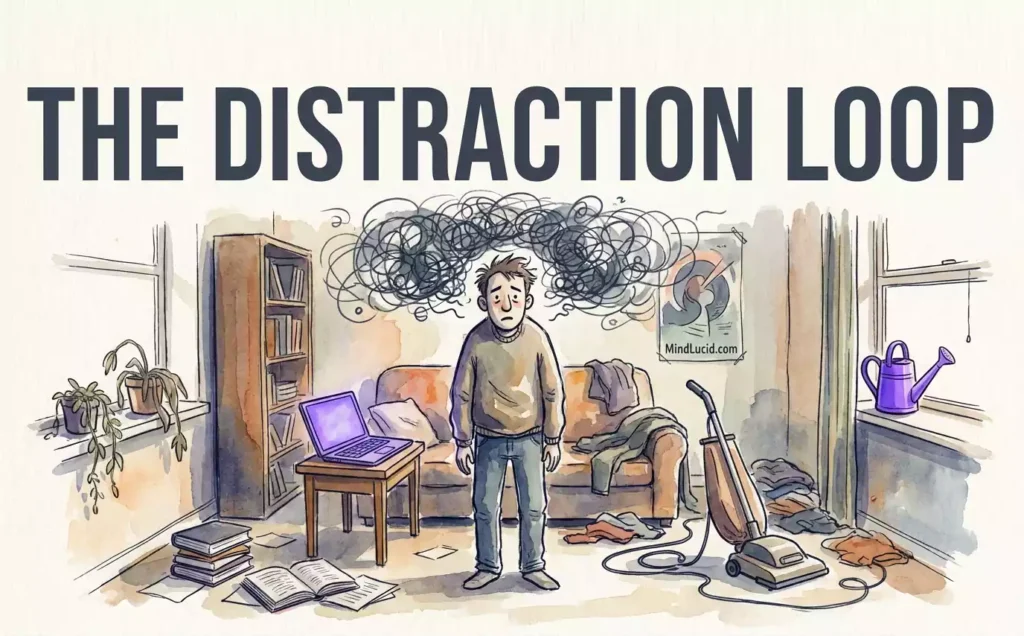
You sit down to clean your desk. It should take ten minutes. But three hours later, you’re standing in the garage, surrounded by boxes you haven’t opened in years, wondering how you got there. Sound familiar? You’ve just experienced the task distraction loop — a pattern where one small task cascades into an unpredictable chain of unrelated activities that swallow your entire afternoon. And the worst part? The desk never got cleaned.
🔍 What Exactly Is the Task Distraction Loop?
The task distraction loop is a behavioral pattern where starting one task triggers a series of tangent tasks that pull you further and further away from your original goal. It’s not laziness, and it’s not a lack of motivation. It’s a specific cognitive pattern where each half-completed action generates a new “urgent” thing to do, creating a chain that can stretch for hours without you even noticing.
Think of it like this: you notice a smudge on your desk → you go to grab a cloth → the cloth drawer is messy → you decide to organize the drawer → you find old batteries → you take them to the garage → the garage is a mess → you start reorganizing the garage. Each step feels completely logical in the moment. But the cumulative result is that you’re miles away from where you started, and the original task remains untouched.
This pattern is especially familiar to people with attention differences. The brain’s natural tendency to seek novelty and respond to immediate stimuli makes it incredibly easy to follow each new thread that presents itself — even when that thread leads away from what you actually need to accomplish.
🧠 The Anatomy of a Distraction Loop
Every task distraction loop follows a remarkably predictable structure. Understanding this structure is the first step to breaking it. Here’s what happens in sequence:
A visual cue or thought interrupts your current focus
You shift to address the new stimulus
“This will only take a minute” or “I’ll come right back”
The tangent reveals yet another distraction
Each cycle reinforces itself. The more tangents you follow, the harder it becomes to remember what you were originally doing. Working memory — the mental workspace that holds your current intentions — gets crowded out by each new thought that demands attention.
✨ Key Insight: The task distraction loop isn’t about being disorganized. It’s about the brain’s natural tendency to chase immediate rewards over long-term goals. Each tiny “win” (like organizing a drawer) releases a small burst of satisfaction, which keeps the loop going.
📋 The Desk-to-Garage Pipeline: A Real-World Breakdown
Let’s trace the exact pathway that takes you from a simple desk cleaning to a full garage reorganization. This isn’t hypothetical — it’s a pattern that plays out in homes every single day. Notice how each step feels reasonable in isolation, but the chain as a whole leads far astray.
| Step | What You Notice | What You Do | Distance from Original Task |
|---|---|---|---|
| 1 | Desk is cluttered | Start cleaning the desk | ✅ On task |
| 2 | Smudge on desk surface | Go to find a cleaning cloth | 📏 2 steps away |
| 3 | Cloth drawer is disorganized | Reorganize the entire drawer | 📏 5 steps away |
| 4 | Old batteries in the drawer | Take batteries to the garage for recycling | 📏 10 steps away |
| 5 | Garage is cluttered | Start “just tidying” the garage | 📏 20 steps away |
| 6 | Old boxes from years ago | Open boxes, sort through contents | 📏 50 steps away |
| 7 | Three hours have passed | Desk is still dirty, garage is half-reorganized | 📏 100 steps away |
What makes this pattern so powerful is that each individual step feels completely justified. The batteries do need to go to the garage. The drawer could benefit from organizing. But the cumulative effect is that your original intention gets buried under a pile of “worthwhile” distractions.
💜 Does This Pattern Feel Familiar?
If you regularly find yourself wondering where your afternoon went — starting one thing and ending up somewhere completely different — the task distraction loop might be more than just a bad habit. It could be a sign of how your brain processes attention and prioritizes tasks. Understanding your unique patterns is the first step toward working with your brain instead of against it.
🔬 Why Your Brain Does This
So why does this happen? Why can you sit down with clear intentions and end up somewhere entirely different? The answer lies in how attention works — and how it differs from person to person.
⚡ The Novelty Drive
Your brain is wired to notice new things. New stimuli — a smudge, a cluttered drawer, an unexpected item — trigger a release of attention-grabbing signals. For many people, especially those with attention differences, this novelty signal is particularly strong. It’s like having a mental radar that’s always scanning for something interesting, even when you’re trying to focus on something else.
🧩 Working Memory Load
Working memory is your brain’s sticky note — it holds your current intention while you work. But that sticky note has limited space. Each new tangent adds another item to the note, and eventually, the original task gets pushed off entirely. By the time you’re in the garage, the desk cleaning is no longer even on the note.
🎭 The Illusion of Productivity
Here’s the tricky part: organizing a drawer or sorting through boxes feels productive. You’re doing things. You’re accomplishing tasks. This sense of productivity provides a dopamine hit that keeps you going — even though you’re productive in entirely the wrong direction. The task distraction loop feeds on this illusion.
💫 Lack of External Structure
When you’re working on a task without clear boundaries or time limits, there’s nothing anchoring you to the original goal. No alarm goes off when you’ve been reorganizing the garage for an hour. No reminder pops up saying “you were supposed to be cleaning your desk.” Without external structure, the loop has no natural endpoint.
💰 The Hidden Cost of the Loop
The task distraction loop isn’t just an amusing quirk — it has real consequences that compound over time. Understanding these costs can help you recognize when you’re caught in the pattern and motivate you to break free.
Hours vanish without progress on what actually matters
The original task looms larger and feels more overwhelming
Half-finished projects pile up in your mind and your home
You blame yourself for “laziness” when the real issue is attention patterns
When these costs accumulate day after day, they create a heavy burden. You might start avoiding tasks altogether because you know from experience that starting one thing will spiral into twenty other things. This avoidance then creates more stress, which makes the loop even harder to break.
💡 Important Reminder: You’re not broken, and this isn’t a character flaw. The task distraction loop is a pattern that can be understood, worked with, and gradually reshaped. Awareness is the foundation of change.
🛠️ Breaking the Loop: Practical Strategies That Actually Work
You don’t need to “fix” your brain to break the task distraction loop. You need to work with it. Here are practical, actionable strategies that respect how your attention actually functions.
🎯 Strategy 1: The Visual Anchor
Write your original task on a sticky note and place it somewhere you can’t ignore. Make it physically impossible to forget what you were doing. The note serves as an external working memory aid, freeing up mental space for the actual work.
⏱️ Strategy 2: The 15-Minute Container
Set a timer for 15 minutes and commit to working only on the original task during that window. If a distraction pops up, write it down on a “later” list and return to the task. When the timer goes off, you can decide whether to continue or take a break.
📝 Strategy 3: The Parking Lot
Keep a dedicated notebook or digital list called the “Parking Lot.” Every time you notice a tangent task (like reorganizing the drawer), write it down and say “I’ll park that for later.” This satisfies the brain’s need to acknowledge the distraction without following it.
🚪 Strategy 4: The Physical Boundary
Before starting a task, define a physical boundary: “I will clean only the desk surface. I will not leave this room.” When you feel the urge to walk to another area, that boundary acts as a tripwire that alerts you to the loop.
🎪 Strategy 5: The Temptation Bundle
Pair the original task with something enjoyable. Listen to your favorite podcast only while cleaning the desk. This makes the original task more appealing than the distractions, which flips the loop’s reward structure in your favor.
✨ The Meta-Strategy: The most effective approach is to notice the loop as it happens. The moment you catch yourself reaching for a tangent, pause and ask: “Is this moving me toward my original goal or away from it?” That single moment of awareness is where change begins.
💬 Frequently Asked Questions
🌟 Final Thoughts: From Looping to Living Intentionally
The task distraction loop isn’t your enemy. It’s a signal — a message from your brain about how it processes the world and what it needs to thrive. When you understand the loop’s mechanics, you stop blaming yourself and start building systems that work with your natural tendencies instead of against them.
Every time you catch yourself mid-loop and choose to return to your original task, you’re strengthening the neural pathways that support intentional action. It gets easier with practice. The goal isn’t perfection — it’s progress. And progress starts with a single moment of awareness.
If you recognize yourself in this article — if the task distraction loop is a regular part of your life — taking a comprehensive assessment can help you understand your unique attention patterns more deeply. Knowledge is power, and the more you know about how your brain works, the more effectively you can design your life around it.