
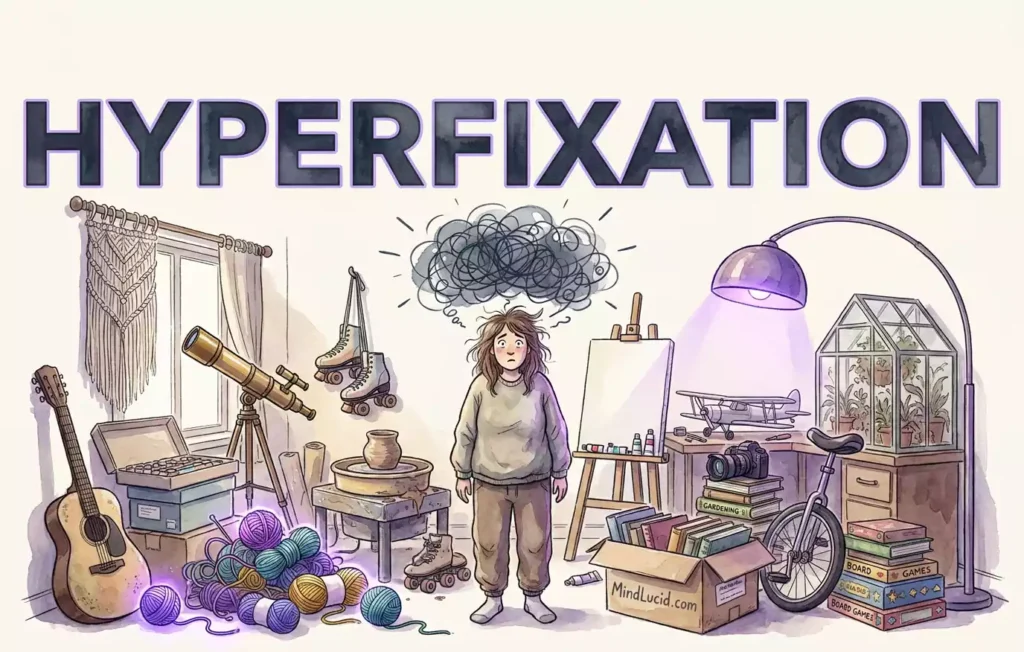
💜 It’s 2 AM. You have fourteen browser tabs open, all devoted to your newest obsession: watercolor painting. You’ve watched every tutorial on YouTube. You’ve compared prices on seventeen different brush sets. You’ve already mentally designed the gallery wall in your living room. By 9 AM, you’ve spent $187 on professional supplies that will arrive in two days. And by day three? The brushes sit unopened in a box under your bed, never to be touched again. If this sounds painfully familiar, welcome to the world of hyperfixation hobbies — the ADHD brain’s favorite way to spend money, time, and emotional energy.
What Are Hyperfixation Hobbies?
Hyperfixation hobbies are intense, short-lived obsessions with a new interest or activity — typically lasting anywhere from a few hours to a few days before the enthusiasm vanishes as quickly as it appeared. For people with ADHD, this isn’t just a casual interest or a passing phase. It’s an all-consuming, dopamine-fueled deep dive into a subject that temporarily becomes the most important thing in the universe.
The key difference between a regular hobby and a hyperfixation hobby comes down to intensity, duration, and the crash afterward. A regular hobby builds gradually over time. A hyperfixation arrives like a lightning bolt — suddenly, urgently, and with zero warning. You don’t just want to learn to knit; you need to learn to knit, right now, with the best yarn, the best needles, and a detailed plan to knit sweaters for everyone you know by Christmas.
And then? The interest evaporates. Not gradually — suddenly. One day you wake up and the thought of knitting makes you feel… nothing. No excitement. No motivation. Just a vague sense of guilt about the $300 worth of merino wool sitting in your closet.
This cycle is incredibly common in the ADHD community, and it’s something that many people experience repeatedly throughout their lives. The hobbies change — crochet, baking, photography, coding, gardening, pottery, calligraphy, candle-making, resin art, miniature painting — but the pattern stays remarkably consistent.
The 48-Hour Phenomenon, Explained
Why 48 hours? While the exact duration varies from person to person, the 48-hour mark represents a critical tipping point in the hyperfixation cycle. It’s the moment when the initial dopamine surge begins to fade, and the reality of actually doing the hobby sets in. Here’s what the typical timeline looks like:
Hour 0–2: The Spark ⚡
Something triggers the interest — a TikTok video, a friend’s recommendation, a random thought while showering. The dopamine hits immediately. You feel alive, excited, and absolutely certain that THIS is your true calling.
Hour 2–8: The Deep Dive 🔍
You’re researching everything. Every tutorial, every product review, every Reddit thread. You’ve bookmarked 47 websites. Your brain is firing on all cylinders, and you can’t stop thinking about it.
Hour 8–24: The Shopping Spree 🛒
You’ve filled your cart with everything you could possibly need. Not just the basics — the professional-grade equipment. You’re not buying entry-level; you’re buying as if you’re already an expert. The spending feels justified because this is the one.
Hour 24–48: The First Attempt 🎨
The supplies arrive (or you’ve gathered them from the craft store). You try the hobby for the first time. It’s… harder than expected. Or not as instantly gratifying. The dopamine starts to wane. You tell yourself you’ll get back to it tomorrow.
Hour 48+: The Fade 💨
Tomorrow comes, and the interest is gone. The supplies sit untouched. You feel a mix of guilt, confusion, and a strange sense of loss. But then — a new interest sparks, and the cycle begins again.
The Brain Behind the Pattern
Understanding hyperfixation hobbies means understanding a bit about how the ADHD brain processes rewards and motivation. Without getting too technical, here’s what’s happening:
🎯 The Dopamine Connection
The ADHD brain craves dopamine — that feel-good chemical that makes things feel exciting, interesting, and worth doing. New hobbies are dopamine goldmines. They’re novel, they’re stimulating, and they promise endless possibilities. Your brain lights up like a Christmas tree every time you discover something new. The problem? Novelty wears off. Once the initial excitement fades, so does the dopamine supply, and your brain starts looking for the next hit.
🔮 The Fantasy vs. Reality Gap
When you’re in the research phase of a hyperfixation, you’re living in a fantasy world where you’re already skilled. You imagine the finished projects, the compliments, the sense of accomplishment. But when reality hits — when you actually try to do the thing and it’s messy, frustrating, and time-consuming — the fantasy collapses. The gap between expectation and reality is where the interest goes to die.
🔄 The Executive Function Factor
Starting a new hobby requires very little executive function. You’re riding the wave of excitement, and everything feels effortless. But continuing a hobby requires planning, organization, patience, and the ability to push through frustration — all things that can be challenging with ADHD. The initial burst of energy isn’t sustainable, and without the structure to maintain it, the hobby fades.
Common Hyperfixation Hobbies & Their Typical Arc
| Hobby Type | Common Supplies Purchased | Average Spend | Typical Duration | What Usually Happens |
|---|---|---|---|---|
| 🎨 Visual Arts | Watercolor sets, acrylics, easels, canvas, brushes | $150–$400 | 24–72 hours | One painting attempted, then supplies stored away |
| 🧶 Fiber Crafts | Yarn, knitting needles, crochet hooks, patterns | $80–$250 | 36–96 hours | Half a scarf completed, interest lost |
| 📸 Photography | Camera, lenses, tripod, editing software | $500–$2000 | 48–120 hours | Camera used for one weekend, then sits in bag |
| 🍞 Baking | Stand mixer, specialty pans, ingredients, tools | $100–$350 | 24–72 hours | One impressive bake shared on social media, then done |
| 💻 Coding | Online courses, books, software subscriptions | $50–$300 | 72–168 hours | Basic tutorial completed, then abandoned |
| 🌱 Gardening | Plants, pots, soil, tools, grow lights | $100–$500 | 1–2 weeks | Plants either die or get given away |
| 🕯️ Candle-Making | Wax, wicks, fragrance oils, molds, jars | $120–$300 | 24–48 hours | One batch made, supplies boxed up |
| 🎸 Music | Instrument, lessons, accessories, sheet music | $200–$800 | 48–96 hours | First few chords learned, instrument collects dust |
Does This Sound Like You? 💜
If you’ve found yourself nodding along to every word of this article — the midnight research spirals, the abandoned supply closets, the guilt that follows every new interest — you might be experiencing a pattern that goes far beyond just “having lots of hobbies.” Understanding your brain’s unique wiring is the first step toward working with it instead of against it. Our comprehensive ADHD test was designed to help you explore your patterns in a thoughtful, non-judgmental way.
The Financial Reality of Hyperfixation Hobbies
Let’s talk about the elephant in the room: the money. Hyperfixation hobbies aren’t just emotionally draining — they can be financially significant too. When you’re in the grip of a hyperfixation, spending feels justified. You tell yourself things like:
- “I need quality supplies to do this properly.”
- “This is an investment in myself.”
- “Once I get good at this, I can even sell my work!”
- “I’ll use this for years.”
And in the moment, all of those things feel absolutely true. The ADHD brain is incredibly skilled at rationalizing purchases when dopamine is involved. But when the interest fades, you’re left with the receipts and the reality.
Many people with ADHD report spending anywhere from $500 to $3,000 per year on hobby supplies that end up barely used. That’s not just a quirk — it’s a real financial consideration. The good news? Once you recognize the pattern, you can start to build systems that protect your wallet while still honoring your brain’s need for novelty and stimulation.
How to Navigate Hyperfixation Hobbies Without the Guilt
Here’s the thing: hyperfixation hobbies aren’t a character flaw. They’re a feature of how your brain works — and they come with real benefits too. People who hyperfixate tend to be curious, enthusiastic, and genuinely passionate about learning. The goal isn’t to eliminate the pattern; it’s to work with it more effectively.
🌟 Embrace the Research Phase (Without the Spending)
The research phase is often the most enjoyable part of a hyperfixation. You get all the dopamine without any of the commitment. So lean into it! Watch all the videos, read all the articles, create all the Pinterest boards. Just hold off on the credit card. The research itself is a valid form of engagement — you don’t need to buy anything to enjoy the learning.
🧪 Try the “Borrow First” Approach
Before committing to a full supply purchase, find a way to try the hobby with minimal investment. Borrow a friend’s equipment. Rent from a local library or makerspace. Take a one-time class. Many hobbies have “starter” versions that cost very little — and if the interest survives the starter phase, then you can consider upgrading.
📦 Create a “Hobby Library” System
Instead of viewing abandoned hobbies as failures, reframe them as a personal hobby library. Your watercolor supplies from last year? They’re not “wasted” — they’re waiting. Many people with ADHD cycle back to hobbies months or even years later. When the urge strikes again, you’ll already have everything you need. Store supplies in clear, labeled containers so they’re easy to find when the interest returns.
🔄 Set a “Completion Minimum”
Before starting a new hobby, set a minimum engagement goal. For example: “I will complete at least three sessions with this hobby before I’m allowed to buy anything beyond basic supplies.” This gives you a chance to see whether the interest has staying power before you invest more deeply.
🎭 Remove the Guilt
Guilt is the most damaging part of the hyperfixation cycle. You’re not “flaky” or “irresponsible” — you’re working with a brain that’s wired for intense bursts of interest. The guilt doesn’t change the behavior; it just makes you feel worse. Accept the pattern, work with it, and let go of the shame.
FAQ About Hyperfixation Hobbies
Embracing Your Brain’s Unique Rhythm
Hyperfixation hobbies are not a problem to be solved — they’re a pattern to be understood. Your brain is wired to seek novelty, to dive deep, and to explore the world with intensity that many people will never experience. The challenge isn’t the curiosity; it’s learning to channel it in ways that don’t leave you feeling drained, guilty, or broke.
Start by being kind to yourself. The supplies in your closet aren’t evidence of failure — they’re artifacts of genuine enthusiasm, markers of a mind that’s alive and engaged with the world. The next time you feel a hyperfixation brewing, try applying some of the strategies from this article. Give yourself permission to enjoy the research without the purchase. Wait 48 hours before buying anything. And remember that your worth isn’t measured by how many projects you finish.
If you’ve recognized yourself in this article — if the pattern feels familiar and you’re wondering whether there’s something more to understand about how your brain works — we invite you to explore our comprehensive ADHD test. It’s designed to help you gain clarity about your experiences and patterns, in a supportive and judgment-free space.
💜 mindlucid.com · Understanding your mind, one pattern at a time 💜