
⚡ The ADHD Brain Explained
You stand in the kitchen. The dishes are in the sink. The counters need wiping. You know what needs to be done. You can picture the end result — a clean, calm kitchen. But somehow, your body won’t move. Your mind starts listing every micro-step: clear the table, rinse the plates, load the dishwasher, check if there are more dishes in the living room, find the sponge, spray the counter, wipe it down, rinse the sponge, dry the counters… and suddenly, a five-minute chore feels like preparing for a mountain expedition. If this sounds familiar, you’re not broken — and you’re definitely not alone. This is what researchers and mental health professionals refer to as a struggle with task sequencing, one of the most misunderstood and exhausting cognitive challenges people with ADHD face every single day.
💡 Key Insight: Task sequencing is not about laziness or lack of motivation. It’s a cognitive difference in how the brain breaks down, orders, and initiates multi-step activities. Understanding this distinction is the first step toward working with your brain instead of against it.
What Is Task Sequencing — And Why Does It Feel Impossible?
Task sequencing is the cognitive ability to take a goal (like “clean the kitchen”) and break it down into a logical, ordered series of actions. For most people, this happens almost automatically. The brain quietly assembles a mental checklist, assigns an order, and initiates the first step without much conscious effort. But for people with ADHD, this automatic process is often disrupted.
Think of task sequencing like a GPS navigation system. A neurotypical brain receives the destination and instantly calculates the optimal route, accounting for traffic, shortcuts, and timing. An ADHD brain, on the other hand, receives the same destination but struggles to generate the turn-by-turn directions. It sees the entire journey at once — all the roads, intersections, and possible detours — but can’t determine which turn comes first. The result is a feeling of being frozen in place, staring at a map that’s too overwhelming to read.
This isn’t a character flaw. It’s a genuine difference in how executive functions operate. The prefrontal cortex — the part of the brain responsible for planning, organizing, and initiating action — works differently when ADHD is in the picture. Neuroimaging studies have shown that individuals with ADHD often show reduced activity in the prefrontal regions when faced with tasks requiring sequential planning. This means the brain literally struggles to generate and maintain the mental map needed to move from point A to point B.
Task sequencing is like trying to follow a recipe where someone threw away the step numbers and scattered the ingredients across the entire kitchen. The information is all there — but the order is missing, and that missing order is everything.
The ADHD Brain: Why Sequencing Gets Tangled
To truly understand why task sequencing becomes such a monumental challenge, it helps to look at what’s happening beneath the surface. The ADHD brain processes information through a slightly different neurological lens, and this difference shows up in several key areas that directly impact sequencing ability.
Working Memory Gaps
Working memory is your brain’s mental whiteboard — the place where you hold and manipulate information temporarily while you work with it. When you sequence a task, you’re essentially writing the steps on this whiteboard, then erasing each one as you complete it. For people with ADHD, this whiteboard often feels smaller than average. Steps disappear from memory before you can act on them, forcing you to repeatedly return to the beginning of the sequence to remember what comes next.
Imagine trying to follow a set of directions while someone keeps erasing random lines from the page. You might remember step one and step four, but steps two and three have vanished. Now you’re stuck, unable to move forward because the middle of the sequence is missing. This is the daily reality of working memory challenges with ADHD.
Executive Function Overload
Executive functions are the brain’s management system — the set of cognitive skills that help you plan, prioritize, initiate, and complete tasks. Task sequencing sits squarely within this domain. When executive functions are impaired or inconsistent, the entire sequencing process becomes effortful and energy-draining.
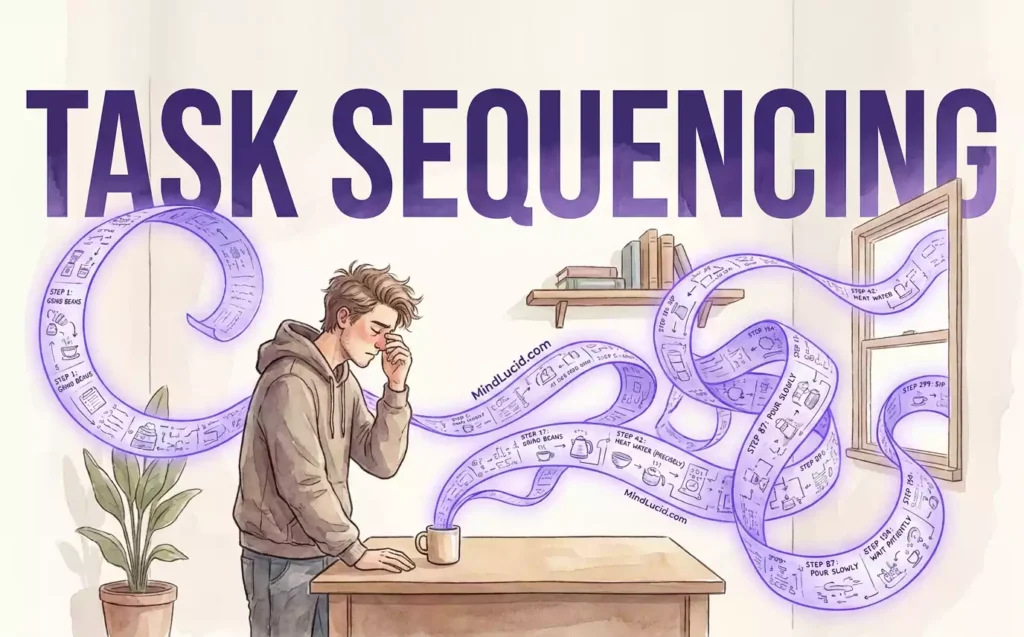
For most people, sequencing a familiar task like making coffee requires almost zero cognitive energy. The brain recognizes the pattern and runs it on autopilot. But for someone with ADHD, even familiar sequences can demand significant executive function resources. The brain has to consciously think through each step: Get the mug. Open the cabinet. Take out the coffee. Put water in the machine… Each micro-decision chips away at your mental energy reserves until you’re exhausted before you’ve even started.
The Dopamine Disconnect
Dopamine is the neurotransmitter most commonly associated with motivation, reward, and the brain’s “go” signal. People with ADHD often have differences in how their brains process and respond to dopamine. This affects task sequencing in a profound way: even when you know what to do and how to do it, the brain may not generate enough of a dopamine signal to actually initiate the action.
This explains why you can stand in front of a sink full of dishes, fully aware of the sequence required to clean them, and still feel completely unable to start. The knowledge is there. The ability is there. But the brain’s “go” button isn’t firing. It’s not procrastination in the traditional sense — it’s a neurological gap between knowing and doing.
🔬 The Science in Plain Language: When researchers study task sequencing in ADHD, they consistently find differences in prefrontal cortex activation patterns. The brain regions responsible for “what comes next” thinking show lower activity levels, meaning the neural pathways that should automatically generate task sequences are underactive. This isn’t a choice — it’s a measurable neurological difference.
From Simple to Mountain: The Escalation Problem
One of the most frustrating aspects of task sequencing challenges is the escalation effect — the way a genuinely simple task transforms into an overwhelming mountain in your mind. This transformation doesn’t happen randomly. It follows a predictable pattern that, once understood, becomes easier to interrupt.
The Step Explosion
A neurotypical brain sees “do the laundry” as a single task. Maybe two or three steps at most: Put clothes in washer. Add detergent. Press start. But the ADHD brain sees the full expanded sequence, and that’s where the trouble begins. It might look something like this:
- Go to the bedroom and gather all dirty clothes
- Check under the bed and behind the door for hidden laundry
- Separate lights from darks
- Check pockets for forgotten items
- Carry the laundry basket to the washing machine
- Open the washer door
- Load the clothes inside
- Measure the detergent
- Select the right wash cycle
- Start the machine
- Remember to come back when it’s done
- Transfer to the dryer
- Fold everything
- Put everything away
Suddenly, “do the laundry” has become fourteen distinct steps. And your brain is attempting to hold all fourteen steps in working memory simultaneously while also calculating the time, energy, and decision-making required for each one. No wonder it feels like climbing a mountain.
The Decision Fatigue Factor
Every step in a sequence involves at least one micro-decision. Should I separate the whites from the colors? Which detergent do I use? What temperature should the water be? Do I fold the shirts now or later? Each of these decisions requires cognitive effort, and when you’re facing a sequence with twenty or thirty micro-decisions, the cumulative load becomes staggering.
For people with ADHD, decision-making is already more effortful than for neurotypical individuals. Adding dozens of small decisions to an already challenging sequencing process creates a perfect storm of cognitive overload. Your brain essentially throws up its hands and says, “This is too much. I’m done.”
🧠 Neurotypical Brain
- ✓ Sees “laundry” as 1-3 steps
- ✓ Auto-generates sequence
- ✓ Minimal conscious effort
- ✓ Quick initiation
- ✓ Low cognitive load
⚡ ADHD Brain
- ✗ Sees “laundry” as 14+ steps
- ✗ Must consciously build sequence
- ✗ Significant mental effort
- ✗ Delayed or blocked initiation
- ✗ High cognitive load
Common Task Sequencing Struggles at a Glance
The gap between what a task looks like from the outside and what it feels like from the inside is where task sequencing struggles hide. The table below illustrates how everyday chores transform in the ADHD mind.
| Everyday Task | What Others See | What You Experience | Hidden Step Count |
|---|---|---|---|
| Making Breakfast | A quick 5-minute routine | Open fridge, decide what to eat, gather ingredients, get pan, turn on stove, crack eggs, don’t break the yolk, find spatula, toast bread, butter toast, plate food, eat before it gets cold… | 12-18 steps |
| Getting Ready for Work | Shower, dress, go | Get up, check time, shower, dry off, choose clothes, do they match, find socks, iron shirt, pack bag, find keys, charge phone, feed cat, lock door… | 15-25 steps |
| Running Errands | A simple trip to the store | Make list, find wallet, get in car, drive, park, find items, compare prices, wait in line, pay, carry bags, drive home, unpack… | 10-16 steps |
| Cleaning the Bathroom | One room, quick wipe down | Gather supplies, clear counter, spray cleaner, scrub sink, clean mirror, wipe faucet, clean toilet, scrub shower, mop floor, empty trash… | 12-20 steps |
| Paying a Bill | A 2-minute online task | Find the bill, open computer, log in, remember password, reset password, find account number, enter payment info, double-check amount, confirm, save confirmation… | 8-14 steps |
Notice the pattern: what looks simple from the outside expands dramatically when your brain must consciously generate and maintain each individual step.
Does Task Sequencing Feel Like Your Daily Reality?
If you recognize yourself in the struggles described above — the mental step explosion, the feeling of being frozen by simple tasks, the exhaustion that comes from planning things others do automatically — you might be experiencing the cognitive patterns associated with ADHD. Our comprehensive assessment takes just a few minutes and can help you understand your unique brain profile.
Practical Strategies to Tame the Mountain
Understanding task sequencing challenges is valuable, but understanding alone doesn’t wash the dishes. The good news is that there are practical, research-backed strategies that can make a real difference. These aren’t quick fixes — they’re approaches that work with your brain’s natural tendencies instead of fighting against them.
1. Externalize the Sequence
The most powerful strategy for task sequencing challenges is to get the sequence out of your head and onto something you can see. Your brain struggles to hold multiple steps in working memory, so don’t ask it to. Write them down. Type them in a notes app. Use a whiteboard. The act of externalizing removes the burden from your working memory and frees up cognitive resources for actually doing the task.
💡 Pro Tip: Keep a small notebook or use your phone’s notes app specifically for task sequences. When you successfully complete a sequence (like cleaning the bathroom), save it. Next time, you won’t have to generate the steps from scratch — you can simply follow your saved recipe.
2. Shrink the Mountain: The Two-Step Rule
When a task feels overwhelmingly complex, reduce it to just two steps. Not the full sequence — just the first two. “Stand up and walk to the kitchen.” That’s it. Once you’re there, the next two steps become clearer. This technique works because it bypasses the need to sequence the entire task upfront. You only need to sequence two steps at a time, which is far more manageable.
Think of it like walking through fog with a flashlight. You can’t see the entire path, but you can see the next few feet. And that’s all you need to keep moving forward.
3. Time-Boxing with a Twist
Instead of trying to complete an entire task, set a timer for a specific, short duration — say, 5 or 10 minutes. The goal isn’t to finish; the goal is simply to start. This reduces the perceived size of the task because you’re no longer committing to the full sequence. You’re committing to five minutes of effort, which feels much more achievable. Often, once you start, the momentum carries you forward.
Externalize It
Write down every step. Get the sequence out of your head and onto paper or a screen where you can see it.
Two-Step Focus
Don’t plan the whole sequence. Just identify the next two steps. That’s all you need to begin.
Time-Boxing
Set a 5-minute timer. The goal is to start, not to finish. Starting is the hardest part.
Build Templates
Save successful sequences as reusable templates. You shouldn’t have to reinvent the wheel every time.
4. Anchor Tasks to Existing Habits
One of the most effective ways to bypass sequencing difficulties is to attach new tasks to existing routines. Your brain already has automatic sequences for certain activities — like brushing your teeth or making your morning coffee. By anchoring a new task to an existing one, you leverage the sequence that’s already working.
For example: “After I pour my morning coffee, I’ll put the breakfast dishes in the dishwasher.” The coffee-pouring sequence is already automatic. Attaching the dish-loading step to it means you don’t need to generate a whole new sequence from scratch.
5. Practice Self-Compassion
This might be the most important strategy of all. Struggling with task sequencing is not a moral failing. It’s not laziness, and it’s not a lack of effort. It’s a genuine cognitive difference that requires different strategies, not more self-criticism. When you find yourself stuck, instead of piling on guilt and frustration, try saying: “My brain processes sequences differently, and that’s okay. I can work with this.”
Self-compassion isn’t about making excuses. It’s about acknowledging the reality of your cognitive experience and choosing to work with it rather than against it. That shift in perspective is often the difference between staying stuck and moving forward.
Common Questions About Task Sequencing
Task sequencing is a topic that raises many questions, especially for people who are just beginning to understand their ADHD-related challenges. Here are some of the most frequently asked questions.
Is task sequencing difficulty the same as procrastination?
No, they’re different. Procrastination is typically defined as voluntarily delaying a task despite knowing it will have negative consequences. Task sequencing difficulty, on the other hand, is a cognitive challenge in breaking down and initiating multi-step tasks. While the two can look similar from the outside, the internal experience is very different. Someone struggling with task sequencing wants to do the task and may be actively trying, but their brain struggles to generate and execute the necessary sequence of steps.
Can task sequencing improve over time?
Yes. While task sequencing challenges are rooted in neurological differences, the brain is remarkably adaptable. With consistent practice using strategies like externalization, habit anchoring, and two-step focusing, many people find that sequencing becomes easier over time. It’s less about “fixing” the brain and more about building systems and tools that compensate for the differences in how the brain naturally processes sequences.
Why do some days feel harder than others?
Task sequencing ability can fluctuate based on many factors, including sleep quality, stress levels, overall cognitive load, and even time of day. On days when your executive function resources are already depleted — perhaps from a stressful meeting or poor sleep — sequencing tasks will feel significantly harder. This variability is a normal part of how the ADHD brain operates, and planning for it (by keeping tasks lighter on high-stress days) can help.
Is task sequencing difficulty unique to ADHD?
While task sequencing challenges are particularly common in people with ADHD, they can also appear in other contexts, such as after a concussion, during periods of extreme stress, or with certain other neurodivergent profiles. However, the persistent and pervasive nature of task sequencing struggles is considered a hallmark feature of ADHD, particularly when it affects multiple areas of daily life.
Moving Forward: From Overwhelm to Action
The journey of understanding task sequencing and how it affects your daily life is deeply personal. It’s about recognizing that the mountain in front of you isn’t real — it’s a perception created by the way your brain processes multi-step information. The steps are real, yes, but the overwhelming size of the task is an illusion created by cognitive overload, not an accurate reflection of the effort required.
When you begin to work with your brain instead of against it — externalizing sequences, shrinking tasks to two steps, anchoring to existing habits, and practicing genuine self-compassion — something remarkable happens. The mountain starts to look less like a mountain and more like a series of small, manageable hills. Each one is climbable. Each one is achievable.
If the struggles described throughout this article resonate with you — if task sequencing feels like a daily battle that others don’t seem to understand — it may be worth exploring whether ADHD plays a role in your experience. Understanding your cognitive profile is not about labeling yourself; it’s about gaining the insight needed to work effectively with your unique brain.
The path forward begins with awareness. Every step you take toward understanding your brain better is a step toward a life where daily chores no longer feel like mountains to climb.