
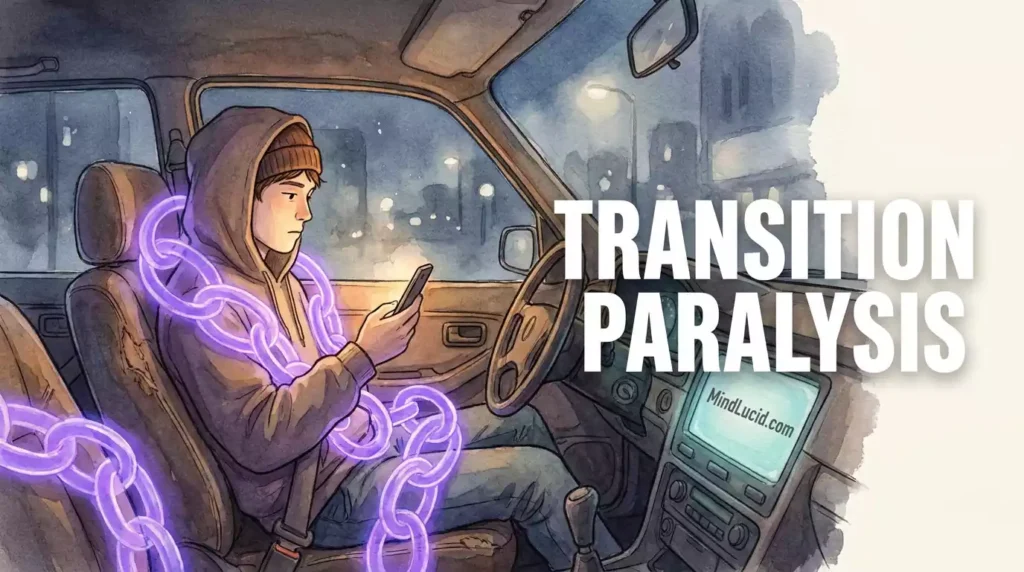
Does this sound familiar?
You pull into the driveway after work. The engine is off. Your hand is on the door handle. But instead of moving, you just… sit there. You stare at the windshield. You scroll your phone. You replay conversations. You tell yourself, “Okay, I’ll go in, in a minute.” Then twenty minutes pass. Forty-five minutes pass. It’s not that you want to sit in the car. It’s that moving from one context to another feels like trying to push through invisible molasses. This isn’t laziness. It has a name: transition paralysis.
If you’ve ever felt frozen in the doorway, stuck on the couch before a shower, or unable to stop doomscrolling because starting dinner feels impossibly heavy, you’re not broken. You’re experiencing one of the most common — and most misunderstood — hallmarks of the ADHD brain. In this guide, we’ll unpack exactly why transition paralysis happens, what it looks like in everyday life, and how understanding it can be the first step toward unlocking a life that feels lighter.
What Is Transition Paralysis? Understanding the Invisible Wall
Transition paralysis is the intense, often overwhelming difficulty in shifting from one activity, task, or environment to another. It’s not about physical mobility. It’s about cognitive and emotional momentum. For a neurotypical brain, moving from “car” to “house” is a seamless, automatic handoff. For an ADHD brain, that handoff requires a massive surge of mental effort — because the brain’s executive function system struggles to disengage from the current state and re-engage with a new one.
Think of it like this: your attention is a high-speed train. Switching tracks requires signals, coordination, and a deliberate slowdown. But with ADHD, the signal system is often delayed. So the train sits on the track, engine idling, waiting for a switch that feels like it will never come. That’s why you can feel stuck even when you know exactly what you’re supposed to do next.
The term “paralysis” is apt because the experience genuinely feels physical. Your body may feel heavy. Your thoughts may loop. You may even experience a dull sense of dread or irritation at the demand of simply walking through a door. This isn’t a character flaw. It’s a measurable difference in how the brain allocates mental energy.
Key Characteristics of Transition Paralysis
- Time distortion: Five minutes of “just resting” becomes 45 minutes without notice.
- Looped thinking: You mentally repeat, “I should get up,” while your body stays still.
- Emotional friction: The upcoming task feels heavier than it logically is — like it carries a hidden weight.
- Relief avoidance: You avoid starting because the act of starting feels disproportionately exhausting, even if the task itself is easy.
- Context cling: Your brain latches onto the current environment (the car, the couch, the scrolling app) because it’s the path of least resistance.
The Brain Science: Why Your Engine Won’t Shift Gears
To understand transition paralysis, we have to look at the brain’s executive function network — the prefrontal cortex and its connections. These regions are responsible for task initiation, inhibition, planning, and cognitive flexibility. In ADHD, these networks often show altered activity and connectivity, especially in the dopamine pathways that regulate motivation and reward.
Here’s the critical piece: dopamine isn’t just about pleasure. It’s about salience and momentum. It’s the chemical that says, “Hey, this next thing matters enough to move toward it.” When dopamine signaling is low or inconsistent, the brain doesn’t receive a strong enough “go” signal. So even though you know you need to go inside, your brain isn’t producing the neurochemical push to make your legs move.
At the same time, the default mode network (DMN) — the brain’s “idle” state — may stay too active during transitions. Instead of quieting down when you try to shift focus, it keeps spinning, pulling your attention back to internal thoughts, daydreams, or the soothing repetition of your phone screen. This creates a tug-of-war between “I should act” and “I’ll just stay here a little longer.”
The Role of “Task Switching Cost”
Every time you switch from one activity to another, your brain pays a cognitive “cost”. It must:
- Inhibit the current activity.
- Hold the new goal in working memory.
- Suppress distractions.
- Initiate the first physical step.
For someone with ADHD, this cost is disproportionately high. It’s like paying a $50 toll every time you change lanes. Eventually, your brain learns to avoid the toll booth entirely — by not switching at all. That’s why you sit in the car: staying is free. Leaving costs more mental energy than your brain is currently willing to spend.
The Parked Car Phenomenon: A Perfect Storm of Transitions
Why is the parked car such a universal ADHD experience? Because it’s a triple-threat scenario: environmental shift, role shift, and sensory shift all collide at once.
| Type of Transition | What’s Changing | Why It’s Heavy for ADHD |
|---|---|---|
| Environmental | Car interior → house interior | Different lighting, temperature, sounds, and spatial layout. The brain must re-map its surroundings. |
| Role Identity | Driver / commuter → parent / partner / worker / self | Switching roles means switching behavioral scripts. The brain must load a new “persona” and its associated expectations. |
| Sensory Load | Quiet, enclosed space → open, unpredictable home | The car can feel like a sensory cocoon. Leaving it means opening yourself to noise, demands, smells, and interactions. |
| Task Load | Driving (done) → “What do I do now?” | The next task is often ambiguous or multi-step, which ADHD brains find especially hard to initiate without external structure. |
Each of these shifts demands a slice of executive function bandwidth. When all four hit simultaneously, the brain becomes overloaded. The result? You stay seated, phone in hand, because the car has become a predictable, low-demand environment. It’s not that you love your car. It’s that your car doesn’t ask anything of you.
And here’s the twist: the longer you sit, the harder it gets. Each passing minute reinforces the “staying” state. The brain’s inertia builds. The thought of moving becomes increasingly aversive, which leads to guilt, which leads to more paralysis. It’s a vicious loop that feeds on itself.
Other Everyday Faces of Transition Paralysis
The parked car is just one scene. Transition paralysis shows up in dozens of ordinary moments, often mislabeled as procrastination or apathy. Let’s look at some of the most common — and most silently painful — examples.
You Might Recognize These Patterns:
- Bed-to-bathroom: You wake up, but can’t physically get out of bed. You lie there, scrolling, for 40 minutes, while your bladder and your responsibilities wait.
- Couch-to-shower: You know a shower will feel good. You’ve wanted one for hours. But the transition from horizontal comfort to vertical hygiene feels like climbing a mountain.
- Work-mode to home-mode: You finish a work call and sit in the same chair, unable to close the laptop and shift into personal time. The boundary blurs, and you feel stuck in a work-shaped fog.
- Playing video game to making dinner: The game is predictable and rewarding. Cooking has multiple steps, potential failure points, and no immediate dopamine. Your brain says, “Stay.”
- Socializing to leaving: You’ve been at the party long enough. You want to go home. But you stand by the door, unable to initiate the “goodbye” transition, feeling trapped by your own body.
If these resonate, you’re not “failing at life.” You’re experiencing a real neurological friction that most people never see — because it happens invisibly, in the small moments that don’t make it onto a to-do list.
The Emotional Tax: Guilt, Shame, and the “Lazy” Label
Here’s the hardest part of transition paralysis: it hurts emotionally. Because the behavior looks like laziness from the outside, people internalize that label. They call themselves lazy, unmotivated, undisciplined, or broken. They hear phrases like “just do it” or “you’re overthinking it,” and those words cut deep because the person already wants to do it — they just can’t initiate the switch.
This creates a secondary layer of suffering: shame. Shame is the feeling that you are fundamentally flawed. Unlike guilt (which says “I did something bad”), shame says “I am something bad.” Every time you sit in the car for 45 minutes, shame whispers: “Why can’t you just be normal? What’s wrong with you?”
That shame then feeds the paralysis. Because now the transition isn’t just a task — it’s a proof of your inadequacy. The emotional stakes rise. The brain’s threat response activates. And the harder you push against yourself, the more frozen you become.
Breaking this loop starts with accurate self-knowledge. When you understand that transition paralysis is a symptom of ADHD-related executive dysfunction — not a character flaw — you can begin to replace shame with curiosity and strategy.
Reframe: Instead of asking, “Why am I so lazy?” ask, “What is my brain struggling to transition away from, and what is it struggling to transition toward?” That single shift in perspective opens the door to real solutions.
How Transition Paralysis Fits into the Bigger ADHD Picture
Transition paralysis doesn’t exist in a vacuum. It’s part of a constellation of ADHD-related executive function challenges. Understanding the full picture can help you see why one symptom never really stands alone.
| ADHD Challenge | How It Connects to Transition Paralysis |
|---|---|
| Time blindness | Losing track of how long you’ve been “sitting there” because time feels abstract, not linear. |
| Task initiation deficit | Difficulty starting any task that lacks immediate novelty, urgency, or external pressure. |
| Emotional dysregulation | The dread, frustration, or overwhelm attached to simple transitions becomes magnified. |
| Hyperfocus / inertia | Getting “stuck” in one state — whether it’s scrolling, gaming, or resting — and unable to brake. |
| Working memory limits | Forgetting what you’re supposed to do next, so the transition feels directionless and vague. |
| Rejection sensitivity | Fear of being judged for “wasting time” or “being lazy” when others notice you stuck in the car. |
When these factors stack together, even a “simple” transition like walking into your own home becomes a complex cognitive event. That’s why self-compassion is not optional — it’s foundational.
Is Transition Paralysis Part of Your ADHD Story?
You’ve read this far because something here struck a nerve. Maybe you’ve spent years calling yourself lazy. Maybe you’ve developed elaborate systems just to get out of your car or off the couch. Maybe you’re tired of feeling like you’re watching your own life from behind a foggy window. It doesn’t have to be this hard. Understanding your brain is the first step toward working with it, not against it. Take our comprehensive ADHD test and start making sense of the patterns that have confused you for so long.
Practical Strategies: Building a Manual Gearshift for Your Brain
While transition paralysis is rooted in brain biology, there are concrete strategies you can use to lower the friction and create artificial momentum. These aren’t magic fixes — they’re external scaffolding that compensates for what your executive function system struggles to do internally.
1. Lower the Activation Energy
The bigger the perceived task, the higher the wall. So shrink the wall. Instead of “go inside and start dinner,” the first step is “put my hand on the door handle.” Then “open the door two inches.” Then “put one foot on the driveway.” Each micro-step feels almost absurdly small — and that’s exactly the point. You’re retraining your brain that the transition isn’t a single giant leap but a series of tiny, non-threatening slides.
2. Create a “Transition Ritual”
Rituals act as bridges. Before leaving the car, try a consistent 10-second pattern: take one deep breath, turn off the radio, place your phone face-down, touch the steering wheel, say out loud, “I’m ready to go in.” The predictability of the ritual gives your brain a clear, familiar “runway” to shift states. Over time, this ritual becomes a trigger that says, “We’re transitioning now.”
3. Use Environmental Anchors
Make the destination environment pull you rather than push yourself. Leave a porch light on. Have a favorite snack waiting in a visible spot. Set a timer for your favorite song to start playing inside the house in three minutes. If the new environment offers immediate, low-effort dopamine, your brain will be more willing to make the switch.
4. Externalize the Countdown
Time blindness makes “I’ll get out in a minute” stretch into forever. Use an external timer with a clear, non-negotiable end: “When this timer rings, I will open the door. Not before. Not after.” This shifts the decision from your internal executive function (which is exhausted) to an external structure (which is reliable).
5. Reduce the Sensory Contrast
If the car-to-house shift is too jarring, soften the boundary. Keep a pair of slippers in the passenger seat. Have your house key in your hand before you park. Play the same podcast in the car and continue it on your phone as you walk in. By carrying a familiar sensory thread from one space to the next, you make the transition feel more continuous and less like a cliff edge.
A Quick 3-Step “Unstuck” Protocol for the Car
- Step 1 — Notice & Name: Say, “I’m experiencing transition paralysis. This is my ADHD brain, not laziness.”
- Step 2 — Shrink It: Identify the tiniest possible physical action. Not “go inside” — “touch the door handle.”
- Step 3 — Signal the Shift: Change one sensory input. Turn off the car radio. Roll down the window. Flip the key in your hand. This breaks the “stuck” loop enough to create a new pattern.
Why Self-Knowledge Matters More Than Willpower
You can have all the hacks in the world, but if you don’t understand why your brain does what it does, the strategies will feel like band-aids on a wound you can’t see. That’s why assessment and diagnosis are so powerful. They replace the vague, shame-soaked narrative — “I’m just lazy and broken” — with a specific, actionable understanding: “I have ADHD-related executive dysfunction, and here’s how my particular profile works.”
When you know your pattern, you stop fighting your brain and start engineering your environment. You stop relying on willpower and start using structure. You stop blaming yourself and start getting curious. That’s not weakness — that’s wisdom. And it’s the most effective path forward.
Transition paralysis is not a life sentence. It’s a signal. A signal that your brain needs a different kind of support than the “just push through” advice you’ve been given your whole life. The more precisely you understand that signal, the more effectively you can respond to it.
Frequently Asked Questions About Transition Paralysis
From Stuck to Understood: Your Next Step
You came here because you recognized something in yourself. The 45 minutes in the parked car. The endless scroll before getting out of bed. The invisible wall between intention and action. That recognition is not a weakness — it’s the first crack in the wall. It’s the moment you stop saying “What’s wrong with me?” and start asking “How does my brain actually work?”
The answer to that question won’t come from willpower. It will come from self-knowledge. And self-knowledge often starts with a structured, thoughtful assessment that helps you see your patterns clearly. Not to label you, but to liberate you. To replace confusion with clarity. To replace shame with strategy.
You don’t have to keep white-knuckling through every transition. You don’t have to keep calling yourself lazy when your brain is simply running on a different operating system. Understanding that operating system — its strengths, its friction points, its hidden demands — is the most powerful thing you can do for yourself. And it starts with a single, honest step.
Take the step. You’ve already started moving.