
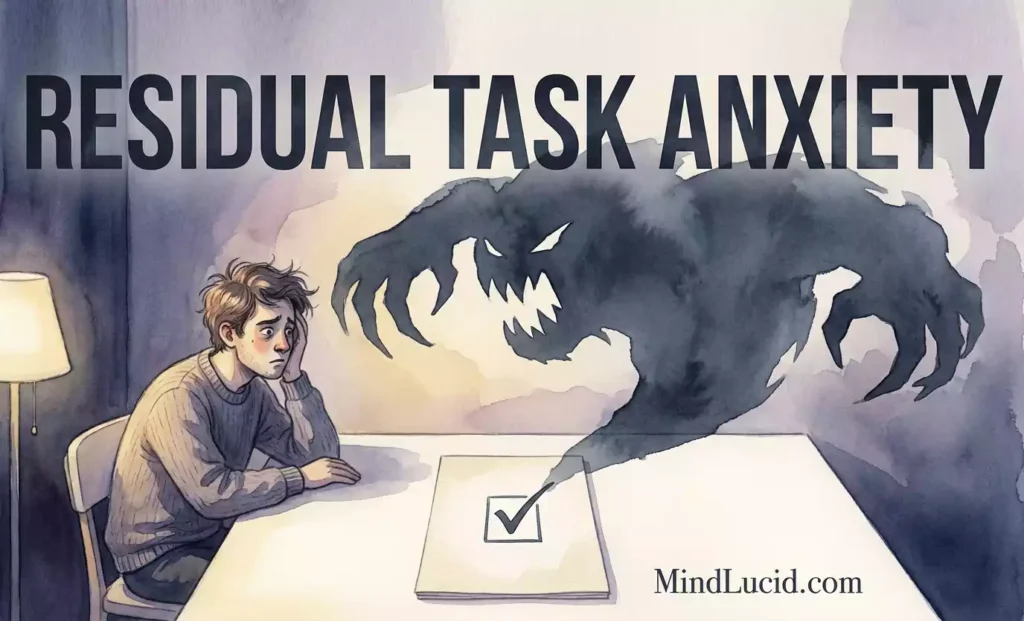
Let’s talk about what residual task anxiety actually is, why it happens, and most importantly, how you can start to work with your brain instead of against it.
What Is Residual Task Anxiety?
Residual task anxiety is the lingering feeling of unease, tension, or dissatisfaction that remains after you’ve completed a task that was delayed, avoided, or loaded with emotional weight. It’s the opposite of the “clean finish” we’re told to expect. Instead of a satisfying click of closure, you get a fizzle — or sometimes a full-blown emotional crash.
For people with ADHD, this experience can be especially confusing. You did the thing. You pushed through the executive dysfunction, the procrastination, the guilt spiral, and the last-minute scramble. So why doesn’t it feel good? Why does your brain still feel like it’s bracing for impact?
The ADHD Connection
ADHD brains often experience time, motivation, and reward differently than neurotypical brains. The dopamine release that typically accompanies task completion is often muted or delayed in ADHD. This means the “reward” part of finishing something doesn’t land the way it’s supposed to. You end up with the exhaustion of the effort without the emotional payoff of completion.
Why Delayed Tasks Feel Different
When a task is done on time and without much friction, your brain processes it as a neutral or mildly positive event. But when a task has been delayed — especially if it involved avoidance, shame, or repeated failed attempts to start — it becomes what psychologists sometimes call an “open loop” in your mind. That open loop consumes mental energy every single day.
By the time you finally close the loop, your nervous system is not primed for celebration. It’s primed for defense. It has learned to associate that task with stress, criticism, and self-judgment. So even when the task is gone, the emotional residue remains. That’s residual task anxiety in action.
The Aftermath Loop: Why the Relief Never Comes
Here’s a pattern many people recognize:
- You avoid a task because it feels overwhelming or ambiguous.
- The avoidance creates guilt, which makes the task feel even heavier.
- You finally complete it, often in a burst of hyperfocus or last-minute urgency.
- Instead of feeling proud, you feel depleted. You may even feel annoyed at yourself for taking so long.
- The next task triggers the same pattern, because your brain now associates completion with emotional hangover, not relief.
This loop is exhausting. It also reinforces the belief that you’re “lazy” or “not trying hard enough,” which is almost never true. What you’re experiencing is a mismatch between how your brain processes delayed tasks and the narrative you’ve been told about productivity.
Emotional Exhaustion Masquerading as Relief
Sometimes residual task anxiety shows up as a flat, numb feeling. Other times it shows up as irritability or even sadness. You might snap at someone for a minor annoyance right after finishing a big project. Or you might feel an urge to immediately start another task to “prove” you’re productive, even though your body is screaming for rest.
This is because the emotional labor of carrying a delayed task is immense. You’ve been holding your breath for a long time. When you finally exhale, it doesn’t feel peaceful — it feels like collapse.
Signs You’re Dealing with Residual Task Anxiety
| Sign | What It Looks Like |
|---|---|
| Post-completion crash | Feeling suddenly exhausted, foggy, or emotionally flat right after finishing. |
| No sense of accomplishment | Thinking “that took way too long” instead of “I did it.” |
| Irritability | Feeling snappy or easily frustrated with others after task completion. |
| Immediate urge to do more | Feeling like you can’t rest until you’ve done something else productive. |
| Avoidance of the next task | Dreading future tasks even more because the last one felt so bad. |
| Self-criticism spiral | Focusing on how long it took or how “badly” you did it rather than the fact that it’s done. |
Why This Matters More Than You Think
If every completed task leaves you feeling depleted rather than relieved, your brain will eventually start avoiding tasks even harder. Why? Because from your brain’s perspective, the outcome of doing things is pain. Not pride, not peace — pain. This is why many people with ADHD find their procrastination actually gets worse over time, even as they become more aware of it. The emotional consequence of finishing is not rewarding.
Understanding residual task anxiety is a crucial step in breaking that cycle. When you can name what’s happening, you can stop interpreting the lack of relief as a personal failure and start seeing it as a predictable neurological pattern — one that can be managed.
Breaking the Cycle: Working With Your ADHD Brain
You don’t need to “fix” your brain to feel better after finishing tasks. You need to adjust your expectations and your approach. Here are some practical shifts that can make a real difference.
1. Shrink the Emotional Weight Before You Start
Much of the anxiety attached to delayed tasks comes from how big they feel in your mind. Before you even begin, try a micro-step: open the document, write one sentence, or set a timer for just three minutes. This reduces the emotional charge and makes the task feel less like a monster.
2. Plan for the Aftermath
If you know you’re going to feel drained after finishing something big, plan a recovery window. Don’t immediately jump to the next task. Give yourself permission to do something genuinely low-demand — walk, stretch, scroll, breathe. This helps your nervous system reset and prevents the post-completion crash from feeling like failure.
3. Create Artificial Closure
ADHD brains often struggle with ambiguous endings. Create a small ritual: close all the tabs, write a one-sentence note to yourself saying “done,” or physically move to a different room. This signals to your brain that the task is truly complete, even if your internal reward system hasn’t caught up.
4. Separate Productivity from Worth
This is a hard one, but it’s foundational. You are not your output. Finishing a task — no matter how long it took — is an act of self-care and responsibility. The fact that it was delayed does not erase the accomplishment. Say it out loud if you need to: “Done is done.”
The Hidden Gift of Residual Task Anxiety
Here’s a reframe: the fact that you feel residual anxiety after finishing a delayed task means you cared. You cared about doing it, you cared about the consequences, and you cared enough to carry the weight for a long time. That’s not laziness. That’s a deeply engaged mind struggling with a system that wasn’t built for it. Your anxiety is not proof of failure — it’s evidence of effort.
When It’s More Than Just Task Anxiety
Sometimes residual task anxiety blends into broader patterns of chronic overwhelm, executive dysfunction, or even burnout. If you find that this experience happens with nearly every task — not just the big, scary ones — it might be worth exploring whether ADHD is part of the picture. Many adults live with undiagnosed ADHD for years, attributing their struggles to personality flaws rather than neurology.
Some common signs that ADHD might be involved include: struggling to start tasks even when you want to do them, losing track of time frequently, feeling mentally exhausted by basic routines, and experiencing intense guilt around productivity. None of these make you broken. They just mean your brain works differently.
See the Bigger Picture of How Your Brain Works
Residual task anxiety is just one piece of a much larger puzzle. If you’ve ever wondered whether your struggles with motivation, focus, guilt, and task completion might be connected to ADHD, you don’t have to keep guessing. Our comprehensive assessment was designed to help you understand your patterns with clarity and compassion.
Q&A: Common Questions About Residual Task Anxiety
Not exactly. Regular anxiety is often about future threats. Residual task anxiety is specifically tied to completed tasks that carried emotional weight. It’s the “echo” of stress after the stressor is gone. Many people experience both, but they are distinct experiences.
Your brain has been in a prolonged state of vigilance around that task. When the task ends, the vigilance doesn’t switch off immediately. Your nervous system needs time to recalibrate. The “worse” feeling is often exhaustion, not regression.
It varies. For some, it fades within minutes or hours. For others, especially after very long-delayed or high-stakes tasks, it can linger for days. If you give yourself proper recovery time, it typically shortens over time.
For people with ADHD, medication can help with the underlying executive dysfunction that leads to task delay in the first place. However, the emotional processing of completion often requires additional strategies like self-compassion and structured recovery time.
Yes. If finishing tasks feels bad, your brain will naturally try to avoid the entire sequence. This is why addressing the emotional aftermath is so important — it breaks the association between completion and discomfort.
Moving Forward With Self-Compassion
You are not lazy, broken, or behind. You are someone who has been carrying a lot — often silently, often without credit. Residual task anxiety is not a flaw in your character. It’s a signal from your brain that the way you’ve been working isn’t sustainable, and that the emotional cost of delay has been higher than anyone around you realizes.
Next time you finish a delayed task and feel that familiar wave of emptiness or irritability, pause. Take a breath. Recognize it for what it is. Then give yourself the one thing the task never gave you: permission to rest without guilt.
This content is for informational and educational purposes only. It is not a substitute for professional medical advice, diagnosis, or treatment. If you’re experiencing significant distress, please reach out to a qualified mental health professional.