
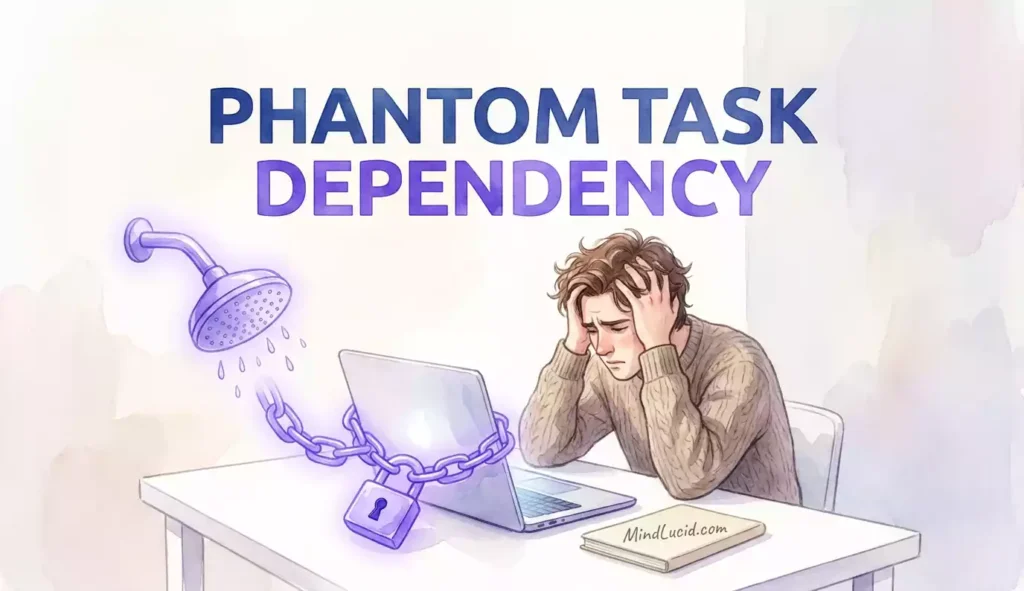
Have you ever found yourself staring at your desk, knowing exactly what needs to be done, yet feeling completely unable to start until you take a shower first? Or until you make that cup of coffee, organize your bookshelf, or scroll through just a few more minutes of social media? If this sounds painfully familiar, you may be experiencing something called phantom task dependency — a hidden pattern that quietly hijacks your productivity and leaves you feeling stuck, frustrated, and exhausted before you’ve even begun.
phantom task dependency is one of the most overlooked reasons why intelligent, capable people struggle to start their work. It doesn’t look like laziness from the outside — but from the inside, it feels like a mental block you can’t explain. Understanding this pattern is the first step toward breaking free from it.
What Is Phantom Task Dependency?
Phantom task dependency refers to a psychological pattern where your brain invents an invisible prerequisite — a “phantom task” — that must be completed before you can begin the work that actually matters. These phantom tasks feel urgent and necessary in the moment, but they are not truly essential. They are mental conditions your mind creates to avoid the discomfort of starting a demanding, uncertain, or emotionally challenging project.
The term captures something many people with ADHD experience daily: the sense that you need to do something else first before you can focus on the task at hand. You need to shower before you can work. You need to clean your desk before you can write. You need to check your email one more time before you can start that presentation. Each of these is a phantom task dependency in action.
These dependencies feel real. Your brain genuinely believes you cannot function until the phantom task is complete. But once the shower is done or the desk is clean, a new phantom task often appears to take its place. This is the trap: the dependency chain never ends, and the real work keeps getting pushed further into the future.
The Psychology Behind Phantom Task Dependency
At its core, phantom task dependency is an avoidance mechanism. Your brain perceives the real task as threatening — not physically dangerous, but psychologically uncomfortable. The task might trigger feelings of uncertainty, fear of failure, perfectionism, or overwhelm. To protect you from that discomfort, your brain redirects your attention toward smaller, more manageable tasks that give you a sense of control and accomplishment.
This pattern is closely tied to how the brain processes dopamine, the neurotransmitter associated with motivation and reward. Small tasks like showering, cleaning, or organizing provide quick, predictable dopamine hits. Larger tasks, especially those with delayed or uncertain rewards, don’t offer the same immediate payoff. For a brain that craves stimulation and certainty, the phantom task feels irresistible.
Perfectionism also plays a significant role in phantom task dependency. If you believe you need to be in the perfect mental or physical state to do your work, you will create endless conditions to meet before you can start. The shower becomes a ritual of readiness. The clean desk becomes a symbol of competence. These rituals feel productive, but they are actually sophisticated forms of procrastination.
Common Phantom Tasks People Create
Phantom tasks come in many forms, and they vary from person to person. Some of the most common examples include everything from personal hygiene rituals to digital housekeeping. The table below illustrates how these seemingly innocent prerequisites operate as phantom task dependency patterns.
| Phantom Task | What It Feels Like | What’s Really Happening |
|---|---|---|
| Taking a shower | “I can’t think clearly until I’m clean” | Avoiding the mental effort of starting |
| Making coffee or tea | “I need caffeine to focus” | Creating a transition ritual that delays work |
| Cleaning your workspace | “I can’t work in a messy environment” | Seeking control before facing uncertainty |
| Checking email or social media | “I need to be caught up first” | Chasing quick dopamine hits |
| Organizing files or apps | “I need everything in order” | Perfectionism masking as preparation |
| Researching instead of doing | “I need more information” | Fear of making mistakes |
The ADHD Connection to Phantom Task Dependency
Phantom task dependency is particularly common in people with ADHD, and it connects directly to the neurological differences that characterize the condition. ADHD affects executive function — the brain’s ability to plan, prioritize, initiate, and sustain goal-directed behavior. Task initiation, in particular, is a well-documented challenge for people with ADHD.
When you have ADHD, the gap between knowing what you need to do and actually starting to do it can feel like a chasm. This is not a matter of willpower or discipline; it’s a difference in how the brain manages motivation and effort. The brain’s reward system responds differently, and tasks that don’t provide immediate stimulation or reward often feel impossible to begin.
Phantom task dependency becomes a coping mechanism for this challenge. By creating a prerequisite task, you give your brain something achievable to do — something that provides a quick win and a sense of momentum. The problem is that these phantom tasks rarely lead to the actual work. Instead, they become a loop of preparation that never quite prepares you for the real thing.
For people with ADHD, the brain’s reward system doesn’t respond to long-term goals the same way it does to immediate, tangible accomplishments. This is why a shower — which provides instant sensory feedback and a visible result — feels more motivating than starting a project that won’t pay off for weeks or months.
Why Your Brain Creates Phantom Tasks
Understanding why your brain creates phantom task dependency patterns is essential to breaking the cycle. The underlying causes are deeply rooted in how we process discomfort, uncertainty, and emotional stress. Let’s explore each factor in detail.
The Discomfort of Uncertainty
When you don’t know exactly how a task will unfold, your brain experiences uncertainty as a mild threat. This is a survival mechanism — uncertainty in the wild often meant danger. Phantom tasks provide the illusion of control in the face of that uncertainty. By doing something predictable first, you feel safer, even if the safety is an illusion.
Fear of Failure
If you’re worried the work won’t be good enough, you’ll avoid starting. Phantom task dependency becomes a way to delay the moment of judgment. Each phantom task pushes the confrontation with potential failure further into the future. The irony is that this delay often makes failure more likely, not less.
Overwhelm Response
When a project feels too big, your brain responds by freezing. This is the fight-flight-freeze response applied to cognitive work. Phantom tasks are a way to feel productive without confronting the overwhelming whole. You’re not actually working on the project, but you feel like you’re making progress.
Sensory and Environmental Triggers
For people with ADHD, certain environments can feel physically uncomfortable. The need to adjust your surroundings becomes a phantom task that must be resolved before you can focus. The temperature, the lighting, the noise level, the feel of your clothes — all of these can become prerequisites for work that never quite gets started.
Dopamine Seeking
Your brain craves stimulation. Phantom tasks provide it. The real task doesn’t. This is why activities that offer quick rewards — like showering, snacking, or checking notifications — feel more compelling than diving into work that offers delayed gratification. The phantom task becomes a dopamine delivery system that your brain prioritizes over the actual work.
Break Free From Phantom Task Dependency
If you recognize yourself in these patterns — the endless prerequisites, the feeling of being stuck before you even start, the guilt that follows — you’re not alone. Understanding your brain is the first step toward real change. Take our comprehensive ADHD assessment to gain deeper clarity about your executive function patterns and discover personalized strategies that actually work for your unique brain.
Breaking the Cycle: Actionable Strategies
Understanding phantom task dependency is only half the battle. The real work lies in interrupting the pattern and replacing it with healthier approaches to task initiation. These strategies are designed to work with your brain, not against it.
The 5-Minute Rule
Commit to working on the real task for just five minutes. Tell yourself you can stop after five minutes if you want to. This bypasses the brain’s resistance to starting because five minutes feels manageable. Once you start, momentum often takes over and carries you past the initial barrier.
Task Chunking
Break the real task into the smallest possible pieces. Instead of “write the report,” tell yourself “open the document and type the title.” Each tiny step is its own phantom task — but a productive one that actually moves you toward your goal.
Body Doubling
Work alongside someone else, either in person or virtually. The presence of another person creates gentle accountability and reduces the anxiety that triggers phantom task creation. You don’t need them to help you — just to be there.
Environmental Setup
Prepare your environment in advance. If you know you’ll need a shower before work, shower the night before. If you need coffee, set up your coffee maker so it’s ready to go. Remove the phantom tasks before they can appear and derail your day.
Cognitive Reframing
Catch yourself when you say “I can’t work until…” and challenge it. Ask yourself: “Is this really true, or is my brain inventing a reason to delay?” Often, the answer is the latter. Naming the pattern weakens its power.
Task Stacking
Attach the real task to an existing habit. If you always make coffee in the morning, use that ritual as a launchpad — the moment you pour your coffee, you open your work document. The established habit becomes a trigger for productivity instead of a phantom task.
Q&A: Phantom Task Dependency Explained
Is phantom task dependency a recognized psychological condition?
Phantom task dependency is not a formal clinical diagnosis. Rather, it’s a descriptive term that captures a common pattern of behavior, particularly among people with ADHD, related to task initiation difficulties and executive dysfunction. It overlaps with concepts like procrastination, avoidance behavior, and task paralysis, but it specifically describes the phenomenon of creating false prerequisites before starting meaningful work.
How is phantom task dependency different from normal procrastination?
Normal procrastination is typically a conscious choice to delay a task. Phantom task dependency feels involuntary — your brain genuinely believes the prerequisite task is necessary before you can begin. The phantom task feels like a requirement, not an excuse. This distinction is crucial because it means traditional anti-procrastination advice often doesn’t work for people experiencing phantom task dependency.
Does everyone with ADHD experience phantom task dependency?
Not everyone with ADHD experiences phantom task dependency in the same way or to the same degree. However, the underlying mechanisms — difficulty with task initiation, dopamine dysregulation, and executive function challenges — make it significantly more common among people with ADHD. The pattern can also occur in people without ADHD, particularly those with anxiety or perfectionist tendencies.
Can phantom task dependency be overcome without medication?
Yes, many people find relief from phantom task dependency through behavioral strategies alone. The techniques described above — the 5-minute rule, task chunking, body doubling, and environmental setup — can be effective without any medication. That said, for people with ADHD, medication may help reduce the underlying executive function challenges that trigger phantom task dependency, making behavioral strategies more effective.
Conclusion: Reclaiming Your Ability to Start
Phantom task dependency is not a character flaw. It’s a pattern — one that can be understood, interrupted, and eventually replaced with healthier approaches to work and focus. By recognizing the phantom tasks you create, understanding why they appear, and applying practical strategies to break the cycle, you can reclaim your ability to start the work that matters.
The journey from stuck to started begins with awareness. Notice when you’re creating a prerequisite. Name it as a phantom task. Challenge its necessity. Then take one small, imperfect step toward the real task. That step — however small — is the beginning of breaking the cycle.
If you recognize yourself in this description, you’re not alone. Many people — especially those with ADHD — experience phantom task dependency regularly. The good news is that awareness is the first step toward change. And if you’re wondering whether ADHD might be the underlying cause of your task initiation struggles, taking a comprehensive assessment can provide clarity and direction for your next steps.
Frequently Asked Questions
Why do I feel like I can’t work until I shower?
This feeling is a classic example of phantom task dependency. Your brain has created a false prerequisite — the shower — as a condition for starting work. The shower provides a predictable, immediate sensory experience that your brain finds comforting compared to the uncertain mental effort of the actual task. Recognizing that this is a phantom task, not a real necessity, is the first step toward breaking the pattern.
How long does it take to break phantom task dependency?
Breaking phantom task dependency is a gradual process, not a single event. Some people notice improvement within days of implementing strategies like the 5-minute rule and task chunking. Others take weeks or months to build new neural pathways. Consistency matters more than speed — each time you catch yourself creating a phantom task and choose to start the real work instead, you’re rewiring your brain’s approach to task initiation.
What should I do if I create a new phantom task after completing one?
This is extremely common — the brain will often generate replacement phantom tasks when one is completed. When this happens, pause and acknowledge what’s happening. Say to yourself: “That’s a phantom task. I don’t actually need to do it right now.” Then use the 5-minute rule to start the real task immediately. The key is to catch the pattern in real-time and refuse to engage with the new prerequisite.
Is phantom task dependency related to anxiety?
Yes, there’s a significant overlap. Phantom task dependency often coexists with anxiety, particularly performance anxiety and perfectionism. The anxiety about the real task — whether it will be good enough, whether you’ll make mistakes, whether you’ll fail — drives the brain to seek comfort in phantom tasks. Addressing the underlying anxiety, through therapy, mindfulness, or other approaches, can reduce the intensity of phantom task dependency.
How do I know if I need professional help for phantom task dependency?
If phantom task dependency is significantly interfering with your work, relationships, or daily functioning — and self-help strategies haven’t provided relief — it may be time to seek professional support. A mental health professional who specializes in ADHD and executive function can help you understand the underlying causes of your task initiation difficulties and develop personalized strategies. Taking an ADHD assessment can also provide valuable insight into whether ADHD is contributing to your experience.