
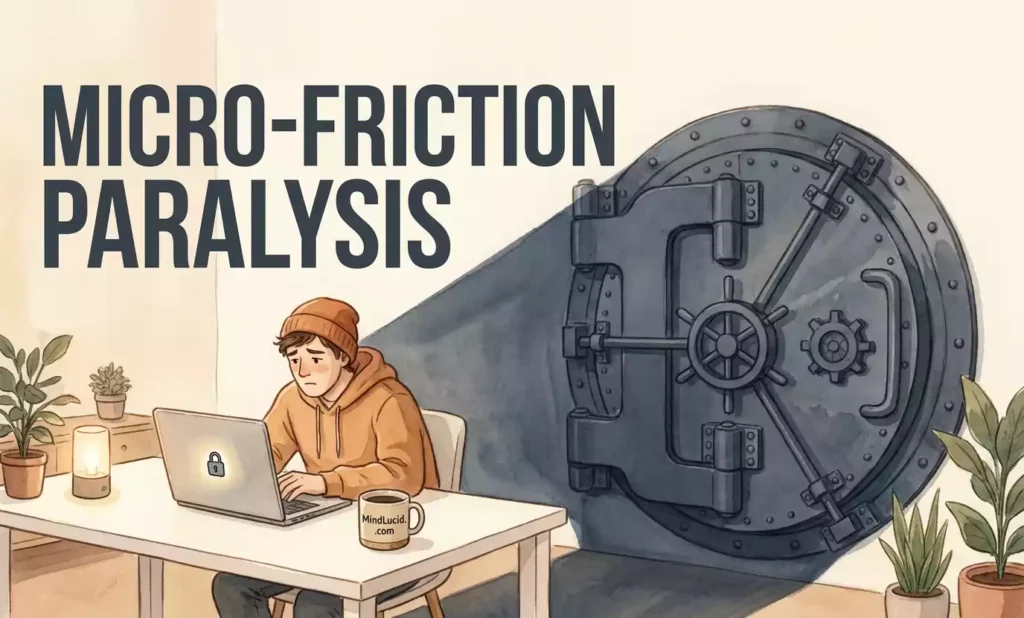
Have you ever stared at a login screen, realized you’ve forgotten your password, and felt a wave of exhaustion so complete that you simply closed the tab? Not out of laziness — but because the mental energy required to reset that password suddenly felt heavier than the entire task you were trying to accomplish. That moment has a name. It’s called micro-friction paralysis, and for many people with ADHD, it’s not just a minor annoyance. It’s the reason a five-minute task can sit untouched for three months.
If this sounds uncomfortably familiar — if you’ve ever had a task take up permanent residence on your to-do list because of one tiny obstacle — keep reading. You’re about to understand exactly why it happens, and what you can do about it. And at the end, there’s a way to find out if this pattern is part of a bigger picture for you.
What Is Micro-Friction Paralysis?
Micro-friction paralysis is the experience of getting completely stuck on a task because of a small, seemingly insignificant obstacle that stands between you and starting. It’s not about the task being difficult. It’s about the tiny hurdle — the forgotten password, the form that needs one more field, the file that needs renaming — that somehow becomes an insurmountable wall.
Think of it like this: you’re ready to go for a run. You’ve got your shoes on, you’re motivated, you’re at the door. But then you realize you can’t find your keys. The run is still the same run. The door is still the same door. But that missing key — that tiny piece of friction — can make the entire endeavor feel impossible.
For someone with ADHD, this isn’t drama. It’s neurology. The brain’s executive function system — responsible for task initiation, planning, and working memory — processes these small frictions differently. What looks like a speed bump to one person feels like a mountain range to another.
The Brain Behind the Block
To understand why micro-friction paralysis happens, it helps to look at what’s happening behind the scenes in an ADHD brain. The key players are executive function, working memory, and dopamine — the brain’s reward and motivation chemical.
Task initiation — the ability to actually start something — is one of the executive functions most commonly challenged in ADHD. When you face a task that requires multiple steps (even small ones), the brain has to hold those steps in working memory, plan the sequence, and then execute. Each additional step — even something as tiny as “reset password” — adds cognitive load. For an ADHD brain that already struggles with working memory and sequencing, that extra step can be the difference between starting and stalling.
Dopamine plays a role too. ADHD brains often have lower baseline dopamine activity, which means tasks that don’t offer immediate reward or novelty require significantly more effort to initiate. A forgotten password isn’t interesting. It’s not novel. It’s not rewarding. It’s pure friction — and a brain that runs on dopamine scarcity will avoid it at all costs.
What makes this especially frustrating is that the person experiencing micro-friction paralysis is often fully aware of how small the obstacle is. They know it would take three minutes to reset a password. They know the task is important. But knowing doesn’t translate into doing, because the block isn’t about knowledge — it’s about the brain’s ability to bridge the gap between intention and action.
The Emotional Layer
Micro-friction paralysis doesn’t happen in a vacuum. Every time you notice the obstacle and don’t overcome it, there’s an emotional response — frustration, shame, self-criticism. Over time, these emotions compound. The task becomes associated not just with the friction itself, but with the negative feelings of avoidance. By the time you confront it again, the emotional weight is ten times heavier than the actual task.
This is why a forgotten password can stop a task for three months. Not because resetting a password takes three months — but because the emotional and cognitive cost of confronting it grows every single day it’s avoided.
Micro-Frictions Hiding in Plain Sight
Micro-frictions are everywhere, and they’re often so small that you don’t even notice them consciously. You just notice that you’re not doing the task. Here are some of the most common culprits — and what they actually feel like when you have ADHD.
| 💜 Micro-Friction | What It Feels Like |
|---|---|
| Forgotten password or login | “I need to reset it, which means checking my email, which means opening a new tab, which means…” — the cascade of steps feels endless. |
| Form with too many required fields | Each field is a decision. Name. Address. Phone. Why do they need my phone? Now I’m questioning everything. |
| File needs renaming or moving | Finding the file, right-clicking, choosing a name — the cognitive effort feels disproportionate to the task. |
| App needs an update | Waiting for the update, restarting, re-logging in — the interruption breaks the flow and the momentum is gone. |
| Email requires a response | Composing a reply means deciding what to say, how to say it, and whether to CC anyone — each decision adds friction. |
| Task requires switching tools | Moving from one app to another, copying information, pasting it — the context switch feels like starting over. |
| Need to look up information | Opening a browser, searching, scanning results, evaluating sources — the research phase becomes the whole task. |
| Printer needs paper or ink | Finding supplies, loading them, troubleshooting — the peripheral task becomes the main event. |
Notice a pattern? None of these obstacles is difficult on its own. But each one requires a context switch — a shift in attention and cognitive mode. And for an ADHD brain, context switching is one of the most expensive operations there is.
Why Small Obstacles Feel Monumental
The gap between “this is a tiny problem” and “I literally cannot do this right now” is where micro-friction paralysis lives. Several factors widen this gap for people with ADHD.
Working memory load. Every additional step in a task has to be held in working memory. ADHD working memory is often limited, so when too many steps pile up, the system overloads. The forgotten password isn’t just “reset password” — it’s “remember which email I used, check that email, click the reset link, create a new password, remember the new password, log in again, and then remember what I was originally doing.” That’s seven steps, not one.
Task-switching costs. Research on attention consistently shows that switching between tasks has a cognitive cost. For ADHD brains, that cost is amplified. A micro-friction forces a switch — from “the task I want to do” to “the obstacle I have to deal with first.” That switch can drain the motivation that was there moments before.
Emotional regulation. Frustration tolerance is often lower in ADHD. When a small obstacle appears, the immediate emotional response can be disproportionately strong — irritation, overwhelm, or a sense of “I can’t deal with this right now.” That emotional surge effectively shuts down the task before it starts.
The all-or-nothing mindset. Many people with ADHD experience tasks as either “completely done” or “not started.” A micro-friction makes the task feel incomplete, which can trigger the all-or-nothing pattern: if I can’t do it perfectly right now, I won’t do it at all.
💜 Does This Pattern Sound Like You?
Micro-friction paralysis is one of many patterns that people with ADHD experience daily. If you’ve been nodding along while reading this — recognizing yourself in the forgotten passwords and the three-month-old tasks — it might be worth taking a closer look at your own cognitive patterns. Our comprehensive ADHD assessment is designed to help you understand how your brain works, identify patterns you might not have noticed, and give you clarity about what’s really going on.
The 3-Month Spiral: How It Happens
No one plans to abandon a task for three months. It happens gradually, through a series of small decisions and avoidances that compound over time. Here’s what the spiral typically looks like.
Day 1: The Encounter
You sit down to do the task. You hit the micro-friction. You think, “I’ll deal with this later.”
Week 1: The Avoidance
The task lingers in your mind. Every time you think about it, you feel a flash of frustration and push it away.
Month 1: The Guilt
The task is now associated with shame. You’ve told yourself you’ll do it “soon” so many times that the word has lost meaning.
Month 3: The Wall
The task has become emotionally radioactive. The original friction was tiny, but the accumulated avoidance has made it feel impossible.
Here’s the cruel irony: the longer a task sits in this spiral, the harder it becomes to start — not because the task changed, but because the emotional context around it changed. The forgotten password at day one is a minor annoyance. At month three, it’s a monument to your own perceived failure.
Breaking this spiral doesn’t require more willpower. It requires a different approach — one that works with your brain instead of against it.
How to Break Free from Micro-Friction Paralysis
The goal isn’t to eliminate micro-frictions — that’s impossible in a world with passwords, forms, and app updates. The goal is to change how you respond to them. Here are practical strategies that actually work for ADHD brains.
Pre-Empty the Friction
Use a password manager. Set up autofill. Keep frequently used files in one place. The less friction there is upfront, the less likely you are to get stuck.
The Two-Minute Rule
If the friction itself takes less than two minutes to resolve, do it immediately. Don’t let it join the pile. Reset the password, update the app, rename the file — right then.
Write the Steps Down
Externalize your working memory. Instead of holding “reset password” as a vague cloud of steps, write them: 1) Open email, 2) Click reset link, 3) Create new password, 4) Log in. Seeing it on paper makes it feel manageable.
Reframe the First Step
Don’t tell yourself you’re doing the whole task. Tell yourself you’re only doing the friction. “I’m not writing the report. I’m just resetting the password.” Shrinking the frame lowers the activation energy.
Body Doubling
Have someone sit with you — in person or virtually — while you tackle the friction. The presence of another person creates accountability and reduces the sense of isolation that makes frictions feel bigger.
Celebrate the Micro-Win
When you do overcome a micro-friction, acknowledge it. Genuinely. The dopamine hit from recognizing your own success — no matter how small — helps build the neural pathways for future task initiation.
Remember: micro-friction paralysis isn’t a character flaw. It’s a pattern rooted in how the ADHD brain processes information and initiates action. The strategies above work because they reduce the cognitive load of the friction, making it easier for the brain to bridge the gap between intention and action.
Common Questions About Micro-Friction Paralysis
❓ Is micro-friction paralysis the same as procrastination?
Not exactly. Procrastination often involves choosing to delay a task you don’t want to do. Micro-friction paralysis is different — you want to do the task, you’re ready to do it, but the small obstacle creates a cognitive block that feels beyond your control. It’s not about motivation; it’s about execution.
❓ Why does it only happen sometimes?
The ADHD brain’s capacity for executive function fluctuates based on many factors: sleep, stress, time of day, medication timing, emotional state, and even what you ate. On high-capacity days, a micro-friction might not phase you. On low-capacity days, the same friction can feel insurmountable. This inconsistency is part of the ADHD experience and can make the pattern especially confusing.
❓ Can micro-friction paralysis affect big tasks too?
Absolutely. In fact, big tasks are often made up of multiple small frictions. A project at work might require logging into three different systems, filling out a form, and coordinating with a colleague. Each of those is a potential friction point. The bigger the task, the more frictions it contains, and the more opportunities there are for paralysis to set in.
❓ Is there a connection between micro-friction paralysis and ADHD?
The pattern is particularly common among people with ADHD due to differences in executive function, working memory, and dopamine regulation. However, it can affect anyone under stress or fatigue. If you experience it frequently and it significantly impacts your daily life, it may be worth exploring whether ADHD or related cognitive patterns are contributing.
❓ What’s the single most effective strategy?
The most universally helpful approach is reducing the friction before you need to overcome it. Password managers, autofill settings, organized file systems, and pre-filled templates eliminate the obstacle before it appears. Prevention is far more effective than intervention when it comes to micro-friction paralysis.
💜 The takeaway: Micro-friction paralysis is real, it’s frustrating, and it’s not your fault. It’s a pattern rooted in how your brain processes small obstacles — and understanding that pattern is the first step toward breaking it.
If you recognized yourself in this article — the forgotten passwords, the avoided tasks, the guilt that builds when a five-minute job stretches into three months — it might be time to explore whether ADHD is part of your story. Our comprehensive assessment at MindLucid is designed to help you understand your cognitive patterns in depth, with results that give you clarity and direction.
You don’t have to keep fighting your brain. You just need to understand it.
Keywords: micro-friction paralysis, ADHD task paralysis, ADHD executive function, task initiation, ADHD procrastination