
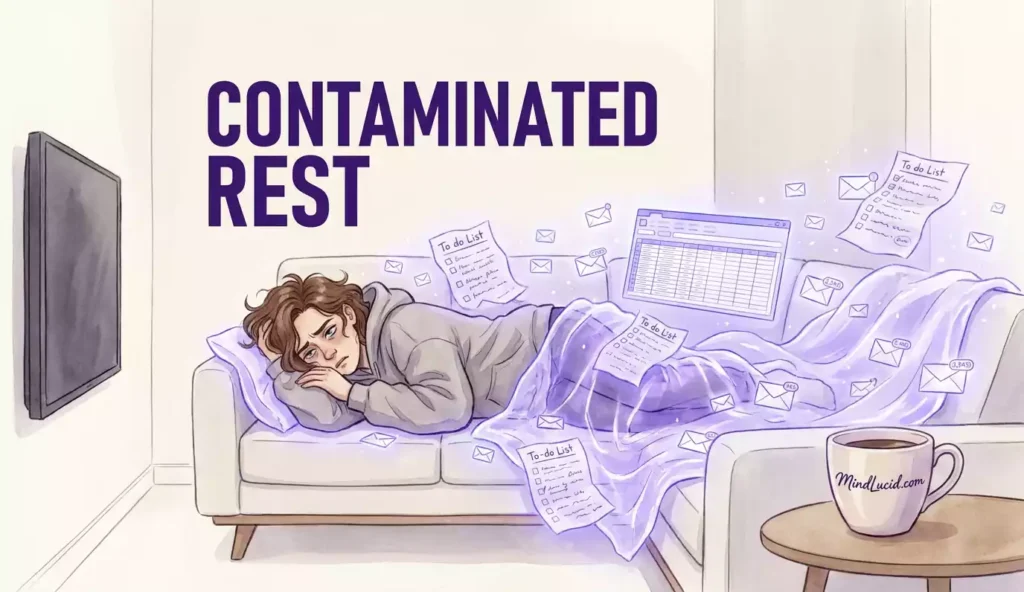
You finally have a free afternoon. No deadlines. No obligations. Just you, your time, and the promise of rest. But instead of feeling relaxed, your brain feels like it’s running a marathon in place. You scroll endlessly. You replay conversations. You mentally reorganize your to-do list. You feel guilty for not being productive. And somehow, after hours of “doing nothing,” you feel more exhausted than when you started. If this sounds painfully familiar, you might be experiencing contaminated rest — a phenomenon where your free time feels anything but restorative.
What Is Contaminated Rest?
Contaminated rest is the experience of having free time that fails to provide actual restoration. It’s rest that is polluted — contaminated — by intrusive thoughts, guilt, anxiety, and the constant mental pressure to be doing something else. For many people with ADHD, rest isn’t a peaceful interlude; it’s a battlefield where the mind wages war against itself.
Imagine pouring yourself a glass of clean water, but someone dropped a drop of ink into it. The water is still water, but it’s no longer drinkable. Contaminated rest works the same way. You might be physically sitting still. You might have scheduled time off. But your mind is swirling with should-haves, to-do lists, and self-criticism. The rest is there — it’s just been poisoned by cognitive noise.
This experience is incredibly common among people with ADHD. The ADHD brain is wired for stimulation, novelty, and forward momentum. When that momentum stops, the brain doesn’t automatically switch to “rest mode.” Instead, it keeps spinning, searching for the next thing to focus on, the next problem to solve, or the next source of stimulation. The result is a paradoxical state where relaxation feels impossible, and free time becomes its own source of stress.
Why the ADHD Brain Struggles to Rest
Understanding contaminated rest requires understanding how the ADHD brain processes downtime. While every brain needs rest, the ADHD brain often experiences rest differently. Here’s why:
The Stimulation Paradox
The ADHD brain craves stimulation. It seeks out novelty, engagement, and mental activity. When you finally stop doing things, your brain doesn’t automatically downshift. Instead, it goes into overdrive searching for the next source of stimulation. This is why sitting in silence can feel unbearable, and why “relaxing” often turns into hours of scrolling, binge-watching, or mentally rehearsing future conversations.
Time Blindness and the Guilt Loop
Many people with ADHD experience time blindness — difficulty perceiving and managing time accurately. When you do take a break, your brain might immediately start calculating how much time you’re “wasting.” Every minute of rest feels like a minute you should be using for something productive. This creates a guilt loop where you can’t enjoy the rest because you’re too busy feeling bad about it.
The Unfinished Task Effect
ADHD often comes with a pile of partially finished projects, unread emails, and half-committed plans. When you try to rest, your brain pulls up this mental inventory and reminds you of everything you haven’t done. The rest period becomes a review session for all your perceived failures and incomplete work.
Difficulty with Task Switching
Transitioning from “work mode” to “rest mode” is a form of task switching — something that’s naturally challenging for ADHD brains. Your mind might stay stuck in work mode long after you’ve stopped working. You might find yourself mentally drafting emails while trying to watch a movie, or planning tomorrow’s schedule while lying in bed.
Signs You’re Experiencing Contaminated Rest
Contaminated rest doesn’t always look the same. It can take many forms, and you might recognize yourself in several of these descriptions. Here’s a detailed look at the common signs:
| Sign | What It Feels Like | Why It Happens |
|---|---|---|
| Mental Rehearsal | You replay conversations, plan future ones, or mentally rehearse scenarios instead of relaxing. | The ADHD brain seeks mental engagement even during downtime. |
| Productivity Guilt | You feel a constant, nagging sense that you “should” be doing something useful. | Societal pressure to be productive collides with ADHD’s natural energy patterns. |
| Doom Scrolling | Hours pass on social media or news feeds without feeling rested or satisfied. | Passive scrolling provides low-effort stimulation without true restoration. |
| Physical Restlessness | You feel fidgety, twitchy, or unable to sit still even when exhausted. | The ADHD brain’s need for movement and stimulation doesn’t switch off. |
| Decision Fatigue | Even choosing a movie or a meal during free time feels overwhelming. | ADHD already taxes executive function, leaving little energy for even small choices. |
| Post-Rest Exhaustion | You feel more tired after “resting” than before you started. | The mental effort of trying to relax is itself exhausting. |
| Racing Thoughts | Your mind won’t stop generating ideas, worries, and plans. | Default mode network activity in ADHD brains can be particularly active. |
Is Contaminated Rest Stealing Your Energy?
If you recognize yourself in these descriptions, you’re not alone — and you’re not broken. Contaminated rest is a real experience that affects many people with ADHD, and understanding it is the first step toward reclaiming your free time. Our comprehensive ADHD assessment is designed to help you understand your unique cognitive patterns, including how you experience rest, focus, and daily life. It takes just a few minutes and provides valuable insights you can use immediately.
The Vicious Cycle of Guilt and Exhaustion
One of the most damaging aspects of contaminated rest is the feedback loop it creates. It goes something like this: You’re exhausted, so you decide to take a break. During the break, you feel guilty for not being productive. The guilt makes you anxious. The anxiety makes it impossible to actually relax. So you end the break more tired than before. Then, because you’re even more exhausted, you need even more rest. But now you’re even more anxious about resting because last time it didn’t work. The cycle repeats, each rotation deepening the exhaustion and the guilt.
This cycle can have real consequences for daily life. It can affect your sleep quality, your mood, your relationships, and your ability to focus during work or study. The constant sense of being “on edge” — even during downtime — means your nervous system never truly gets to reset. Over time, this builds up into chronic fatigue, irritability, and a deepening sense of burnout.
Many people with ADHD describe this experience as feeling like their brain has a motor that never turns off. Even when they’re sitting on the couch, the engine is still revving. The body is at rest, but the mind is racing. This is the essence of contaminated rest — the physical state of rest without the mental experience of it.
The Difference Between Clean and Contaminated Rest
Clean rest is what rest is supposed to feel like. You sit down, your mind settles, and you feel genuinely replenished afterward. Your thoughts slow down. Your body relaxes. You lose track of time in a pleasant way. When you get up, you feel ready to engage with the world again.
Contaminated rest is the opposite. You sit down, but your mind keeps spinning. You feel restless and guilty. You’re physically still but mentally exhausted. Time either drags or disappears in unfulfilling ways. When you get up, you feel more drained than before.
The key difference isn’t what you’re doing — it’s how your mind is experiencing it. The same activity (watching TV, for example) could be clean rest for one person and contaminated rest for another, depending on what’s happening in their mind during the activity.
Common Triggers That Contaminate Your Rest
Understanding what contaminates your rest is crucial for addressing it. Here are the most common triggers that turn free time into mental turmoil:
1. Passive Screen Time
Scrolling through social media, watching endless short videos, or flipping through channels without engagement isn’t rest — it’s distraction. The ADHD brain receives just enough stimulation to stay occupied, but not enough to feel fulfilled. You’re not relaxing; you’re numbing. After hours of this, you feel hollow and unrefreshed.
2. Unfinished Business
That project you started last month. That email you’ve been avoiding. That phone call you need to make. When these unfinished tasks pile up, they become mental clutter that contaminates every free moment. Your brain treats rest time as a reminder service for all the things you haven’t done.
3. Social Expectations
Feeling like you need to be “on” even during downtime. Responding to messages immediately. Checking work emails. Maintaining a social media presence. These expectations — often self-imposed — prevent your brain from ever truly disconnecting.
4. Rumination
Replaying past events, analyzing mistakes, worrying about the future — rumination is a major contaminant. The ADHD brain can get stuck in repetitive thought loops, especially when there’s no external stimulus to break the cycle.
5. Perfectionism About Rest
This is a subtle but powerful trigger. You decide to rest, but then you feel pressure to rest “correctly.” You should be meditating. You should be reading. You should be doing something relaxing and productive at the same time. This pressure to optimize rest actually prevents you from resting at all.
Frequently Asked Questions About Contaminated Rest
Pathways to Cleaner Rest
Breaking free from contaminated rest isn’t about trying harder to relax — that only adds more pressure. It’s about understanding your brain and working with it, not against it. Here are some approaches that many people with ADHD find helpful:
Redefine What Rest Means for You
Rest doesn’t have to mean lying still or doing nothing. For an ADHD brain, true rest might look like going for a walk while listening to music, doing a hands-on hobby, or engaging in gentle physical activity. Movement can actually be more restful for an ADHD brain than sitting still, because it provides the stimulation your brain craves while allowing your mind to decompress.
Use Time Boundaries
Instead of trying to rest indefinitely, give yourself a specific time frame. “I will rest for 30 minutes, and I don’t need to think about anything else during that time.” This reduces the anxiety of “wasting time” because the boundary makes the rest feel contained and legitimate.
Remove the Scroll Trap
Passive scrolling is one of the biggest contaminants of rest. Try replacing it with something that engages your brain in a satisfying way — reading something you enjoy, playing a game that requires focus, working on a puzzle, or listening to a podcast while doing something with your hands.
Do a Brain Dump First
Before you try to rest, take five minutes to write down everything that’s on your mind — tasks, worries, ideas, reminders. Getting these thoughts out of your head and onto paper can significantly reduce the mental noise that contaminates your rest time.
Practice Micro-Rest
Instead of waiting for large blocks of free time that never feel restful, try incorporating small moments of rest throughout your day. A two-minute breathing pause, a five-minute stretch, a brief walk outside. These micro-rests can add up and often feel less “contaminated” than long, pressured rest periods.
Be Kind to Yourself
This is perhaps the most important step. Contaminated rest feeds on self-criticism. The more you berate yourself for not resting “properly,” the harder genuine rest becomes. Try approaching your rest with curiosity instead of judgment. Notice what’s happening without blaming yourself for it.
Moving Forward: From Contaminated to Cleaner Rest
Contaminated rest is not a character flaw. It’s not laziness, and it’s not a sign that you’re doing something wrong. It’s a very real experience that arises from the way your brain processes downtime — and it’s especially common for people with ADHD. The good news is that awareness is the first and most powerful step toward change.
When you start to recognize the signs of contaminated rest — the guilt, the racing thoughts, the restless scrolling — you can begin to interrupt the pattern. You can choose different activities, set different boundaries, and most importantly, treat yourself with more compassion. Your brain works differently, and that means your rest will look different too. That’s not a problem to solve; it’s a reality to understand and work with.
If you’ve been struggling with rest that never feels restful, know that there’s a path forward. Understanding your unique cognitive patterns is the first step. Our comprehensive ADHD assessment is designed to help you gain clarity about how your mind works — including how you experience downtime, focus, and energy. It’s free, it takes just a few minutes, and it can provide the insights you need to start reclaiming your rest.
Ready to Understand Your Mind Better?
Contaminated rest is just one piece of the ADHD puzzle. Get a clearer picture of your cognitive patterns, strengths, and challenges with our free, comprehensive ADHD assessment. No sign-up required. Just valuable insights in minutes.