
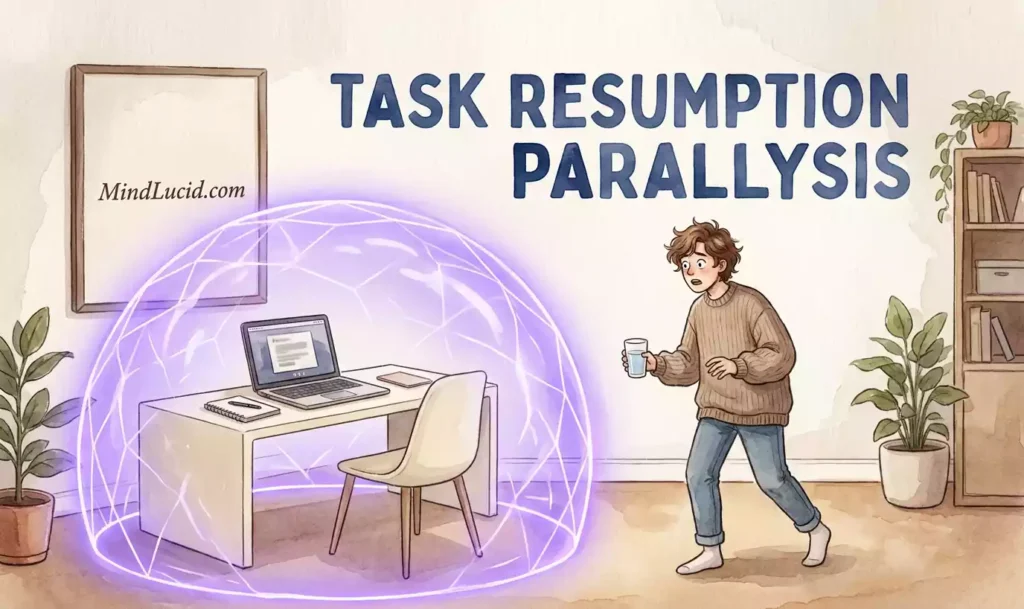
You told yourself it would be five minutes. Just a quick check of your phone, a stretch, a glass of water, a glance at your messages. But now it’s 3:47 PM, the document is still open on your screen exactly where you left it three hours ago, and your chest tightens with a familiar, sinking mixture of guilt, frustration, and disbelief. You haven’t been doing anything “important.” You’ve just been… stuck. This is task resumption paralysis — the invisible wall between you and the work you genuinely want to finish.
What Is Task Resumption Paralysis?
Task resumption paralysis refers to the intense psychological difficulty of returning to a task after an interruption or break — even a deliberate, well-intentioned one. Unlike simple procrastination, which often involves avoiding a task because it’s unpleasant or overwhelming, task resumption paralysis strikes even when you want to return to the work. You might sit in front of your screen, hands hovering over the keyboard, fully aware of what needs to be done, yet completely unable to initiate the mental state required to re-enter the task.
For individuals with ADHD, this experience is not occasional frustration — it’s a frequent, exhausting cognitive pattern. The “5-minute break” becomes a black hole not because of laziness or lack of discipline, but because the brain’s executive functions — the systems responsible for task initiation, context reconstruction, and attention reallocation — face an unusually heavy load when called upon to restore a previous cognitive state.
⚡ The Core Paradox
The more mentally engaged you were before the break, the harder it becomes to resume afterward. Deep focus creates rich mental context — and rebuilding that context from scratch is exactly where task resumption paralysis takes hold. Your brain isn’t refusing to work; it’s overwhelmed by the complexity of reconstructing the exact mental model you had just ten minutes ago.
The Neuroscience Behind the 5-Minute Trap
To understand why a short break can completely derail your workday, you need to look at what happens inside the ADHD brain the moment you step away from a task. Several interconnected cognitive mechanisms contribute to task resumption paralysis:
🧠 Attention Residue: The Ghost of Your Break
Every time you switch your attention from one thing to another — even briefly — a portion of your cognitive resources remains stuck on the previous activity. Psychologists call this attention residue, and it’s one of the primary drivers of task resumption paralysis. When you check your phone during a “quick break,” you’re not just glancing at a notification; you’re opening a mental tab that remains active even after you put the phone down. When you try to return to work, your brain is simultaneously processing both the work task and the lingering activation from whatever you were just doing.
🔄 Task-Switching Costs: The Hidden Tax
Multitasking research consistently shows that every switch between tasks carries a measurable cognitive cost — typically between 20-40% of your productive capacity for several minutes after the switch. For an ADHD brain, these costs are amplified because the neural pathways responsible for shifting sets — moving from one mental framework to another — operate less efficiently. Task resumption paralysis is essentially the extreme end of this spectrum: the switching cost becomes so high that the brain simply refuses to pay it.
🎯 Dopamine Dynamics: The Lure of the Novel
Breaks almost always involve low-effort, high-reward activities: scrolling social media, watching short videos, checking messages, browsing. Each of these delivers a rapid micro-dose of dopamine — the neurotransmitter that signals reward and motivation. For an ADHD brain, which typically has lower baseline dopamine availability, these activities are disproportionately attractive. Returning to a cognitively demanding task means trading a rich dopamine source for a much slower, more effortful reward. Your brain, operating on its default settings, will resist that trade every single time — and that resistance feels like paralysis.
📊 Working Memory Overload
To resume a complex task, your working memory needs to reload all the relevant information: where you were, what you were about to do next, which sub-tasks remain, what constraints apply, what your last thought was. This is a heavy computational lift even under optimal conditions. For individuals with ADHD, who often have reduced working memory capacity, this reconstruction process is disproportionately exhausting. The brain anticipates this exhaustion and prevents task re-entry as a form of cognitive self-protection — but the result feels like being frozen in place.
Common Signs You’re Stuck in Task Resumption Paralysis
Recognizing the pattern is the first step toward breaking it. Task resumption paralysis manifests in distinct ways that are different from simple distraction or fatigue. Here are the most common indicators:
Why a 5-Minute Break Becomes a 5-Hour Detour
It seems mathematically absurd: a 300-second pause should not transform into a 18,000-second disappearance. Yet this is exactly what happens with task resumption paralysis, and the reasons are rooted in how ADHD brains process transitions:
1. Context Collapse
During deep work, your brain constructs a rich, multidimensional mental model of the task: goals, sub-goals, constraints, recent progress, next steps, emotional associations, and sensory anchors. A break — especially one involving a completely different type of stimulation — causes this model to dissolve rapidly. Within minutes, the neural connections that held the model together weaken, and you’re left with only fragments. Reconstructing a collapsed context is one of the most cognitively expensive operations your brain can perform, and it’s the core of task resumption paralysis.
2. The Initiation Barrier
Task initiation — the act of starting something — requires a surge of executive function energy. For ADHD brains, this is already a scarce resource. After a break, the initiation barrier is doubled because you’re not just starting a task; you’re re-starting it, which requires both the energy to begin and the energy to reconstruct the context you’ve lost. The combined cost feels insurmountable.
3. Emotional Contamination
As the minutes of non-work accumulate, shame and guilt begin to compound. You become hyper-aware of the time slipping away, which generates anxiety, which makes the task feel even more threatening, which further paralyzes your ability to engage with it. This emotional feedback loop is a hallmark of task resumption paralysis and explains why the longer you’re stuck, the harder it becomes to get unstuck.
| Dimension | Typical Break Experience | ADHD Break Experience |
|---|---|---|
| Duration of break | Stays close to planned duration | Expands dramatically (5 min → 2-4 hrs) |
| Context retention | Task details remain accessible | Context largely lost within minutes |
| Resumption effort | Low to moderate | Extremely high — feels like starting from scratch |
| Emotional state on return | Neutral or slightly annoyed | Anxious, guilty, overwhelmed |
| Need for external cues | Minimal — can self-direct | High — needs visual/auditory anchors |
| Frequency of occurrence | Occasional | Daily or multiple times per day |
| Recovery time | Immediate to 5 minutes | 15 minutes to several hours — or never |
Is Task Resumption Paralysis Your Daily Reality?
If you’ve read this far and found yourself nodding at every single sign, every mechanism, and every experience described — you’re not broken, and you’re not lazy. Task resumption paralysis is a real, identifiable cognitive pattern that disproportionately affects individuals with ADHD. Understanding why your brain does this is the first step toward working with it instead of against it. Our comprehensive ADHD assessment can help you identify whether your experience fits the broader ADHD profile, giving you the clarity and direction you need to build strategies that actually work for your unique brain.
Practical Strategies to Break Through Task Resumption Paralysis
Understanding the neuroscience is empowering, but what you really need are actionable techniques that work with your ADHD brain, not against it. Here are eight strategies specifically designed to address task resumption paralysis:
How to Know If It’s ADHD — And Why It Matters
Everyone experiences difficulty resuming tasks occasionally. But when task resumption paralysis becomes a daily, recurring pattern that significantly impacts your ability to complete work, meet deadlines, and maintain your sense of competence — it may be a symptom of undiagnosed ADHD. This matters because the strategies that work for neurotypical brains (try harder, just focus, eliminate distractions) often make things worse for ADHD brains by adding pressure without addressing the underlying neurological differences.
ADHD is not a character flaw or a discipline problem — it’s a neurodevelopmental difference that affects executive function, working memory, attention regulation, and motivation systems. When you understand that your brain operates differently, you can stop fighting yourself and start building systems that work with your natural cognitive patterns. A comprehensive ADHD assessment can help you understand whether your experience with task resumption paralysis fits the broader ADHD profile, giving you the self-knowledge you need to move forward effectively.
Frequently Asked Questions
Moving Forward: From Paralysis to Momentum
Task resumption paralysis is not a personal failing. It’s not evidence that you lack discipline, willpower, or commitment. It’s a real cognitive phenomenon rooted in how your brain manages attention, context, and executive function — and for those with ADHD, it’s amplified by genuine neurological differences that make task-switching and context reconstruction far more demanding.
The strategies outlined in this article — leaving threads, using visual anchors, choosing boring breaks, chunking tasks, priming your environment — are not quick fixes or magic solutions. They are structural interventions that work by reducing the cognitive load your brain has to carry when transitioning back to work. They work with your brain’s natural tendencies rather than fighting against them.
But the most important step is understanding your own brain. If you recognize yourself in the patterns described here — if task resumption paralysis is a recurring, daily reality that undermines your productivity, your confidence, and your sense of control — then it’s time to get a clearer picture of what’s actually happening. A comprehensive ADHD assessment can help you understand whether your experience fits the ADHD profile, providing the clarity and direction you need to build effective systems and seek appropriate support.
You don’t have to keep losing entire workdays to “5-minute” breaks. You don’t have to keep fighting a battle against your own brain. Understanding is the first step toward change — and that understanding starts with knowing what you’re actually working with.
💜 Your brain isn’t broken. It’s just wired differently — and once you understand the wiring, everything changes.