
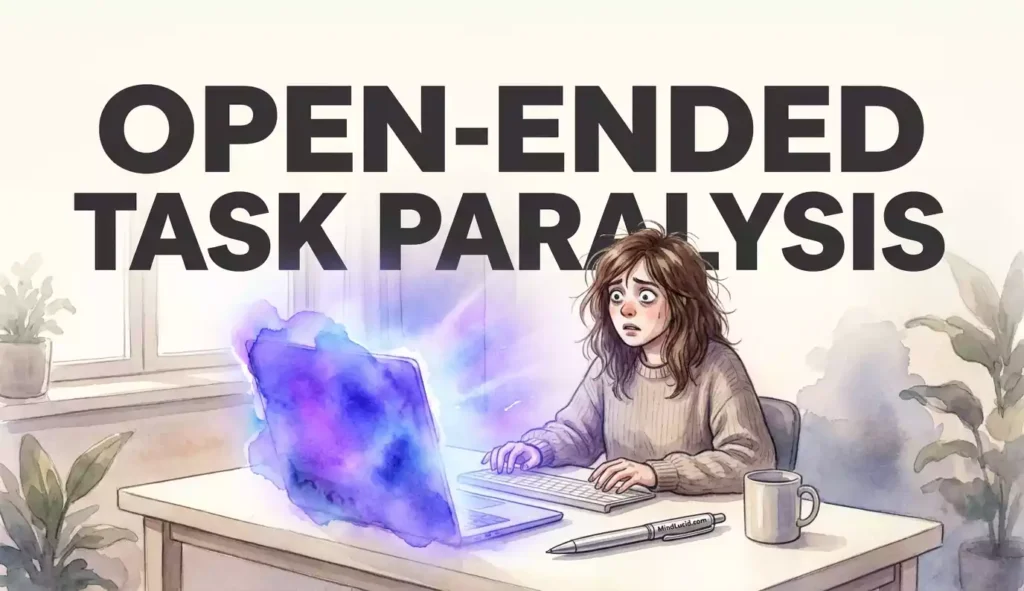
You have a project. You have the skills. You have the time. But the assignment says something along the lines of “use your best judgment” or “create something engaging.” Suddenly, your brain doesn’t just slow down—it freezes entirely. If this sounds painfully familiar, you are not dealing with laziness. You are likely experiencing open-ended task paralysis.
This very specific cognitive roadblock is one of the most frustrating, yet invisible, symptoms of ADHD. It is the reason why you can hyper-focus on solving a complex math problem but cannot bring yourself to start a simple “creative writing” prompt. It is why a blank canvas feels like a threat, but a template feels like a lifesaver.
🧠 What Exactly Is Open-Ended Task Paralysis?
Open-ended task paralysis is a specific type of procrastination or “stuckness” that occurs when a task lacks clear boundaries, specific instructions, or a defined finish line. In the context of ADHD, this is not a preference issue—it is a neurological one.
When you have ADHD, your brain’s executive functions—the management system responsible for planning, prioritizing, and initiating tasks—work differently. The ADHD brain is often driven by interest, novelty, urgency, or competition. When you are handed a task that is a blank slate, the brain perceives it as an overwhelming, infinite possibility set. There are too many choices, too many directions, and no immediate dopamine reward for starting.
Instead of picking a starting point, the brain short-circuits. You might find yourself staring at a cursor, rearranging your desk, or opening social media—not because you want to avoid the work, but because your brain is desperately looking for a clear, immediate stimulus to grab onto.
💡 The “Paradox of Choice” in ADHD
While most people can filter out irrelevant options, the ADHD brain often treats every option as equally important. Ten ideas feel like ten emergencies. This creates a gridlock. The freedom to “do anything” becomes a prison of “doing nothing.”
⚠️ Why “Just Do Whatever You Think Is Best” Is a Trigger Phrase
For a neurotypical brain, the phrase “do whatever you think is best” signals trust and autonomy. For an ADHD brain, it often signals abandonment in a sea of undefined variables. This phrase strips away the external structure that the ADHD brain relies on to regulate focus.
Here is what happens internally when you hear that phrase:
- Activation Gap: You need to generate your own starting energy without a clear prompt. The ADHD brain has a lower baseline of dopamine, making self-initiation difficult without external scaffolding.
- Evaluation Overload: You immediately start evaluating every possible route. “Should I write a report? A presentation? A video? What font should I use? What is the vibe?” The working memory gets flooded.
- Fear of the “Wrong” Choice: ADHD often comes with Rejection Sensitive Dysphoria (RSD). The fear of doing a “bad job” on an ambiguous task is amplified because you don’t know what “good” looks like. You freeze to avoid failure.
🔍 The Visual Difference
When a task has clear parameters, your brain sees a bridge. When a task is open-ended, your brain sees a chasm. The steps to cross the chasm are invisible, so your legs refuse to move.
📊 Clear vs. Open-Ended: The ADHD Experience
To understand why open-ended task paralysis happens, it helps to see the contrast between a structured task and an open one. The table below illustrates how the brain reacts to the level of definition provided.
| Task Element | Clear / Structured Task | Open-Ended Task |
|---|---|---|
| Starting Point | Obvious (Step 1 is given) | Invisible (You must create Step 1) |
| Required Decision Making | Low to Moderate | High to Infinite |
| Dopamine Response | Rewarding (Checkboxes, progress) | Aversive (Unknown reward) |
| Mental Friction | Low (The path is paved) | Severe (The path is a jungle) |
| Typical Outcome | Completion | Paralysis or Shutdown |
This is why you might excel at assembling furniture with a manual but fail to start a “creative journaling” exercise. The manual provides the dopamine hits of sequential progress. The journal provides only a blank page and a rising sense of dread.
🚨 Common Symptoms of Open-Ended Task Paralysis
Open-ended task paralysis doesn’t always look like sitting still and staring at a wall. It often looks like productive avoidance. Here are the hallmark signs that you are stuck in this specific loop:
Cursor Staring
You open a document and cannot type the first word. You type a line, delete it, and repeat for an hour.
Over-Researching
You tell yourself you are “preparing,” but you are actually just collecting information to avoid committing to a direction.
Micro-Distractions
You keep checking your phone or cleaning your desk. It feels like stress relief, but it is your brain escaping the ambiguity.
Physical Discomfort
The task feels physically heavy. You might feel tired, tense, or even sleepy just thinking about starting it.
If these patterns sound like your daily reality, it is a strong indicator that your executive function is being overwhelmed by the lack of structure. This is a core challenge in ADHD, and it is measurable. To understand your specific profile, taking a comprehensive assessment can be a crucial first step.
Is Open-Ended Paralysis Holding You Back?
If you freeze when a task is too vague, or you find yourself constantly asking for clarification just to survive a project, your brain might be asking for help. Discover how your executive function patterns compare to others. Take our in-depth ADHD assessment designed to illuminate the specific roadblocks in your thinking process.
🛠️ How to Break the Freeze: Strategies That Actually Work
Overcoming open-ended task paralysis is not about trying harder. It is about hacking your environment to provide the structure your brain is missing. Here are actionable strategies to dismantle the wall of ambiguity.
1. The “Artificial Deadline” Method
Since the ADHD brain responds to urgency, create urgency. Do not say, “I will work on this project.” Say, “I will work on this project for exactly 15 minutes, and I only need to produce a terrible first draft.” The time constraint replaces the open-ended timeline.
2. Constrain the Canvas
If you are told to “do whatever you think is best,” take a step back and ask for a “template, an example, or a bad example.” If you cannot ask anyone, create your own template. Before you start the actual work, write down three things: “What is the goal?”, “What is the audience?”, and “What is the minimum output?”
✅ The “Draft Zero” Philosophy
Tell yourself you are writing “Draft Zero.” It is not the real work; it is just a warm-up. This lowers the stakes and removes the pressure of the “open-ended” quality bar. You cannot edit a blank page, but you can edit a bad page.
3. Body Doubling
Working alongside someone else—even silently on a video call—provides external accountability. The presence of another person acts as an anchor. It fills the void of the “open-ended” nature by providing a shared context.
4. Reduce the Axis of Choice
If you are overwhelmed by “What should I choose?”, limit your options to two. Not “What topic should I write about?” but “Should I write about Topic A or Topic B?” By narrowing the field, you kickstart the decision-making engine.
📋 Quick Reference: Open vs. Structured Adaptation
Use this table to convert freezing tasks into doable ones. The goal is to shift the task from “Open” to “Closed” in your mind.
| Original Open-Ended Task | Structured “ADHD-Friendly” Version |
|---|---|
| “Write a blog post about anything.” | “Write 3 bullet points about the top mistake people make with X.” |
| “Design a marketing campaign.” | “Copy the structure of last year’s campaign and change the colors/text.” |
| “Research potential clients.” | “Find 5 companies in City Y and put their email addresses in a spreadsheet.” |
| “Clean the house.” | “Put everything on the floor into a box. Once the floor is clear, stop.” |
❓ Frequently Asked Questions
Is open-ended task paralysis only an ADHD thing?
No, everyone experiences indecision sometimes. However, for people with ADHD, it is chronic, severe, and often linked to executive dysfunction. It is not a preference; it is a barrier to functioning.
Why do I freeze when I have too much freedom?
Because freedom is ambiguous. The ADHD brain uses dopamine to select focus. When there is no clear “winner” among options, the dopamine signal is flat, and the brain refuses to engage.
Does medication help with this specific paralysis?
Medication can help by increasing baseline dopamine, making it easier to self-initiate. However, behavioral strategies like templating and body doubling are often still needed to provide the external structure.
Is this the same as procrastination?
Procrastination is a choice. Paralysis is a failure to initiate despite a desire to work. You are not avoiding the work for pleasure; you are stuck looking at the work and feeling physical distress.
✨ The Path Forward
Understanding open-ended task paralysis is the first step toward liberating yourself from it. The next step is to stop blaming yourself for not trying hard enough. Your brain is not broken; it just requires a different set of tools. You wouldn’t try to cut wood with a hammer and then blame the hammer.
You need to build your own scaffolding. You need to translate the vague into the specific. And if you are wondering whether these patterns are part of a broader picture of ADHD, it might be time to look deeper. The way you process open-ended instructions is a significant clue about how your mind is wired. Finding out your cognitive profile isn’t about labeling yourself—it’s about finally understanding why “just do it” never worked for you.