
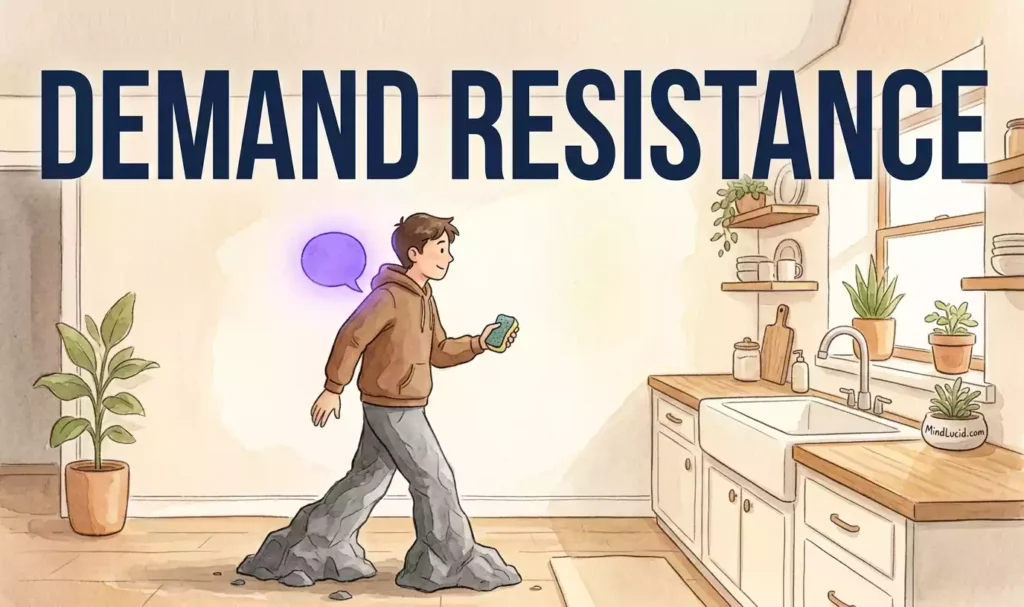
Picture this scenario: You are sitting on the couch, and you suddenly notice that the kitchen counter is cluttered. You think to yourself, “I should probably wipe that down and organize it.” You actually feel a mild sense of motivation. You start to physically stand up to complete the task. You are entirely willing and prepared to do it. But in that exact microsecond, your partner walks into the room and casually says, “Hey, could you wipe down the kitchen counter today?” Instantly, a heavy, invisible wall crashes down in front of you. The motivation evaporates. Your body feels physically heavy. The task that you were literally just about to do voluntarily now feels completely insurmountable, physically repulsive, and entirely impossible. You sit back down, feeling a mix of frustration, guilt, and stubbornness that you cannot quite explain.
If you have ever experienced this jarring phenomenon, you are not alone, and you are not simply being lazy or uncooperative. This profound and overwhelming sensation is known as demand resistance paralysis. It is an intensely frustrating psychological and physiological experience that is frequently misunderstood by both the people witnessing it and the individuals experiencing it. Often misinterpreted as defiance, sheer stubbornness, or a lack of motivation, demand resistance paralysis is actually a deeply ingrained neuro-cognitive response. It is incredibly common among individuals exploring their neurodivergence, particularly those navigating ADHD, autism, or distinct nervous system sensitivities. By understanding the roots of demand resistance paralysis, we can begin to untangle the shame associated with it and discover actionable, deeply empathetic ways to navigate our daily lives without constantly fighting our own brains.
What Exactly is Demand Resistance Paralysis?
To fully grasp why this happens, we must first break down the terminology. In the context of neurodivergent experiences and nervous system responses, a “demand” is anything that signifies an expectation, a requirement, or a loss of autonomy. Demands are not always aggressive orders barked by an angry boss; they are often deeply subtle. A demand can be an external request (like a friend asking you to text them back, a partner asking you to do a chore, or a bill arriving in the mail), but it can also be an internal expectation (like telling yourself you must eat a healthy lunch, you have to go to the gym, or you should enjoy your favorite hobby today). The moment the word “should” or “must” enters the equation, a demand has been established.
The “resistance” aspect is where the misunderstanding usually occurs. This resistance is rarely a conscious, calculated decision to rebel. It is not the mindset of a mischievous child thinking, “I won’t do it just because you told me to.” Instead, it is an involuntary, visceral pushback from the autonomic nervous system. It feels less like a choice and more like a physical reflex, similar to pulling your hand away from a hot stove. Your brain detects a threat to your autonomy, and it immediately deploys defense mechanisms.
Finally, the “paralysis” is the lived reality of this response. When demand resistance hits, it does not just make you not want to do the task; it makes you feel as though you literally cannot do the task. This paralysis is a form of executive dysfunction. The pathways in the brain responsible for task initiation, planning, and execution suddenly experience a massive traffic jam. You might sit there staring at the task, screaming at yourself internally to just move your body, but you remain frozen. The paralysis is frequently accompanied by a profound sense of physical tension, mental fog, and overwhelming cognitive load.
The Psychology Behind the Paralysis: Why the Brain Freezes
Why does being told to do something make it so impossible? To answer this, we have to look away from concepts of willpower and motivation, and instead look toward the autonomic nervous system and the human need for autonomy. Autonomy—the feeling of being in control of one’s own choices, actions, and destiny—is a fundamental human drive. For neurotypical individuals, a minor loss of autonomy (like being asked to file a report at work or take out the trash at home) is mildly annoying but easily processed. The brain registers the request, categorizes it as a necessary part of life, and executes the task.
However, for many individuals with ADHD or highly sensitive nervous systems, the brain processes demands differently. When a demand is perceived, the amygdala (the brain’s threat detection center) may misinterpret this loss of autonomy as a literal threat to survival or safety. This triggers a stress response. Most people are familiar with the “fight or flight” responses, but there is also the “freeze” response. Demand resistance paralysis is, in essence, a freeze response triggered by a perceived threat to your autonomy.
“Demand resistance paralysis occurs when the brain’s threat-detection system hijacks the executive functioning system, prioritizing autonomy protection over task completion.”
When the freeze response is activated, the prefrontal cortex—the logical, forward-thinking part of the brain responsible for executive functions like task initiation and emotional regulation—goes offline. The brain is effectively saying, “We are under threat! Halt all non-essential operations! Do not move forward with this demand!” This is why logic fails in the face of demand resistance paralysis. You can know logically that doing the dishes will only take five minutes, that it will make your partner happy, and that it will make your house look better. But logic cannot override an active nervous system threat response. The demand creates an autonomy deficit, and the brain paralyzes the body to prevent any further compliance that might drain the remaining autonomy.
Demand Resistance vs. Procrastination vs. Laziness
One of the most painful aspects of demand resistance paralysis is the internal and external judgment it brings. It is incredibly common to label oneself as “lazy” or a “chronic procrastinator.” Distinguishing between these concepts is vital for developing self-compassion and finding the right tools to move forward.
| Trait / Experience | Laziness | Procrastination | Demand Resistance Paralysis |
|---|---|---|---|
| Core Feeling | Apathy and comfort. You do not care about the task and feel perfectly fine not doing it. | Avoidance driven by anxiety or the desire for short-term gratification. | Intense internal friction, physical tension, and a feeling of being “trapped” or frozen. |
| Intent to Complete | Low. There is no real internal drive or desire to get the task done. | High, but delayed. You want to do it eventually, just “not right now.” | High. You desperately want the task done, but feel neurologically blocked from initiating. |
| The Trigger | Lack of interest or sheer preference for doing nothing. | The task is perceived as boring, difficult, overwhelming, or unpleasant. | The perception of an expectation, a loss of autonomy, or the word “should.” |
| Emotional Result | Relaxation or indifference. | Guilt, rising anxiety as a deadline approaches, and eventual panic. | Overwhelming shame, frustration with oneself, and physical exhaustion from the internal battle. |
As the table illustrates, laziness is a state of apathy that feels good to the person experiencing it. Demand resistance paralysis, on the other hand, is agonizing. You are expending massive amounts of mental energy simply trying to do the task, only to find yourself completely stuck. Recognizing this difference is the first major step in releasing the shame that surrounds executive functioning challenges.
Is Your Brain Wired Differently?
Do you frequently experience demand resistance paralysis, overwhelming executive dysfunction, or a mind that never seems to stop racing? These experiences are often key indicators of ADHD and unique neurodivergent traits. Understanding exactly how your specific brain processes demands, emotions, and focus is the most critical step toward finding harmony and self-compassion. Stop fighting your natural neurology and start understanding it.
How Demand Resistance Paralysis Shows Up in Daily Life
Because demands can be both external and internal, this paralysis can infect almost every area of daily life. It is a shape-shifter, appearing in professional environments, romantic relationships, and even in our most cherished personal hobbies. Let’s look at how this phenomenon practically manifests.
You have been assigned a new project at work. Initially, you are thrilled. You have great ideas, you are hyper-focusing, and you are making incredible progress ahead of schedule. Then, your manager sends an email: “Hi! Love the progress. Can you make sure you update the tracking spreadsheet every day at 4 PM, and present a mandatory progress report in tomorrow’s meeting?” Suddenly, the joy is sucked out of the project. It is no longer your creative endeavor; it is an obligation tied to compliance. The paralysis sets in, and you find yourself completely unable to work on the project you loved just yesterday.
You deeply love your partner and you want to contribute equitably to the household. On a Saturday morning, you wake up intending to clean the garage. As you are drinking your coffee, your partner hands you a written list of chores, with “Clean the garage” right at the top. The visual representation of the demand triggers an immediate nervous system freeze. You might become irritable, start an argument over something unrelated, or retreat to the couch to scroll on your phone for three hours, entirely paralyzed by the list.
You love painting. It is your ultimate stress relief. You paint beautiful landscapes, and your friends tell you that you should start an Etsy shop or take commissions. The moment you agree to a commission—the moment someone is paying you and expecting a painting by a certain deadline—painting ceases to be a safe haven. It becomes a demand. You stare at the blank canvas for weeks, completely paralyzed, wondering why you suddenly hate the one thing that used to bring you peace.
“I want to do this. I know how to do this. I have all the tools to do this. Why can’t I just move my body and do it? It feels like my brain is a car revving in neutral, burning through gas but going absolutely nowhere.”
Actionable Strategies to Navigate Demand Resistance Paralysis
Because demand resistance paralysis is rooted in the nervous system and executive functioning, traditional productivity advice like “just make a to-do list,” “set an alarm,” or “just push through it” will almost always fail—and often make the paralysis worse. Navigating this requires a completely different approach, one centered on nervous system regulation and autonomy recovery. Here are highly effective, non-medical strategies to help you navigate demand resistance.
1. Autonomy Injection (The Power of Choice)
If the paralysis is triggered by a loss of autonomy, the antidote is to inject autonomy back into the situation. You can do this by intentionally creating choices where there seemingly are none. If you have to clean the house, do not just tell yourself “I must clean.” Instead, give your brain an autonomous choice: “I am going to clean for exactly 15 minutes, but I have total freedom to choose whether I clean the kitchen counters, vacuum the living room, or just organize the mail pile.” By offering your brain a choice, you satisfy the need for control and bypass the threat response.
2. Reframing the Narrative: Declarative vs. Imperative Language
Imperative language gives commands (“Do the dishes,” “You need to finish this report,” “Take out the trash”). Declarative language simply states facts or observations (“The dishwasher is empty,” “The trash is overflowing,” “The report is due tomorrow”). When you or a partner use declarative language, you remove the direct demand. You are simply providing information, which allows your brain the space to autonomously decide to act on that information. If you struggle with internal demands, try changing your self-talk from “I have to do laundry” to “Having clean clothes would make my morning easier tomorrow.”
3. Implement Low-Demand Transitions
Transitions—moving from a state of rest to a state of task execution—are incredibly difficult when dealing with executive dysfunction. Jumping straight from scrolling on your phone to doing a high-demand task is often impossible. Instead, build a “low-demand bridge.” If you are on the couch and need to work, your first step isn’t “start working.” Your first step is simply to stand up and walk to the kitchen for a glass of water. From there, you walk to your desk and just sit down. You lower the demand of each step so drastically that the brain does not perceive it as a threat.
4. De-escalate the Nervous System
Because demand resistance is a freeze response, you cannot logic your way out of it; you must regulate your physiology. When you feel the paralysis setting in, stop trying to force the task. Walk away. Engage in sensory regulation: splash cold water on your face, do 30 seconds of intense physical movement (like jumping jacks or shaking your hands out), or engage in deep, slow breathing. By showing your nervous system that you are physically safe, the prefrontal cortex can come back online, restoring your executive functions.
5. Radical Acceptance and the “Permission to Fail”
Sometimes, the internal demand to “stop being paralyzed and just do it” becomes the biggest demand of all, trapping you in a horrific feedback loop. The fastest way out is sometimes radical acceptance. Say out loud to yourself: “I am experiencing demand resistance paralysis right now. I am not going to do this task for the next hour, and I completely give myself permission to just sit here.” Ironically, by removing the demand that you must overcome the paralysis, you eliminate the threat. Many people find that once they truly give themselves permission not to do the task, the paralysis lifts entirely.
Frequently Asked Questions
Understanding the nuances of your cognitive responses can be overwhelming. Below are answers to some of the most common questions regarding demand resistance paralysis.
Is this the same thing as PDA (Pathological Demand Avoidance)?
While they are closely related and often discussed together, they are generally considered distinct in degree. PDA (frequently reframed in neurodivergent communities as Pervasive Drive for Autonomy) is recognized in some regions as a specific behavioral profile, often associated with the autism spectrum, characterized by an extreme, pervasive avoidance of everyday demands. Demand resistance paralysis, however, is a broader psychological and physiological experience that can affect anyone, particularly those with ADHD, executive dysfunction, or burnout, occurring episodically rather than constantly.
How can I explain this to my partner without it sounding like an excuse?
Communication is vital. Approach the conversation during a calm, low-stress moment—never in the middle of a paralysis episode. Explain it through the lens of neurology, not behavior. You might say, “When I am given a direct request or a list, my nervous system misinterprets it as a loss of autonomy, and I physically freeze up. It is not because I don’t care about you or our home. Can we experiment with using declarative language, like pointing out what needs to be done rather than telling me to do it?”
Can internal “shoulds” really be just as paralyzing as external demands?
Absolutely. For many individuals, internal demands are actually far more paralyzing than external ones. When a boss gives a demand, there is a clear external consequence (losing a job) that can sometimes force compliance. When you place a demand on yourself (e.g., “I really should read a book instead of watching TV”), there is no immediate external consequence, leaving you to battle entirely within your own mind. The brain rebels against its own rigid expectations.
Does this mean I just never have to do anything I don’t want to do?
Not at all. Life inherently requires us to complete tasks we would rather avoid, like paying taxes, doing chores, or meeting deadlines. The goal of understanding demand resistance paralysis is not to avoid responsibilities, but to change how you approach them. By understanding your unique neurological triggers, you can learn to trick your brain into compliance through autonomy, gamification, and nervous system regulation, allowing you to meet your responsibilities without burning out.
Can a history of burnout make demand resistance paralysis worse?
Yes, significantly. When you are experiencing chronic burnout, your nervous system is already frayed and operating at maximum capacity. In a state of burnout, your window of tolerance for stress shrinks drastically. A minor demand that you could normally handle on a good day suddenly becomes the tipping point for a massive nervous system freeze. Healing from burnout often naturally reduces the severity of demand resistance.
Reframing the Narrative: You Are Not Broken
Living with demand resistance paralysis can feel incredibly isolating. In a society that glorifies constant productivity, discipline, and unquestioning compliance, having a brain that physically shuts down when faced with a demand can make you feel fundamentally broken or inadequate. But you are not broken. You simply have a nervous system that fiercely and fiercely protects its autonomy.
The journey forward does not involve beating yourself into submission or finding the perfect daily planner that will magically cure your executive dysfunction. It involves radical self-compassion. It involves acknowledging that your cognitive responses are valid, real, and completely outside of your immediate voluntary control. By learning the language of your own nervous system, utilizing low-demand transitions, and injecting autonomy back into your daily routines, you can slowly begin to thaw the paralysis. Remember, the goal is never perfection; the goal is working with your wonderfully unique mind, rather than against it.