
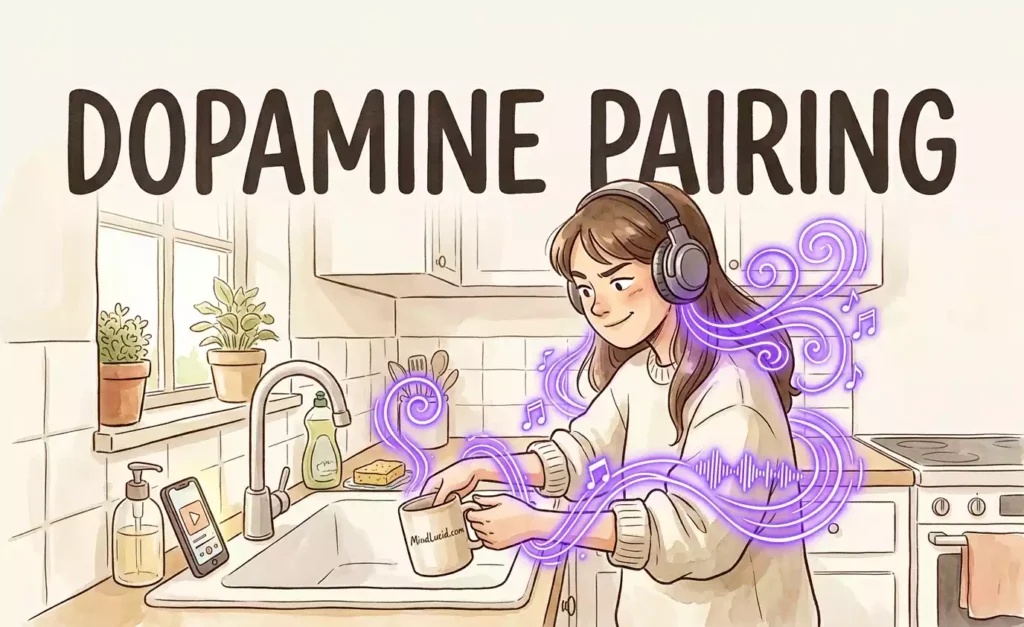
You’re standing at the sink. The water is running. The sponge is in your hand. And you are completely, totally frozen — because your podcast hasn’t finished loading yet.
Maybe it’s the dishes. Maybe it’s folding laundry, opening mail, or walking on a treadmill. The task isn’t hard. It isn’t even especially unpleasant. It’s just… flat. Silent. Understimulating. And your brain would rather do literally anything else — including reorganizing the entire garage.
Here’s what nobody tells you: you’re not lazy, and you’re not broken. You’ve stumbled onto one of the most effective focus strategies in the ADHD toolkit. You just didn’t know it had a name. It’s called dopamine pairing — and once you understand how it works, you can stop feeling guilty about needing a podcast to wash a single plate, and start using the exact same trick on purpose.
What Is Dopamine Pairing, Exactly?
Dopamine pairing is the habit of attaching a task your brain finds dull to a source of stimulation your brain genuinely enjoys — so the two get processed as one single experience instead of two competing ones.
Dopamine pairing = (a low-interest task) + (an enjoyable stimulus), deliberately bundled together so your brain says yes to the whole package.
The dishes don’t change. The podcast doesn’t change. What changes is the package. Your brain stops evaluating “wash the dishes” in isolation and starts evaluating “wash the dishes while listening to a true-crime episode” — and that second version is something it will actually agree to.
You may have heard this idea called “temptation bundling,” “task bundling,” or “stimulation stacking” in behavioral research. The ADHD community tends to call it dopamine pairing, because that name describes the felt experience so accurately: you’re borrowing the reward from something fun and spending it on something necessary.
Why You Can’t Wash Dishes Without a Podcast
The task isn’t the problem — the silence is
A sink full of dishes asks almost nothing of your brain. No puzzle to solve. No deadline. No novelty. No chance of a satisfying “aha.” For a brain that runs on engagement, that’s the worst possible recipe: real effort, zero stimulation.
So your brain does what brains do — it goes looking for something more interesting. It drifts toward your phone. It suddenly remembers the bookshelf that desperately needs reorganizing. It invents ten urgent tasks that didn’t exist five minutes ago. Anything to escape the flatness.
That isn’t a character flaw. That’s a brain protecting itself from boredom — and boredom is genuinely uncomfortable when your attention system is wired the way yours is.
The interest-based nervous system
The psychiatrist Dr. William Dodson described ADHD as an “interest-based nervous system.” The idea is simple and it explains a great deal: instead of being powered by importance, obligation, or long-term consequences the way many neurotypical brains are, ADHD brains tend to run on four fuels.
Interest
If it’s genuinely fascinating, focus shows up for free. If it isn’t, focus has to be dragged in by force.
Novelty
New, different, or unexpected tasks light the brain up. Familiar and repetitive ones quietly switch it off.
Challenge
A game, a puzzle, a personal record to beat — competition turns a chore into something worth doing.
Urgency
The last-minute panic sprint works. It’s just exhausting, and it isn’t available on demand.
Notice what’s missing from that list? Necessity. “I have to do this” is not fuel. “This is fascinating” is fuel. “This is a race against the clock” is fuel. “This is new and shiny” is fuel.
Dopamine pairing works because it smuggles one of those four fuels into a task that has none of them. The dishes stay boring. The experience stops being boring.
Why audio is the perfect partner
Not every kind of stimulation can be stacked onto a task. Scrolling social media while doing dishes doesn’t work — your hands are wet, your eyes are needed elsewhere, and the task keeps getting interrupted. Audio is different. It occupies exactly the part of your attention that was screaming for input, while leaving your hands, eyes, and body free to work.
That’s why the “podcast on while doing chores” combination is so common among ADHD adults. It isn’t a quirky habit or a procrastination trick. It’s a workaround that genuinely works.
| What your brain registers | Chores alone | Chores + a podcast |
|---|---|---|
| Stimulation level | Near zero | Steady and engaging |
| Motivation source | Obligation (“I should”) | Interest (“I want to hear the rest”) |
| Time perception | Endless and sticky | Surprisingly fast |
| Difficulty starting | Very high | Noticeably lower |
| What pulls you away | Everything | Almost nothing |
| How it feels after | Drained and guilty | Done — and weirdly good |
The Dopamine Pairing Formula That Actually Works
Most people discover dopamine pairing by accident, then wonder why it stops working after a few weeks. The trick is that a strong pairing has four ingredients. Skip one, and the whole thing collapses.
(Low-interest task) + (High-interest companion) + (Free hands) + (Zero-friction start) = Movement
Every element matters. Here’s what each one actually does.
1. The task
Something repetitive and low-interest: dishes, folding, tidying, admin, walking, data entry. The flatter the task, the more it needs a partner.
2. The companion
Something genuinely interesting to you — not something you think you should enjoy. Pretend-interest doesn’t fuel anything.
3. Free hands
Audio, music, a phone call, a timer. Nothing that needs your fingers or your gaze, because those are already busy.
4. Zero-friction start
Queued up, headphones charged, ready before you walk into the room. Decision-making kills the window.
The most underrated ingredient is the fourth one. If you have to spend three minutes choosing what to listen to, you’ll lose the momentum you had — and the dishes will still be there tomorrow.
Does This Sound Like Your Brain, Every Single Day?
Needing stimulation to start boring tasks is one small clue among many. If you’ve spent years wondering why you can focus for eight hours on something you love and eight seconds on something you don’t, it’s worth getting a clearer picture. Our comprehensive ADHD assessment walks you through the patterns that matter — focus, motivation, restlessness, follow-through, emotional intensity — and gives you an honest, structured read on how your brain is wired. It’s free, it’s thorough, and it takes just a few minutes.
Go to the full free testFree • Detailed results • No sign-up required
8 Real-Life Dopamine Pairings You Can Steal Today
You don’t need to invent anything. These are the pairings that show up again and again in ADHD communities — the ones people actually keep using after the novelty wears off.
Dishes + true crime
The classic. One episode usually equals one full sink. Save the show so it’s only available at the sink.
Laundry + comfort rewatch
A show you’ve seen ten times needs almost no attention, so your hands stay busy and the pile disappears.
Inbox + instrumental beats
Email needs language processing, so keep the audio lyric-free and let the music set the pace.
Shower + audiobook
A waterproof speaker turns a five-minute routine into the part of the day you look forward to.
Treadmill + a private playlist
Only allowed on the treadmill. It becomes a reward your brain asks for instead of a punishment.
Bills + a timer + a good drink
Urgency and a small treat, stacked on top of paperwork. Twenty minutes, then you’re free.
Tidying + a phone call
Hands busy, mouth busy, brain happy. Works especially well with a friend who also has a mess to tackle.
Commute + a learning podcast
Dead time becomes something you own. The drive stops feeling like a gap in your day.
Dopamine Pairing vs. Body Doubling: What’s the Difference?
These two strategies get mixed up constantly, and honestly, they’re cousins. Both are about adding something to a task so your brain stops stalling. But they solve different problems — and knowing which one you need saves a lot of trial and error.
| Factor | Dopamine Pairing | Body Doubling |
|---|---|---|
| What it adds | Stimulation and interest | Presence and accountability |
| Best for | Repetitive, physical, boring tasks | Tasks that feel overwhelming or scary to begin |
| Example | Dishes + a podcast | Paying bills on a video call with a friend |
| Works alone? | Yes, completely solo | Needs another person, in person or virtual |
| Main risk | Choosing a companion that’s too distracting | Depending on someone else’s schedule |
| Can you combine them? | Absolutely — a friend on speakerphone while you both clean is both at once, and it’s extremely effective. | |
When Dopamine Pairing Backfires — 5 Mistakes to Avoid
Pairing isn’t magic, and it isn’t unlimited. These are the five ways people accidentally break it.
Pairing with something that needs your hands or eyes
Subtitled shows, video essays, or anything visual competes directly with the task. Both get done badly. Stick to audio.
Choosing something too gripping
If you’re standing frozen in the middle of the kitchen because the plot just twisted, you’ve replaced the task instead of supporting it. Aim for engaging, not consuming.
Never rotating your pairings
Novelty fades. The show that lit your brain up in week one becomes wallpaper by week six. Keep two or three options in rotation.
Using it for literally everything
Some tasks need quiet, single-channel focus — deep reading, complex problem-solving, writing something precise. Pairing those usually makes them harder, not easier.
Skipping the “landing”
When the episode ends and the task isn’t finished, the spell breaks and you stall. Always have the next thing queued so there’s no silence to fall into.
How to Build Your Personal Pairing Menu
A pairing menu is just a short, pre-decided list of task-and-companion combinations you can grab without thinking. Here’s how to build one in about ten minutes.
- List your stuck tasks. Write down the five chores or routines that sit undone the longest. Be specific — “dishes,” “folding laundry,” “opening mail,” not “cleaning.”
- List what you genuinely enjoy. Not what sounds productive. Actual things: a specific podcast, a genre of music, a friend you like talking to, a show you’ve memorized.
- Match by channel, not by vibe. Hands-on task? Choose audio. Task that needs your eyes but not your hands? Try music. The channels should complement, never collide.
- Build the launch ritual. Decide what happens in the ten seconds before you start: headphones on, episode queued, timer set, drink poured. Same sequence every time.
- Rotate to protect novelty. When a pairing starts feeling flat, swap the companion — not the task. Keep one show reserved exclusively for one chore so it stays special.
Try This Tonight: A 60-Second Starter
Before you need it, set it up. Charge your headphones and place them where the task happens. Queue exactly one episode — not a list, one. Decide that the episode only plays while your hands are moving. Then start the audio before you walk into the room. The audio leads; you follow. That single change — starting the sound first — is often the difference between a task that happens and a task that waits another three weeks.
Frequently Asked Questions About Dopamine Pairing
QIs dopamine pairing the same as multitasking?
Not really, and the difference matters. Classic multitasking splits your attention between two things that need the same resource — like reading email during a call. Dopamine pairing deliberately combines a task that uses your hands with stimulation that uses your ears. They run on different channels, so they don’t compete. Done well, pairing can actually reduce the mental noise that pulls you off task.
QIs it bad that I can’t do chores without a podcast?
No. You’ve found a tool that helps your brain start and finish tasks that would otherwise sit there for days. The goal was never to do boring things in silence — it’s to get them done. If a podcast turns a two-hour standoff with the sink into fifteen minutes of easy work, that’s a win, not a weakness.
QDoes dopamine pairing work for studying or work tasks?
Sometimes, and it depends on the task. Pairing works beautifully for repetitive or physical work — data entry, tidying, folding, exercising, admin. It works far less well for tasks that need language processing, like reading dense material or writing something complex, because a podcast competes for the same mental channel. For those, try instrumental music, ambient sound, or a body double instead.
QWhy does my favourite podcast stop working after a while?
Novelty fades. The same stimulus that lit your brain up in week one becomes background noise by week six. That’s completely normal — and it’s exactly why rotating your pairings matters. Keep two or three options going and swap them when a task starts feeling sticky again.
QCan I use dopamine pairing if I’m easily overstimulated?
Yes, but go gently. If two streams of input feel like too much, choose a single low-key option: ambient music, rain sounds, a familiar album, or a long-form audio essay at low volume. Some people pair with a warm drink, a scented candle, or a specific chair instead of audio. The point is adding something pleasant, not adding chaos.
QIs dopamine pairing only useful for people with ADHD?
Not at all — plenty of people without ADHD use a playlist to get through a workout. What’s different is the intensity. For ADHD brains, pairing often isn’t a nice extra. It’s the difference between a task happening today and a task not happening for three weeks.
QWhat if I can’t find anything I actually enjoy?
Start smaller than you think. It doesn’t have to be a podcast. It can be a specific drink you only make during chores, a playlist from a year you loved, a phone call with a friend, or a show you’ve seen a hundred times. Enjoyment doesn’t have to be exciting — it just has to be something your brain is willing to lean toward.
The Bottom Line
You were never bad at dishes. You were doing them in a silence your brain couldn’t work with. Dopamine pairing isn’t cheating, and it isn’t a crutch — it’s you finally speaking your brain’s language instead of waiting for it to learn yours.
Start with one task. One pairing. One episode. And if you recognize yourself in every paragraph above — the frozen starts, the endless scrolling, the tasks that wait for weeks — that’s worth understanding properly, not just working around.
Ready to see the full picture?
Take the comprehensive, free ADHD assessment and get a clear, structured look at how your brain actually works.