
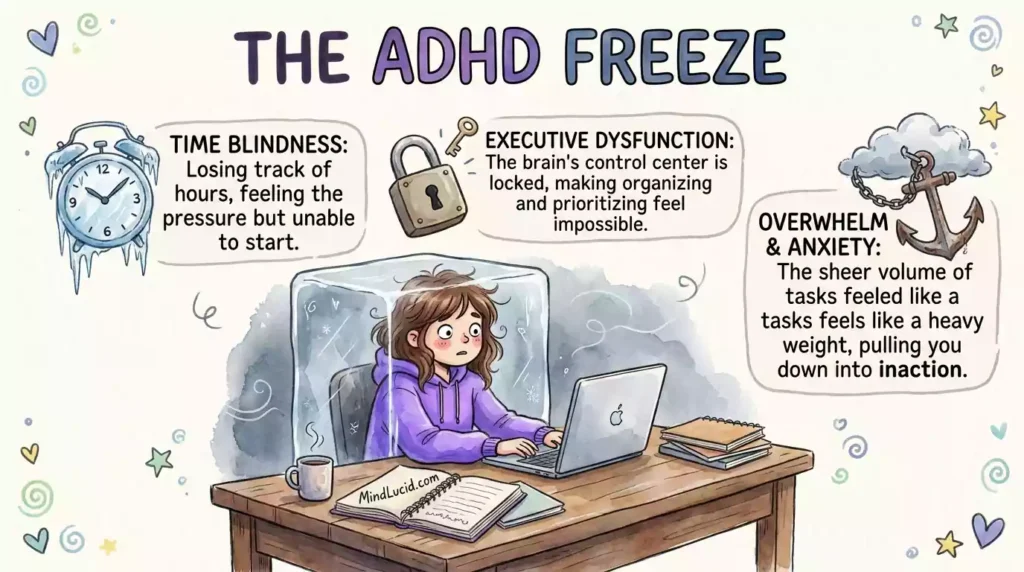
ADHD paralysis is one of the most misunderstood and emotionally painful experiences a person with ADHD can face. You sit down to work. You know exactly what needs to be done. You want to do it. But your brain simply refuses to start. Your body feels heavy. Your mind races with thoughts, yet you remain frozen in place — scrolling, staring, or pacing. Minutes turn into hours. Hours turn into an entire day lost to the void. If this sounds painfully familiar, you are not broken. You are not lazy. You are experiencing what psychologists and ADHD specialists call task paralysis — a core feature of executive dysfunction that affects millions of adults worldwide. In this comprehensive guide, we will explore exactly what ADHD paralysis is, why it happens in your brain, the different forms it takes, and most importantly — how to break free from it.
🧠 What Is ADHD Paralysis?
ADHD paralysis, also known as ADHD freeze or executive dysfunction paralysis, is a neurological phenomenon where a person with ADHD becomes mentally and physically incapable of initiating or completing a task — despite having the desire, ability, and urgent need to do so. Unlike ordinary hesitation, this is not a choice. It is an involuntary shutdown of the brain’s executive functioning system.
The term “paralysis” is used deliberately because the experience genuinely mirrors physical paralysis. You might be sitting in front of your laptop with a deadline looming, yet your hands will not move toward the keyboard. You might need to make a simple phone call, but your brain treats it as if it were scaling Mount Everest. This is not a character flaw — it is a measurable difference in how the ADHD brain processes task initiation.
Research published in the Journal of Attention Disorders and work by leading ADHD experts like Dr. Russell Barkley and Dr. Thomas E. Brown confirms that ADHD paralysis stems from deficits in executive functions — the brain’s “management system” responsible for planning, prioritizing, initiating action, and regulating emotions. When this system is impaired, even simple tasks can feel insurmountable.
What makes ADHD paralysis particularly devastating is the shame spiral it creates. The longer you remain stuck, the more you criticize yourself. The more you criticize yourself, the worse the paralysis becomes. This vicious cycle can lead to chronic anxiety, depression, and even burnout. Understanding that this is a neurobiological issue — not a moral failing — is the first step toward healing.
⚡ ADHD Paralysis vs. Procrastination vs. Laziness
One of the most damaging myths about ADHD paralysis is that it is simply “laziness” or “procrastination.” This misunderstanding causes immense harm, both from external critics and from the internal critic within the person with ADHD. The reality is that these three experiences are fundamentally different in their causes, emotional experiences, and solutions. Understanding the difference is crucial for self-compassion and effective treatment.
| Characteristic | ADHD Paralysis | Procrastination | Laziness |
|---|---|---|---|
| Root Cause | Neurological executive dysfunction | Avoidance of discomfort or fear | Lack of desire or motivation |
| Emotional Experience | Intense frustration, shame, guilt, and inner turmoil | Mild anxiety or pressure with relief when avoided | Indifference, contentment with inactivity |
| Desire to Act | Strong desire to act but unable to initiate | Wants to act but chooses to delay | No desire to act at all |
| Response to Deadlines | Deadlines trigger sudden activation but with intense stress | Deadlines motivate action | Deadlines may be ignored |
| Emotional Aftermath | Shame, self-criticism, guilt | Mild regret or relief | None |
| Solution Approach | ADHD-specific strategies, medication, therapy | Time management techniques | Finding purpose or discipline |
As the table clearly shows, ADHD paralysis is not a choice, a habit, or a personality trait. It is a neurological barrier that requires understanding, accommodation, and often professional treatment. If you have been called “lazy” your entire life but internally feel a constant battle against invisible walls, it is time to consider that something deeper may be at play.
🔬 The Neuroscience Behind ADHD Paralysis
To truly understand ADHD paralysis, we need to look inside the brain. The condition is rooted in the prefrontal cortex — the part of the brain responsible for executive functions such as planning, decision-making, impulse control, and initiating action. In individuals with ADHD, this region often shows reduced activity and connectivity when compared to neurotypical brains.
One of the key neurotransmitters involved is dopamine. Dopamine plays a critical role in motivation, reward anticipation, and the brain’s ability to initiate action. In the ADHD brain, dopamine signaling is often dysregulated — either too little dopamine is available, or dopamine receptors are less responsive. This means that tasks that do not provide immediate reward or stimulation fail to activate the brain’s motivation pathways.
This is why people with ADHD often experience the phenomenon of interest-based nervous system. They can hyperfocus for hours on something fascinating (like a video game or a creative project) but cannot summon even 5 minutes of focus for a necessary but boring task. The brain is not being stubborn — it is starving for the dopamine it needs to initiate action.
Additionally, the Default Mode Network (DMN) — the brain network active during rest, daydreaming, and mind-wandering — has been found to be overactive in people with ADHD. When you try to switch from a resting state to a focused task, the DMN should deactivate. But in ADHD, this transition is impaired. Your brain remains stuck in “idle mode,” unable to shift into “task mode.” This neurological stuckness is the biological basis of the freezing sensation.
Understanding this neuroscience is liberating. It means that your paralysis is not your fault. Your brain is wired differently, and with the right strategies and support, you can learn to work with your brain instead of against it.
🎯 4 Types of ADHD Paralysis
ADHD paralysis is not a one-size-fits-all experience. Different situations can trigger different forms of paralysis, and understanding which type you are experiencing is key to finding the right coping strategy. Here are the four most common types:
Task Initiation Paralysis
The most common form — the inability to start a task, even one you desperately want to complete. Your brain sees the task as a massive wall with no visible door. This often happens with large projects, unpleasant chores, or tasks with unclear first steps.
Decision Paralysis
When faced with too many choices, the ADHD brain becomes overwhelmed and shuts down. This can apply to big decisions (choosing a career path) or small ones (what to eat for dinner). The abundance of options creates cognitive overload, and the brain responds by freezing.
Transition Paralysis
Difficulty switching between tasks or activities. You might be fully engaged in one activity but feel physically unable to stop and move to the next. This is why people with ADHD often struggle with interruptions or changing routines — the brain gets “stuck” in the current mode.
Emotional Paralysis
Intense emotions — especially shame, anxiety, or overwhelm — can trigger a freeze response. When the emotional brain (amygdala) is flooded, the executive function system shuts down entirely. This creates a loop where emotional distress causes paralysis, which then creates more emotional distress.
Many people with ADHD experience multiple types of paralysis at different times. Recognizing your patterns is the first step toward breaking them.
💜 Ready to Understand Your ADHD Patterns?
Our comprehensive free ADHD test can help you identify whether your experiences align with ADHD, including executive dysfunction and task paralysis. It takes just a few minutes and provides personalized insights.
🛠️ How to Break Through ADHD Paralysis
Breaking through ADHD paralysis requires a multi-faceted approach. What works for one person may not work for another, but the following strategies have been shown to be effective for many individuals with ADHD. The key is to work with your brain, not against it.
🎯 Micro-Tasking: Make the First Step Insanely Small
The ADHD brain is overwhelmed by large, vague tasks. “Write a report” feels impossible. “Open Google Docs” feels manageable. The strategy of micro-tasking involves breaking tasks down into steps so tiny they feel almost ridiculous. Instead of “clean the kitchen,” try “pick up one dish.” The momentum from completing even a tiny action triggers a small dopamine release, which can help you take the next step.
⏰ Body Doubling
Body doubling is a technique where you work alongside another person — either in person or virtually — who is also working on their own task. The presence of another person creates a sense of accountability and external structure that the ADHD brain often needs to initiate action. This has become especially popular through virtual body doubling platforms and ADHD communities.
🎧 Stimulation & Sensory Regulation
Since the ADHD brain is chronically under-stimulated, adding sensory stimulation can help activate the motivation system. This might mean listening to music with a strong beat, using fidget toys, chewing gum, or working in a busy café. The additional stimulation provides the dopamine boost needed to overcome the initiation threshold.
🧘 Emotional Regulation Techniques
Since shame and anxiety fuel the paralysis cycle, regulating your emotions is crucial. Techniques like deep breathing, mindfulness meditation, journaling, and self-compassion exercises can help calm the emotional brain and reactivate the executive function system. Remember: you cannot bully yourself out of ADHD paralysis. Self-compassion is a neurological necessity, not a luxury.
💊 Medication & Professional Treatment
For many people with ADHD, medication (such as stimulants or non-stimulants) is the most effective tool for reducing paralysis. Medication works by normalizing dopamine levels in the brain, making it easier to initiate tasks. Combined with therapy (especially Cognitive Behavioral Therapy adapted for ADHD), medication can dramatically reduce the frequency and intensity of paralysis episodes.
🏥 When to Seek Professional Help
While occasional procrastination is a universal human experience, frequent and impairing ADHD paralysis is different. If you recognize the following patterns in your life, it may be time to seek a professional ADHD assessment:
- You frequently lose entire days to paralysis, unable to complete essential tasks
- Your work, academic, or personal relationships are suffering as a result
- You experience intense shame, guilt, or depression related to being “stuck”
- Your paralysis has persisted for years despite trying various self-help strategies
- You feel like you are constantly fighting against your own brain just to function
- You recognize other ADHD symptoms in yourself, such as chronic disorganization, forgetfulness, or impulsive behavior
A proper ADHD assessment involves a comprehensive evaluation by a qualified mental health professional. The assessment typically includes clinical interviews, behavior rating scales, and sometimes cognitive testing. Getting a diagnosis can be life-changing — it provides an explanation for years of struggle and opens the door to effective treatment.
💜 Take the First Step Today
If you have been struggling with ADHD paralysis and are ready to understand your brain better, taking a comprehensive ADHD test is an excellent first step. Our free ADHD assessment at MindLucid is designed by mental health professionals and provides personalized insights into your symptoms, including executive dysfunction, attention patterns, and impulse control. It takes just a few minutes and could be the beginning of a transformative journey toward self-understanding.
❓ Frequently Asked Questions About ADHD Paralysis
ADHD paralysis is a specific manifestation of executive dysfunction. Executive dysfunction refers to the broader impairment of the brain’s management system, affecting planning, working memory, impulse control, and task initiation. ADHD paralysis specifically describes the “freezing” sensation when unable to start or switch tasks, which is one symptom of executive dysfunction.
Yes, medication does not eliminate ADHD paralysis completely, though it often reduces its frequency and intensity. Medication helps normalize dopamine levels, making task initiation easier, but it is not a cure. Many people find that medication combined with behavioral strategies and environmental accommodations provides the best results.
The duration varies greatly from person to person and situation to situation. Some episodes last a few minutes, while others can stretch into days or even weeks during periods of high stress or burnout. The duration often depends on factors like the perceived difficulty of the task, emotional state, sleep quality, and whether effective coping strategies are employed.
ADHD paralysis and burnout can feed into each other. Chronic ADHD paralysis can lead to burnout from the constant stress of fighting your own brain. Conversely, burnout can exacerbate ADHD symptoms, making paralysis more frequent and severe. If you are experiencing both, it is important to address both the ADHD and the burnout simultaneously.
Yes, many people with ADHD experience what is sometimes called “bedtime paralysis” — the inability to transition from their current activity to getting ready for bed. The same executive dysfunction that prevents task initiation can also prevent the transition to sleep. Additionally, the anxiety and shame from a day spent in paralysis can lead to rumination that interferes with sleep quality.
💫 Final Thoughts: You Are Not Broken
ADHD paralysis is one of the most challenging and misunderstood aspects of living with ADHD. The constant battle against your own brain can be exhausting, demoralizing, and deeply isolating. But here is the truth: you are not lazy, you are not broken, and you are not alone. Millions of people around the world experience the same invisible walls, the same frustrating freeze, and the same painful shame spiral.
The fact that you are reading this article means you are ready to understand yourself better. You are ready to stop blaming yourself and start working with your brain. Whether you are just beginning to explore whether ADHD might explain your experiences, or you have been diagnosed for years, the journey toward self-understanding is always worthwhile.
If you recognize yourself in the patterns described in this article — the freezing, the shame, the last-minute activation, the inability to switch tasks — we encourage you to take the next step. Our comprehensive free ADHD test at MindLucid is designed to provide you with a deeper understanding of your symptoms and whether they align with ADHD patterns. It takes just a few minutes, and the insights you gain could be the key that unlocks a new chapter of self-compassion, effective treatment, and genuine healing.
Your brain is not your enemy. With understanding, support, and the right strategies, you can learn to navigate ADHD paralysis and build a life that works with your unique neurology — not against it.