
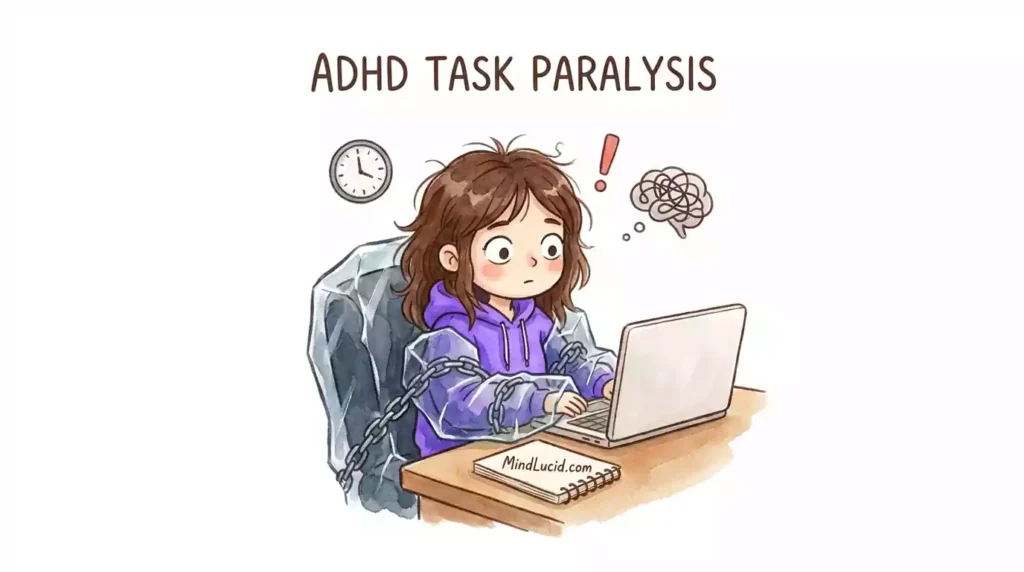
Have you ever sat down to start an important task—something you genuinely want to do—only to find yourself frozen, scrolling, or staring at a blank screen? If you have ADHD, this isn’t laziness. It’s a neurobiological pattern often called ADHD task paralysis or ADHD freeze. It can make deadlines feel impossible, drain your confidence, and leave you wondering why you can’t “just do it.” In this guide, we’ll unpack what ADHD task paralysis really is, why it happens, and how to break the freeze. You’ll also find practical strategies and a link to the full MindLucid ADHD test for deeper clarity.
🧠 The Invisible Wall: What Is ADHD Task Paralysis?
ADHD task paralysis—sometimes called ADHD freeze or executive dysfunction—is the experience of wanting to start a task but feeling completely unable to initiate action. It’s not about being lazy or unmotivated; it’s a breakdown in the brain’s executive functioning system, particularly in task initiation and prioritization.
For neurotypical brains, starting a task is often automatic. For ADHD brains, the prefrontal cortex—the part responsible for planning, organizing, and initiating—has lower dopamine activity. This makes tasks that are boring, complex, or emotionally loaded feel like climbing a mountain. The result? You freeze, avoid, or scroll. Understanding this is the first step toward self-compassion and practical change.
🔬 The Neuroscience Behind ADHD Freeze
ADHD is linked to differences in dopamine and norepinephrine pathways. Dopamine is the brain’s “motivation molecule.” When levels are low, tasks that don’t provide immediate reward or stimulation fail to activate the brain’s action centers. This is why people with ADHD often describe a physical sensation of being stuck—like the brain is saying “no” even though the mind says “go.”
Research also points to differences in the default mode network (DMN) and its interaction with the task-positive network (TPN). In ADHD, the DMN may intrude during focused tasks, causing mind-wandering, daydreaming, or a sudden urge to do something else. This neurobiological tug-of-war makes task initiation particularly exhausting.
- Low tonic dopamine reduces motivation for non-stimulating tasks.
- Impaired executive function makes planning and sequencing feel overwhelming.
- DMN intrusions hijack attention and create internal distraction.
- Emotional dysregulation amplifies the fear of failure or imperfection.
🆚 ADHD Task Paralysis vs. Procrastination: Key Differences
It’s easy to confuse ADHD task paralysis with ordinary procrastination, but they’re not the same. Procrastination is often a choice to delay an unpleasant task; ADHD paralysis feels involuntary—like your brain is on strike.
| Feature | ADHD Task Paralysis | Typical Procrastination |
|---|---|---|
| Voluntary? | Feels involuntary, brain “freezes” | Often a conscious delay |
| Emotion | Overwhelm, shame, anxiety | Mild guilt, avoidance |
| Trigger | Complexity, low stimulation, ambiguity | Boredom, dislike |
| Deadline effect | May worsen freeze; last-minute rush | Thrives on deadline pressure |
| Improvement with “just try harder” | No—often worsens | Sometimes works |
If the freeze feels beyond your control, it may be a symptom of ADHD rather than a habit.
🌀 The ADHD Freeze Cycle: Why “Just Try Harder” Backfires
Many people with ADHD have heard “you just need to focus” or “stop being lazy.” But the ADHD freeze cycle is self-reinforcing. It typically looks like this:
- Trigger: You face a task that is overwhelming, boring, or ambiguous.
- Brain freeze: Executive function collapses; you can’t start.
- Avoidance: You reach for your phone, clean something else, or zone out.
- Shame spiral: You berate yourself, which increases emotional load.
- More paralysis: The emotional weight makes the task even harder to start.
Breaking the cycle requires reducing emotional load, lowering the barrier to start, and using ADHD-friendly strategies—not willpower.
🚨 Common Triggers of ADHD Paralysis
Understanding your triggers can help you prevent or manage freeze. Common triggers include:
- Ambiguous tasks: “Organize your life” has no clear starting point.
- Perfectionism: Fear of doing it wrong stops you from starting at all.
- Overwhelm: Too many steps or too much information at once.
- Low stimulation: Repetitive or boring tasks fail to engage the ADHD brain.
- Emotional weight: Tasks tied to criticism, failure, or high stakes.
- Transition difficulties: Switching from one activity to another can trigger freeze.
🧩 7 Signs You’re Stuck in ADHD Task Paralysis
Not sure if what you’re experiencing is ADHD task paralysis? See how many resonate:
- You know what to do but can’t physically start.
- You open your laptop and immediately feel exhausted.
- Small tasks feel disproportionately huge.
- You wait for urgency or panic to kick in before acting.
- You feel intense guilt after “wasting” hours.
- You often ask yourself, “Why can’t I just do this?”
- You need novelty, pressure, or interest to motivate action.
If several of these feel familiar, the full MindLucid test can help you explore whether ADHD is part of your story.
🛠️ Breaking the Freeze: Practical Strategies That Work
Once you understand ADHD task paralysis, you can start using strategies that work with your brain, not against it. Try these:
1. Shrink the Task
Instead of “write report,” try “open document and type one sentence.” The goal is to lower the activation energy.
2. Use the 5-Minute Rule
Tell yourself you’ll only work for five minutes. Often, starting is the hardest part, and momentum takes over.
3. Add Stimulation
ADHD brains crave dopamine. Pair boring tasks with music, a body double, or a fidget toy to increase engagement.
4. Externalize Your Executive Function
Use timers, checklists, voice notes, and visual reminders. Make the plan visible and concrete.
5. Practice Self-Compassion
Shame fuels the freeze cycle. Replace self-criticism with curiosity: “What made this task hard for me?”
6. Identify the Real Starting Point
Ask: “What is the very first physical action?” If it’s “pick up pen,” that’s your task. If it’s “open browser,” do that.
🧪 How the MindLucid ADHD Test Can Help You Get Clarity
The signs above are just a snapshot. If you’re wondering whether your task paralysis, focus struggles, or overwhelm might be related to ADHD, the full MindLucid ADHD test offers a deeper, evidence-based self-assessment. It examines key ADHD symptoms across multiple domains, giving you a clearer understanding of your patterns and a starting point for conversation with a professional.
Taking the full test is free, takes only a few minutes, and can help you move from self-blame to clarity.
❓ Frequently Asked Questions
Is ADHD task paralysis a formal diagnosis?
No, it’s a descriptive term for a specific manifestation of executive dysfunction in ADHD. It’s not a separate diagnosis but a common experience.
Can ADHD paralysis look like depression?
Yes, both can involve low motivation and inactivity. However, ADHD paralysis is often linked to task initiation and executive function, while depression typically involves persistent low mood and loss of interest. Many people have both.
Does medication help with ADHD task paralysis?
For many people, stimulant and non-stimulant ADHD medications improve executive function and make task initiation easier. However, medication works best when combined with behavioral strategies and accommodations.
How is ADHD task paralysis different from anxiety freeze?
Anxiety freeze is usually tied to fear or panic about a specific outcome, while ADHD paralysis stems from executive dysfunction and low dopamine. They can co-occur, and the strategies may overlap.
Can adults develop ADHD task paralysis later in life?
ADHD is a neurodevelopmental condition, so symptoms usually begin in childhood, though they may become more noticeable in adulthood as demands increase. If you’re experiencing new onset of severe paralysis, consider a full evaluation.
Post Title: ADHD Task Initiation Paralysis: Why You Can’t Start and How to Overcome It