
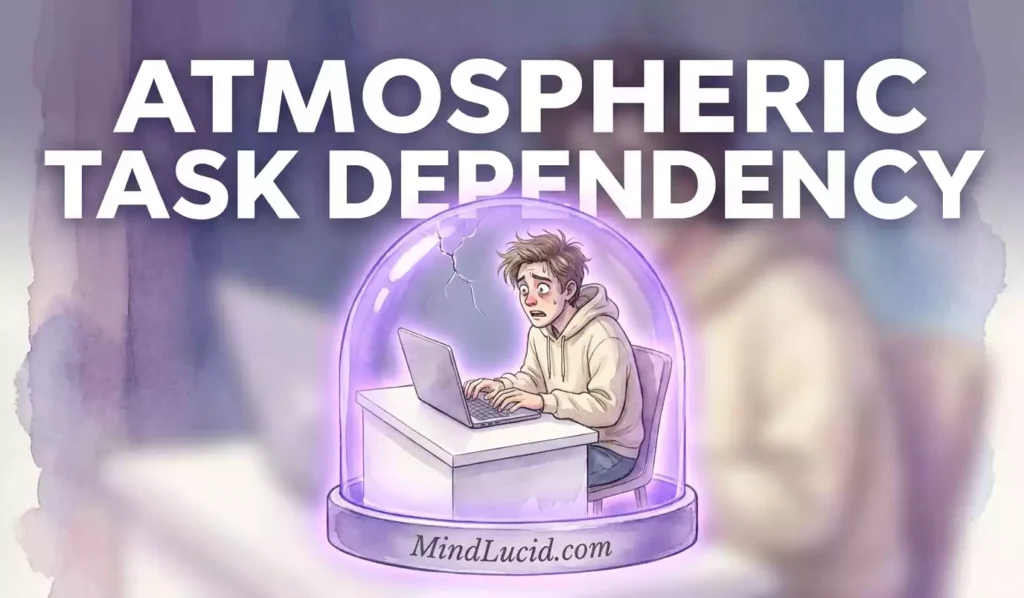
You sit down at your desk, coffee steaming, to-do list ready, and… nothing. The lighting feels wrong. The chair isn’t quite comfortable. The room is too quiet — or maybe too loud. The playlist isn’t right. Your brain refuses to engage, and you find yourself reorganizing folders, scrolling through aesthetic desk setups on social media, or “just quickly” redecorating your workspace instead of actually starting the task. If this sounds painfully familiar, you may be experiencing what researchers and ADHD specialists increasingly refer to as atmospheric task dependency.
What Exactly Is Atmospheric Task Dependency?
Atmospheric task dependency — sometimes shortened to ATD — describes a cognitive pattern where an individual feels unable to initiate or sustain focused work unless their surrounding environment meets a highly specific, often unspoken set of sensory and emotional conditions. It’s not just about having a clean desk or a quiet room. It’s about the vibe being exactly right: the lighting, the temperature, the background noise level, the visual aesthetics, the emotional tone of the space, and sometimes even the time of day or the specific playlist playing.
While anyone can occasionally feel picky about their work environment, for individuals with ADHD, this experience can become a significant barrier to productivity. The brain’s executive function systems — responsible for task initiation, attention regulation, and impulse control — already face an uphill battle. When you add the extra cognitive load of environmental discomfort or sensory dissatisfaction, the threshold for starting a task rises dramatically.
Think of it like this: a neurotypical brain might need the environment to be 70% “acceptable” to begin working. An ADHD brain experiencing atmospheric task dependency might need it at 95–100% before the executive function centers feel safe enough to engage. That’s a massive difference — and it’s exactly why so many people with ADHD find themselves trapped in cycles of procrastination that feel completely out of their control.
The Science Behind the “Vibe”
Why does your brain care so much about whether the lighting is warm or cool, whether there’s a candle lit, or whether your desk faces the window? The answer lies in how ADHD brains process sensory information and regulate attention.
Research on ADHD has consistently shown that individuals with ADHD often experience atypical sensory processing. This means that environmental stimuli — sounds, lights, textures, temperatures, and even visual clutter — are processed more intensely and less efficiently than in neurotypical brains. What might be a minor annoyance to someone else can feel like a genuine cognitive roadblock to someone with ADHD.
Furthermore, ADHD is fundamentally a disorder of dopamine regulation. Dopamine is the neurotransmitter most associated with motivation, reward, and the anticipation of pleasure. When dopamine levels are low or dopamine signaling is inefficient — as is common in ADHD — the brain struggles to generate enough internal motivation to begin tasks, especially tasks that don’t provide immediate rewards. This is why “boring” tasks feel nearly impossible while highly engaging or novel tasks feel effortless.
Atmospheric task dependency sits at the intersection of these two challenges. The sensory discomfort drains what little dopamine is available, while the search for the “perfect vibe” becomes a form of micro-novelty seeking — a way to squeeze out tiny dopamine hits through environmental tweaking, playlist curation, or workspace reorganization. Unfortunately, this often masquerades as productivity while actually being a sophisticated form of procrastination.
Why ADHD Brains Are Especially Vulnerable
Not everyone who enjoys a tidy workspace or a specific playlist has atmospheric task dependency. What makes this pattern particularly prevalent — and particularly problematic — in ADHD is the way it interacts with core executive function deficits. Let’s break down the specific mechanisms:
⚡ Task Initiation Deficit
Starting a task requires a burst of executive function energy. When you add environmental dissatisfaction on top of this, the energy required multiplies. The brain rationalizes: “I’ll start once the environment is right” — but “right” never comes.
🎯 Attention Dysregulation
ADHD brains are constantly scanning for stimuli. A slightly uncomfortable chair, a buzzing light, or a cluttered desk becomes a magnet for attention, pulling focus away from the task and toward the environment itself.
💭 Emotional Dysregulation
Frustration with the environment can quickly spiral into self-criticism: “Why can’t I just work like a normal person?” This emotional spiral further depletes executive function resources, making task initiation even harder.
🔮 Perfectionism Overlap
Many people with ADHD develop perfectionistic tendencies as a coping mechanism. Atmospheric task dependency can be an extension of this: if the conditions aren’t perfect, the work won’t be perfect, so why start at all?
The result is a self-reinforcing loop. You can’t start because the vibe isn’t right. You try to fix the vibe. Fixing the vibe becomes the task itself. Hours pass. Now you’re exhausted from “working” all day but haven’t actually accomplished anything. The guilt sets in. Tomorrow, the bar for the “perfect vibe” is even higher because you’re also carrying yesterday’s guilt. And so the cycle continues.
Signs You Might Have Atmospheric Task Dependency
Wondering if this pattern applies to you? Here are the most common indicators that atmospheric task dependency is affecting your productivity:
- ✅ You spend more time setting up your workspace than actually working in it
- ✅ You have multiple “productivity” playlists but rarely get past the first few songs
- ✅ You feel physically uncomfortable or mentally “blocked” when the lighting, temperature, or noise level is slightly off
- ✅ You’ve reorganized your desk, folders, or digital workspace multiple times in the past month
- ✅ You can work perfectly in certain environments (coffee shops, libraries) but feel paralyzed at home
- ✅ You frequently tell yourself “I’ll start as soon as I [insert environmental fix]” — and the list keeps growing
- ✅ Small environmental disruptions (a phone notification, someone walking by) completely derail your focus
📋 Normal Preference vs. Atmospheric Task Dependency
| Characteristic | Typical Preference | Atmospheric Task Dependency |
|---|---|---|
| Response to imperfect conditions | Mild annoyance, can still work | Complete shutdown, cannot initiate task |
| Time spent on environment | Minimal, quick adjustments | Hours spent perfecting conditions |
| Emotional response | Slight frustration, then adaptation | Anxiety, overwhelm, self-criticism |
| Task completion | Tasks get done despite environment | Tasks frequently abandoned or never started |
| Flexibility | Can adapt to various settings | Rigid requirements for “the right” setting |
| Self-awareness | Recognizes preference without judgment | Feels shame, confusion, or self-blame |
✨ Is Atmospheric Task Dependency Holding You Back?
If you recognize yourself in these patterns — the endless environment tweaking, the paralysis when conditions aren’t perfect, the hours lost to “setting up” instead of doing — you’re not broken, and you’re definitely not alone. These experiences are common in adults with ADHD, and understanding your unique cognitive profile is the first step toward breaking free from the cycle. Take our comprehensive, research-informed ADHD assessment to gain clarity on your symptoms and discover personalized strategies that actually work for your brain.
The Hidden Cost of Waiting for Perfect Conditions
Atmospheric task dependency carries a significant psychological and practical price tag. Beyond the obvious productivity losses, this pattern can erode self-esteem, strain relationships, and reinforce negative beliefs about your capabilities. Here’s what’s really at stake:
Time Dilation: What feels like “just five minutes of setup” often becomes two hours of playlist curation, desk rearrangement, and color-coded folder creation. Over weeks and months, this adds up to hundreds of hours of lost work time — time that could have been spent on meaningful projects, rest, or connection.
Identity Erosion: Every time you fail to start a task because “the vibe wasn’t right,” a small voice in your head records the failure. Over time, this can crystallize into a negative self-narrative: “I’m lazy,” “I’m undisciplined,” “I can’t be trusted to do hard things.” This narrative becomes a self-fulfilling prophecy that makes future task initiation even harder.
Relationship Strain: Partners, family members, and colleagues may struggle to understand why you can’t “just work.” They may interpret your behavior as avoidance, lack of commitment, or even manipulation. The shame you feel about your inability to explain what’s happening only deepens the isolation.
Financial and Career Impact: Missed deadlines, incomplete projects, and chronic underperformance can have serious consequences for your professional life. The gap between your true capabilities and your actual output — created largely by atmospheric task dependency — is often the most painful part of the experience.
Practical Strategies to Break Free
Understanding atmospheric task dependency is important, but knowledge alone won’t change behavior. You need practical, ADHD-friendly strategies that work with your brain’s quirks rather than against them. Here are evidence-informed approaches that many people with ADHD find genuinely helpful:
🌊 The Two-Minute Environment Rule
Give yourself a hard limit of two minutes to adjust your environment before starting. If the lighting isn’t perfect after two minutes, you start anyway. The key is making “good enough” the standard, not “perfect.” Your brain will adapt faster than you expect.
🎯 Micro-Commitment Technique
Instead of committing to “do the task,” commit to “spend five minutes in the environment while slightly uncomfortable.” Often, the discomfort fades once you begin, and the momentum carries you forward. The first five minutes are always the hardest.
🔗 Environment-Anchor Associations
Train your brain to associate certain environmental triggers with work. For example, always use the same specific playlist, light a particular candle, or sit in a specific chair when you work. Over time, these anchors trigger a work-ready state automatically.
🧩 Sensory Toolkit Creation
Build a portable “sensory kit” with items that help you regulate: noise-canceling headphones, fidget tools, a specific type of lighting you can attach anywhere, a familiar scent. This gives you environmental control without the endless search for the perfect space.
💭 Cognitive Reframing
When you catch yourself thinking “I can’t work until X is perfect,” reframe it: “My brain is seeking comfort. I can feel discomfort and still take one small action.” This separates the feeling (which is valid) from the behavior (which is negotiable).
⏰ Body-Doubling and Accountability
Working alongside someone else — even virtually — can bypass the need for environmental perfection. The presence of another person creates external accountability that your internal motivation system may struggle to generate on its own.
Remember: the goal isn’t to eliminate atmospheric task dependency overnight. It’s to gradually reduce the threshold for “good enough” while building strategies that make task initiation feel more accessible. Celebrate small wins — every time you start a task in less-than-perfect conditions, you’re rewiring your brain’s expectations.
Frequently Asked Questions
No, atmospheric task dependency is not a formal clinical diagnosis. It’s a descriptive term used by ADHD specialists, coaches, and individuals with ADHD to describe a common experiential pattern. It often occurs alongside formally diagnosable conditions like ADHD, anxiety, or obsessive-compulsive tendencies. If you’re experiencing significant impairment in your daily functioning, it’s important to consult with a qualified mental health professional.
Yes. While atmospheric task dependency is particularly common in people with ADHD due to executive function and sensory processing differences, it can also occur in individuals with anxiety disorders, autism spectrum conditions, high sensitivity, or perfectionistic personality traits. The underlying mechanisms may differ, but the behavioral pattern can look similar.
Procrastination is a broad term for delaying tasks, often driven by avoidance, fear of failure, or poor time management. Atmospheric task dependency is more specific: it’s the inability to initiate work unless environmental conditions feel “right.” The delay is specifically tied to sensory and atmospheric factors rather than the task itself. That said, atmospheric task dependency can absolutely be a form of procrastination — just a very specific, environmentally-driven one.
For individuals with ADHD, stimulant and non-stimulant medications that improve dopamine signaling may help reduce the intensity of atmospheric task dependency. When executive function is better supported chemically, the brain may not rely as heavily on environmental optimization to feel “ready” to work. However, medication is most effective when combined with behavioral strategies and environmental adaptations. Always consult with a prescribing physician about medication options.
Many people with ADHD find that atmospheric task dependency decreases significantly with a combination of self-awareness, behavioral strategies, and appropriate treatment. However, the goal isn’t necessarily to eliminate the preference for a comfortable environment — that’s human and normal. The goal is to reduce the dependency on perfect conditions so you can function effectively even when things aren’t ideal. Progress, not perfection, is the target.
If atmospheric task dependency is causing significant distress, impairing your ability to meet deadlines or fulfill responsibilities, damaging your relationships, or leading to persistent feelings of shame and self-blame, it’s worth seeking professional support. A comprehensive ADHD assessment can help clarify whether ADHD or another condition is contributing to your experience, and a qualified therapist or coach can help you develop personalized strategies.
Ready to understand your brain better? Our comprehensive ADHD assessment takes just a few minutes and provides insights into your unique cognitive patterns — including atmospheric task dependency and related symptoms. No medical jargon, no judgment, just clarity.