
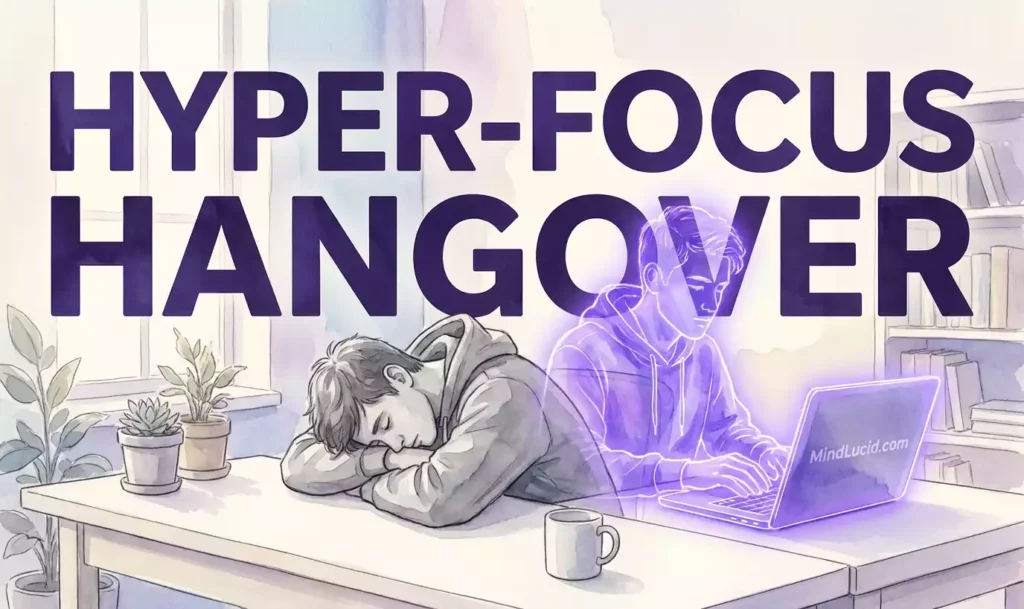
You finally sat down to work on that project. The world faded away. You didn’t check your phone, didn’t hear your stomach growl, didn’t notice the sun going down. Then you looked up and realized eight hours had passed in what felt like thirty minutes. You got more done than you had in the previous two weeks combined. You felt unstoppable — almost electric. And then the next morning arrived. Your brain felt like it was wading through syrup. Words wouldn’t come. Decisions felt impossible. That brilliant, productive version of you? Gone. Welcome to the hyper-focus hangover — the cognitive crash that follows an intense ADHD-driven productivity surge, and one of the most confusing and frustrating experiences for anyone navigating an ADHD brain.
What Exactly Is a Hyper-Focus Hangover?
The hyper-focus hangover is the mental and physical crash that occurs after a prolonged period of intense, uninterrupted concentration — the kind of deep focus many ADHD brains are surprisingly capable of, especially when the task is interesting, urgent, novel, or personally meaningful. Unlike ordinary tiredness, which fades with a good night’s sleep, this hangover can stretch for days. It leaves you feeling drained, foggy, emotionally flat, and mentally slow. You might find yourself rereading the same email five times, forgetting what you walked into a room for, or snapping at someone over something trivial — all because your brain’s resources are temporarily depleted.
Think of it like this: when you hyper-focus, your brain runs at full throttle. It’s exhilarating. But no engine can sustain redline RPMs forever. When the fuel runs out — and it always does — the system needs extended time to recover. The more intense the focus, the longer the recovery window. A single day of extreme productivity can genuinely require two to three days of reduced cognitive function before your baseline returns. This isn’t weakness or laziness. It’s the natural consequence of how ADHD brains manage attention and energy.
Key insight: Hyper-focus isn’t a “superpower” that comes without cost. It’s more like borrowing energy from your future self. The crash isn’t a sign that something is wrong with you — it’s a predictable pattern that many people with ADHD experience. Understanding this pattern is the first step toward managing it.
The Science Behind the Crash: What’s Happening in Your Brain
To understand why the hyper-focus hangover hits so hard, it helps to look at what’s happening behind the scenes. When you enter a hyper-focused state, your brain is essentially running an intensive program with limited system resources. Several key mechanisms are at play.
Dopamine Depletion and the Reward System
ADHD brains are often described as having a dopamine-hungry reward system. When you hyper-focus on something that’s genuinely engaging, your brain releases significant amounts of dopamine and norepinephrine. These neurotransmitters are what make you feel alert, motivated, and capable. But here’s the problem: your brain’s stores of these chemicals are finite. After hours of sustained release, the supply runs low. Rebuilding those stores doesn’t happen overnight. It takes time — often two to three days — for your brain to replenish its neurotransmitter reserves. During that recovery period, everything feels harder because your brain is literally running on reduced chemical resources.
Cognitive Fatigue and Executive Function Drain
Your executive functions — the mental skills that help you plan, prioritize, regulate emotions, and shift attention — require energy to operate. Hyper-focus puts enormous demands on these systems. While you’re “in the zone,” your brain is actively suppressing distractions, maintaining task-relevant information, and inhibiting the urge to switch to something else. That suppression and maintenance require constant energy expenditure. When the session ends, your executive function battery is drained. The result? For the next few days, tasks that normally feel automatic — choosing what to eat, responding to a text, deciding which task to start first — suddenly feel overwhelming.
The Attention “Rubber Band” Effect
ADHD attention often operates like a rubber band. Most of the time, it’s loose and hard to direct — attention scatters everywhere. But when something triggers hyper-focus, that rubber band snaps tight in one direction. The problem is that a rubber band snapped tight for hours doesn’t gently return to its original shape. It rebounds. After an intense focus session, your attention system may swing in the opposite direction — becoming even more scattered, distractible, and resistant to direction than usual. This rebound effect is a core part of why the fog after hyper-focus can feel even worse than your typical ADHD distractibility.
Physical Neglect During Hyper-Focus
During a hyper-focus session, basic needs often get ignored. You skip meals, forget to drink water, don’t move from your chair for hours, and ignore bathroom cues. Your body doesn’t process this neglect as “fine” just because you were mentally absorbed. The physical toll — dehydration, low blood sugar, muscle stiffness, eye strain — contributes to the overall crash. Your body and brain are intertwined systems. When one is depleted, the other suffers. A hyper-focus hangover is as much a physical recovery process as it is a mental one.
Signs You’re Experiencing a Hyper-Focus Hangover
Not sure if what you’re feeling is a hyper-focus hangover or just ordinary tiredness? The distinction matters because the recovery approach is different. Here’s a side-by-side comparison to help you recognize the pattern.
| Characteristic | Ordinary Tiredness | Hyper-Focus Hangover |
|---|---|---|
| Duration | Resolves after one good night’s sleep | Lasts 2–3 days, sometimes longer |
| Mental clarity | Clears up with rest | Persistent brain fog despite sleep |
| Decision-making | Slower but still functional | Feels nearly impossible; even small choices overwhelm |
| Emotional state | Mild irritability or grogginess | Emotional flatness, irritability, or sudden mood swings |
| Focus ability | Reduced but recoverable with effort | Attention scatters; can’t engage even with effort |
| Physical symptoms | Heavy eyelids, yawning | Headache, eye strain, muscle tension, dehydration |
| Response to rest | Improves steadily | Improves only marginally day by day |
| Self-criticism | Minimal | High — “Why can’t I just function?” |
If you’re checking off items from the right-hand column, you’re likely dealing with a hyper-focus hangover. The good news? Knowing what you’re dealing with means you can stop blaming yourself and start supporting your brain’s recovery.
Why ADHD Brains Are Especially Prone to This Cycle
If you have ADHD, you’re more likely to experience both extreme hyper-focus and the subsequent crash. This isn’t a coincidence — it’s built into the way ADHD brains process interest, motivation, and attention.
🎯 Interest-Based Attention
ADHD attention isn’t driven by importance — it’s driven by interest, urgency, novelty, or challenge. When something hits those triggers, focus locks in with unusual intensity. When nothing triggers interest, focus scatters. This all-or-nothing pattern makes extreme focus followed by extreme fog a natural rhythm.
🧩 Dopamine Sensitivity
ADHD brains process dopamine differently. When a task provides a dopamine-rich experience — problem-solving, creative flow, urgency — the brain drinks it in greedily. But the crash afterward is proportional to the spike. Higher highs lead to lower lows.
⏰ Time Blindness
During hyper-focus, the ADHD brain often loses track of time entirely. Hours feel like minutes. This time blindness means you’re less likely to take breaks, eat, or hydrate — extending the depletion window and intensifying the crash.
🔁 Task-Shifting Difficulty
Transitioning out of a hyper-focused state is notoriously hard for ADHD brains. When you finally do break away, the cognitive cost of that transition is higher, leaving you more depleted than someone without ADHD who shifts attention more fluidly.
Understanding these patterns isn’t about labeling yourself as broken. It’s about recognizing how your brain operates so you can work with it instead of against it. The hyper-focus hangover isn’t a personal failure — it’s a predictable consequence of how your brain manages attention and energy.
Are Your Focus Patterns Affecting Your Life?
If the cycle of intense focus followed by days of fog sounds familiar, you’re not alone. Many people with ADHD experience exactly what you’re going through — the frustration, the self-blame, the confusion about why you can’t just “be consistent.” Understanding your unique attention patterns is the first step toward working with your brain instead of fighting it. Our comprehensive ADHD assessment takes just a few minutes and can help you connect the dots between your focus patterns, energy cycles, and daily challenges.
The 3-Day Fog: Breaking Down the Recovery Timeline
Why does a hyper-focus hangover last three days and not just a few hours? The answer lies in how your brain prioritizes recovery. Different cognitive systems recover at different rates, and your brain doesn’t restore everything simultaneously. Here’s what the typical recovery timeline looks like.
Day 1: The Immediate Crash
This is the heaviest fog day. Your brain feels like it’s wrapped in cotton. Executive functions are at their lowest point — planning, organizing, and decision-making feel almost impossible. You might experience headaches, eye strain, and emotional sensitivity. The best thing you can do on this day is lower your expectations dramatically and focus only on basic self-care: hydration, simple food, gentle movement, and rest. Trying to “push through” on Day 1 usually backfires and extends the recovery window.
Day 2: The Slow Rebuild
You’re not as foggy as Day 1, but you’re far from your baseline. Mental tasks feel like they require twice the usual effort. Attention is still scattered, and you may find yourself easily distracted or irritable. This is the day when many people make the mistake of overcompensating — trying to “catch up” on everything they missed. Instead, focus on light cognitive work. Small wins help rebuild your confidence without overtaxing your recovering systems.
Day 3: The Return to Baseline
By Day 3, most people feel significantly better. The fog has largely lifted, energy is returning, and focus is becoming more manageable. You’re not quite at 100%, but you’re close. This is a good day to resume normal activities gradually — not all at once. Jumping straight into another intense focus session on Day 3 can trigger another crash, creating a vicious cycle of burnout and recovery.
Keep in mind that this timeline is a general pattern, not a strict schedule. Some people recover in two days. Others need four or five, especially after an unusually long or intense hyper-focus period. The key is recognizing your own recovery curve and respecting it.
Breaking the Cycle: Practical Strategies That Help
The goal isn’t to eliminate hyper-focus entirely — for many people with ADHD, those deep focus sessions are where their best work happens. The goal is to reduce the severity of the subsequent crash and shorten the recovery window. Here are practical strategies that can help.
Set External Interruption Cues
One of the biggest contributors to the hyper-focus hangover is the physical neglect that happens during the session. Set timers or alarms — not to stop working, but to remind yourself to drink water, stand up, stretch, or eat something. A vibrating smartwatch alarm can be especially effective. Even a 60-second break every 90 minutes can dramatically reduce the physical toll.
Plan Your “Crash Day” in Advance
If you know you’re heading into a hyper-focus session (a deadline, a project launch, a creative burst), plan ahead for the recovery. Clear your calendar for the next day or two. Prep simple meals in advance. Let people know you’ll be less responsive. Having a recovery plan in place reduces the guilt and stress that often make the hangover worse.
Practice the “Transition Ritual”
Coming out of hyper-focus abruptly is jarring for the brain. Instead of trying to jump straight into other activities, create a short transition ritual. This might be a 10-minute walk, a warm shower, a few minutes of deep breathing, or sitting with a cup of tea without looking at any screens. This helps your brain downshift gradually instead of slamming from one extreme to another.
Use “Focus Windows” Instead of Marathon Sessions
When possible, break your hyper-focus time into shorter windows with planned recovery periods. Instead of one eight-hour marathon, try two three-hour blocks separated by a genuine break (food, movement, rest). You’ll still get deep focus, but the crash afterward will be significantly less severe because you gave your brain a chance to partially recover mid-way.
Prioritize Sleep and Hydration
Your brain’s recovery during a hyper-focus hangover depends heavily on sleep quality. During the recovery days, protect your sleep schedule aggressively. Go to bed at a consistent time, create a dark and cool sleep environment, and avoid screens in the hour before bed. Hydration is equally critical — your brain is highly sensitive to dehydration, and even mild dehydration can worsen brain fog.
Practice Self-Compassion
This might be the most important strategy of all. The hyper-focus hangover often triggers intense self-criticism — “Why can’t I just be consistent? Why do I always crash after being productive?” That self-criticism adds emotional weight to an already depleted system, making recovery harder. Instead, practice speaking to yourself the way you’d speak to a friend going through the same thing. The crash isn’t a character flaw. It’s a pattern your brain follows. Patterns can be understood and gradually shaped.
Remember: Your worth isn’t measured by your productivity. The hyper-focus hangover doesn’t erase the work you accomplished during your focus session. It’s a reminder that your brain operates in cycles — and cycles always come back around.
Frequently Asked Questions
How long does a hyper-focus hangover typically last?
Most people experience a hyper-focus hangover for two to three days, though the duration depends on several factors including the length and intensity of the focus session, your overall stress levels, sleep quality during recovery, and whether you took any breaks during the hyper-focus period. After an especially long or intense session, recovery can extend to four or five days. The key is recognizing your own pattern and not judging yourself for needing more time.
Is hyper-focus hangover only something people with ADHD experience?
No, anyone can experience a crash after intense concentration. However, people with ADHD are more prone to hyper-focus hangover because ADHD is associated with more extreme attention patterns — very high focus when interested and very low focus when not. The intensity of ADHD hyper-focus often exceeds what neurotypical people experience, making the subsequent crash proportionally more severe. Additionally, ADHD-related time blindness and task-shifting difficulty can extend the depletion period.
Can I prevent hyper-focus hangover entirely?
Preventing a hyper-focus hangover entirely may not be realistic if you experience intense hyper-focus, but you can significantly reduce its severity. The most effective strategies include setting external interruption cues (timers, alarms) to take brief breaks during focus sessions, staying hydrated and fed, planning recovery days in advance, and using transition rituals to ease out of hyper-focus gradually. Breaking marathon sessions into shorter windows with genuine breaks is also highly effective.
What should I do on Day 1 of a hyper-focus hangover?
On the first day of a hyper-focus hangover, your primary goal should be recovery — not productivity. Drink plenty of water, eat simple nourishing foods, get some gentle movement (even a short walk), and reduce cognitive demands as much as possible. Avoid making important decisions, limit screen time, and resist the urge to push through. Trying to force productivity during the heaviest fog day typically backfires and extends the recovery period. Rest is productive in this context.
Is hyper-focus a sign of ADHD or just a personality trait?
Hyper-focus can occur in people without ADHD, but when it’s combined with other patterns — difficulty sustaining attention on uninteresting tasks, time blindness, task-switching struggles, and the characteristic crash afterward — it may be part of an ADHD pattern. Many people with ADHD describe hyper-focus as a double-edged sword: it enables bursts of incredible productivity but comes with a significant recovery cost. A comprehensive ADHD assessment can help you understand whether your focus patterns fit the ADHD profile and what that means for your daily life.
Final Thoughts: Understanding Your Brain Is the First Step
The hyper-focus hangover is one of the most misunderstood aspects of living with an ADHD brain. From the outside, it looks inconsistent — how can someone be so productive one day and so scattered the next? But from the inside, it makes perfect sense. Your brain operates in cycles of intensity and recovery. The productivity isn’t the anomaly, and neither is the fog. They’re two sides of the same coin.
When you understand this pattern — when you can recognize the signs of a hyper-focus hangover and anticipate when it’s coming — you stop fighting yourself. You start planning around your cycles instead of against them. You give yourself permission to recover without guilt. And you begin to see your attention patterns not as a flaw to fix, but as a rhythm to understand.
If this resonates with you — if you’ve experienced the frustration of intense focus followed by days of fog — you might be wondering whether ADHD is part of your story. Taking a comprehensive ADHD assessment can help you connect the dots. Understanding your brain’s patterns is the first step toward working with them instead of against them. And that understanding is genuinely life-changing.
Your brain isn’t broken. It just works differently. And different can be powerful — once you learn how to navigate it.