
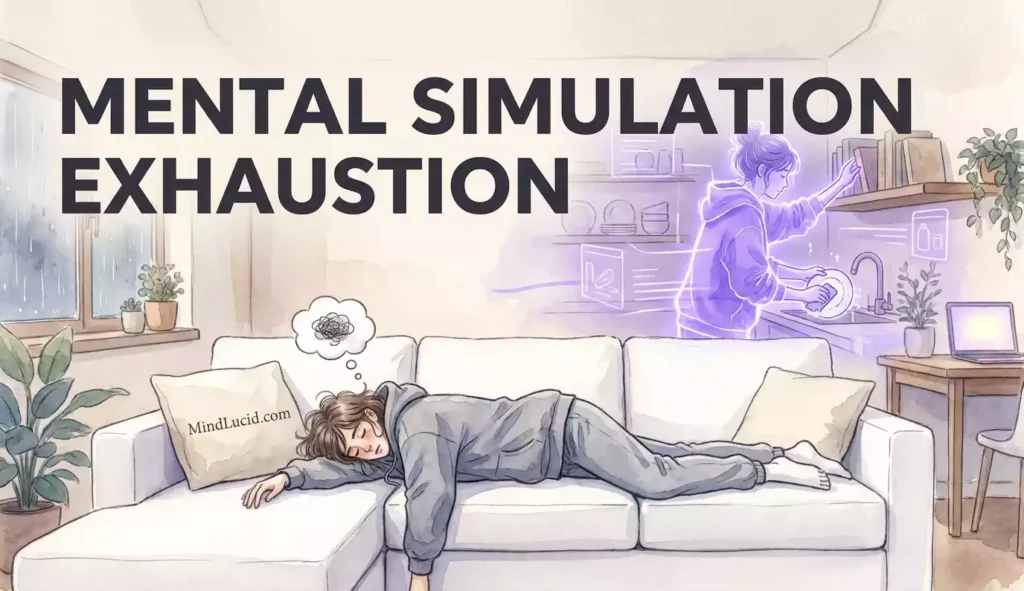
You sit down to start a project. You know exactly what needs to be done. But before you even begin, your mind runs through every step, every possible outcome, every obstacle, every variation of how it might go wrong. Ten minutes later, you haven’t moved—but you feel completely drained. Your brain has already done the work without your body ever catching up. This is mental simulation exhaustion, and it’s one of the most overlooked reasons why highly capable people struggle to take action.
What Is Mental Simulation Exhaustion?
Mental simulation exhaustion happens when your brain engages in vivid, detailed imagining of a task before you actually perform it. It’s not simple daydreaming or casual planning. It’s an intense cognitive rehearsal where your mind constructs the entire experience—the steps, the feelings, the potential obstacles, the imagined reactions of others, and even the emotional weight of completion or failure. By the time you’re ready to start, your cognitive resources have already been spent on the simulation itself.
For people with ADHD or ADHD-like patterns, this experience is amplified. The brain’s natural tendency toward hyper-focus, combined with difficulty filtering out irrelevant details, means that simulating a task can become as mentally taxing as actually doing it. The result? A profound sense of fatigue, procrastination, and often, guilt.
Understanding this phenomenon is the first step toward breaking the cycle. It’s not laziness, and it’s not a lack of willpower. It’s a cognitive pattern that can be recognized, understood, and managed with the right strategies.
Why Thinking Feels Like Doing: The Cognitive Cost of Simulation
Your brain doesn’t fully distinguish between vividly imagining an action and actually performing it. When you simulate a task in your mind with enough detail, the same neural networks that would activate during the real task begin to fire. Your brain processes the simulation as a partial performance of the task itself.
This is why after spending thirty minutes mentally rehearsing a difficult conversation, you might feel as though you’ve already had it. Your nervous system has responded to the imagined scenario as if it were real—releasing stress hormones, increasing heart rate, and consuming glucose. The simulation wasn’t free. It cost you real energy.
The Energy Drain Nobody Talks About
When you mentally simulate a task, your brain consumes actual metabolic energy. Glucose is used. Neural pathways are activated. Neurotransmitters are deployed. This isn’t metaphorical tiredness—it’s physiological. After extensive simulation, your brain is genuinely depleted, and the motivation to then perform the actual task drops dramatically. The simulation has already given your brain a sense of partial completion, reducing the drive to follow through with real action.
The ADHD Amplification Effect
For ADHD brains, the simulation process can become even more exhausting. The ADHD mind tends to generate multiple parallel scenarios simultaneously. Instead of simulating one version of a task, it might simulate five or ten. Each scenario branches into sub-scenarios. The brain’s executive function system, which is already working harder in ADHD, becomes overloaded trying to manage all these imagined possibilities. This is why a person with ADHD might feel utterly paralyzed before a seemingly simple task—their brain has already run dozens of simulations and is now too tired to execute any of them.
How Mental Simulation Exhaustion Shows Up in Daily Life
Mental simulation exhaustion doesn’t announce itself with a label. It hides in everyday experiences, often mistaken for procrastination, anxiety, or simply being “tired.” Here are the most common ways it manifests:
Morning Paralysis
You wake up with a list of things to do. Before getting out of bed, you run through each task in your mind. By the time you physically get up, you feel like you’ve already worked a full day. The actual tasks now feel like a second shift.
The Pre-Meeting Exhaustion
You have a meeting at 3 PM. Starting at 10 AM, your brain begins rehearsing what you’ll say, how others might respond, what questions could come up. By the time the meeting arrives, you’re mentally spent, and your performance suffers—not because you’re unprepared, but because you’ve over-prepared in your head.
The Project Stall
You need to write a report, create a presentation, or complete a project. You open the document, then close it. You think about the structure, the content, the formatting. Your mind builds the whole thing in your head. But your hands never move. The simulation felt like progress, but nothing was actually produced.
Decision Fatigue Before Action
Choosing what to wear, what to eat, or which route to take becomes overwhelming because your brain simulates each option in detail. By the time you decide, you’re too tired to actually follow through with the activity.
Common Mental Simulation Triggers: A Quick Reference
The following table outlines situations that commonly trigger mental simulation exhaustion and the cognitive patterns behind them. Recognizing your triggers is a powerful first step.
| Trigger Situation | What Your Brain Does | Energy Cost | Result |
|---|---|---|---|
| Starting a new project | Simulates entire workflow, outcomes, obstacles | Very High | Overwhelm, delayed start |
| Writing an email | Rehearses phrasing, tone, recipient reactions | Medium | Drafting anxiety, avoidance |
| Making a phone call | Scripts entire conversation, anticipates responses | High | Call avoidance, rescheduling |
| Planning your day | Mentally executes each task in sequence | Medium-High | Feeling busy without doing anything |
| Preparing for a social event | Imagines scenarios, conversations, judgments | High | Social fatigue before arriving |
| Tackling a household task | Visualizes steps, effort required, cleanup | Medium | Task feels bigger than it is |
Does This Sound Like Your Daily Reality?
If you recognize yourself in these patterns—if thinking about tasks consistently leaves you too tired to actually do them—you’re not alone. This experience is deeply connected to how the ADHD brain processes and plans. Understanding your unique cognitive profile can be the key that unlocks everything else.
The ADHD Connection: Why Your Brain Simulates So Much
If you have ADHD or suspect you might, mental simulation exhaustion is not just an occasional annoyance—it can be a defining feature of your daily experience. Here’s why the ADHD brain is especially prone to this pattern:
Hyperactive Default Mode Network
The default mode network (DMN) is the brain system active during mind-wandering, self-referential thinking, and mental simulation. In ADHD brains, the DMN often remains overly active even when you’re trying to focus on something specific. This means your brain is constantly generating simulations, scenarios, and possibilities in the background—whether you want it to or not. You’re not choosing to simulate; it’s happening automatically.
Executive Function Overload
Executive functions are the brain’s management system—planning, prioritizing, initiating, and sustaining action. In ADHD, this system works harder to accomplish the same tasks. When your brain simultaneously runs mental simulations while trying to initiate real action, the executive function system becomes overloaded. The result is that feeling of being stuck: you want to start, but your brain’s management center is already at capacity.
Emotional Dysregulation Intensifies Simulation
ADHD often involves stronger emotional reactions to anticipated events. When you simulate a task, your brain doesn’t just imagine the steps—it also generates the emotional experience of each step. If you anticipate frustration, boredom, or failure, your brain pre-experiences those emotions during the simulation. This emotional preview makes the real task feel even more daunting, further draining your motivation.
Signs You’re Experiencing Mental Simulation Exhaustion
Recognizing the pattern is essential. Here are the key indicators that mental simulation exhaustion is affecting your life:
You feel tired before you start. The thought of a task triggers fatigue even when you’ve had adequate sleep and rest.
You mentally “complete” tasks without doing them. You feel a sense of accomplishment from thinking about something thoroughly, even though no external progress was made.
Your brain won’t stop generating scenarios. Even when you try to relax, your mind continues to simulate upcoming tasks, conversations, and events.
Small tasks feel disproportionately heavy. Things that should take five minutes feel like hour-long ordeals because your brain has already run through them dozens of times.
You experience guilt after periods of “thinking.” You spend hours mentally preparing, then feel terrible because nothing was actually accomplished.
Physical symptoms appear during simulation. You may notice muscle tension, increased heart rate, or shallow breathing while simply thinking about a task.
Frequently Asked Questions About Mental Simulation Exhaustion
Practical Strategies to Reclaim Your Energy
Breaking the cycle of mental simulation exhaustion requires a combination of awareness, external tools, and gentle behavior shifts. Here are strategies that can help:
Time-Box Your Planning
Set a specific, short time limit for planning or thinking about a task before you start. Give yourself five minutes to outline, then commit to action. When the timer goes off, you start. This prevents the simulation from expanding indefinitely.
Externalize Your Thinking
Instead of simulating in your head, put it on paper. Write down the steps, the concerns, the scenarios. External thinking uses different neural pathways and reduces the cognitive load. A notebook, a notes app, or a voice memo can serve as an external brain that holds the simulation so your mind doesn’t have to.
Use the Two-Minute Rule
If a task can be started in under two minutes, start it immediately without any simulation. The act of starting—even in a small way—breaks the simulation loop. Once you’re in motion, your brain shifts from simulation mode to execution mode.
Practice Sensory Grounding
When you notice your brain starting to simulate excessively, ground yourself in physical sensation. Feel your feet on the floor, notice the temperature of the air, touch a textured object. This interrupts the simulation loop and brings your attention back to the present moment where action actually happens.
Reduce the Stakes
Often, simulations run wild because we’ve attached enormous importance to the outcome. Remind yourself that most tasks don’t require perfection. Done is better than perfect. Most things can be fixed, revised, or redone. Lowering the perceived stakes reduces the brain’s need to simulate every possible outcome.
Celebrate Starting, Not Just Finishing
Your brain has learned that simulation feels like progress. To rewire this, you need to associate real action with reward. Every time you start a task—even if you only work for five minutes—acknowledge the win. This builds new neural pathways that make action more rewarding than simulation.
When to Explore Further
If mental simulation exhaustion is a consistent part of your life, if it’s affecting your work, relationships, or sense of well-being, it’s worth exploring whether ADHD or related cognitive patterns might be at play. Many people spend years feeling frustrated, believing they’re lazy or undisciplined, when in reality, their brain is simply processing information differently.
Understanding your cognitive profile isn’t about labeling yourself—it’s about gaining clarity. When you understand why your brain does what it does, you can stop fighting against it and start working with it. The strategies that work for neurotypical brains often don’t work for ADHD brains, and knowing the difference can be life-changing.
Ready to Understand Your Brain Better?
If you’ve recognized yourself in this article—if mental simulation has been draining your energy and preventing you from taking action—take the first step toward clarity. Our comprehensive ADHD assessment is designed to help you understand your cognitive patterns and identify whether ADHD might be part of your story.
Free · Comprehensive · Takes approximately 15-20 minutes