
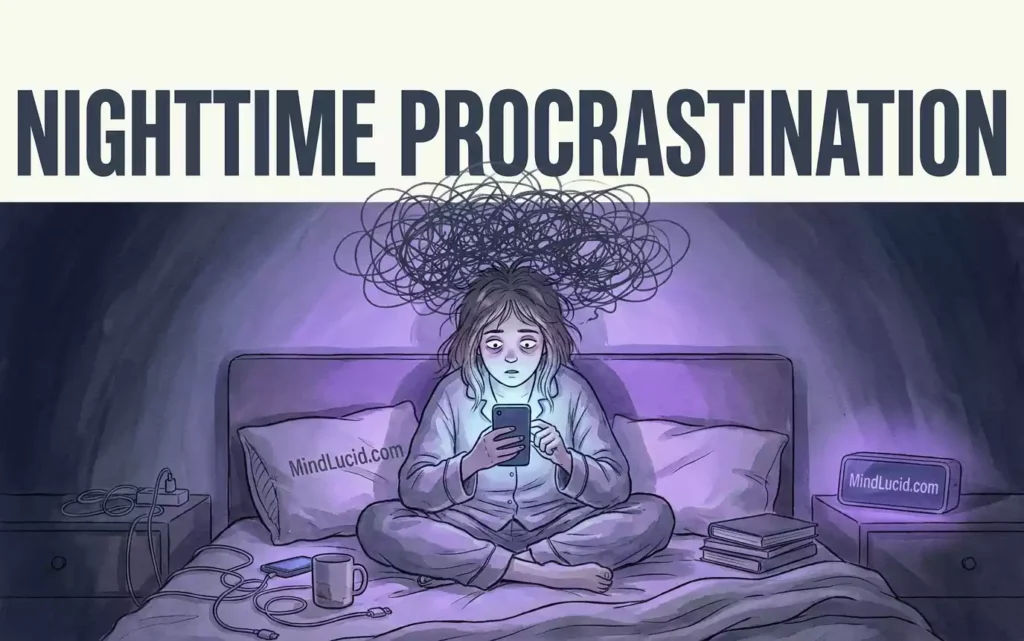
🌙 You’re exhausted. Your eyes are heavy. Your body aches for rest. Yet here you are, scrolling through your phone at 1:47 AM, watching another episode, or reorganizing a playlist you’ll never listen to again. You know you need sleep. You want sleep. But something keeps you from surrendering to it. This isn’t laziness, and it’s not a lack of discipline. It’s sleep procrastination — a fascinating psychological pattern that affects millions of people, especially those with ADHD brains wired for stimulation, novelty, and resistance to transitions. Let’s explore why you delay sleep even when your body is screaming for it, and what’s really happening in your mind during those late-night hours.
🧠 What Is Sleep Procrastination?
Sleep procrastination is the voluntary delay of going to bed, despite knowing there will be negative consequences the next day. It’s not insomnia — people who experience this pattern can fall asleep quickly once they actually try. The challenge lies in the transition from wakefulness to sleep. The term gained widespread attention after researchers at Utrecht University in the Netherlands formally studied it, coining the phrase “bedtime procrastination” to describe this uniquely modern phenomenon.
Think of it as a tug-of-war between two versions of yourself. The morning version of you desperately wishes you’d gone to bed earlier. The nighttime version of you feels an almost irresistible pull to extend the day just a little longer. This internal conflict isn’t about being irresponsible or lacking willpower — it’s about how your brain processes time, reward, and the transition between states of consciousness.
💜 The Key Difference
Sleep procrastination differs from clinical sleep issues in one crucial way: choice. You’re not lying awake unable to sleep. You’re actively choosing to stay awake, even when every signal from your body says it’s time to rest. This distinction matters because it means the solution lies not in sleep medication or medical intervention, but in understanding and working with your psychological patterns.
🔍 The Psychology Behind Nighttime Delay
Understanding sleep procrastination requires looking beneath the surface. On the outside, it looks like you’re just scrolling your phone or watching TV. But inside, several powerful psychological forces are at play simultaneously.
⚡ The Revenge Factor
One of the most widely discussed explanations is something called “revenge bedtime procrastination.” This term originated in China and gained global attention during the pandemic. It describes the act of reclaiming personal time that you feel was stolen from you during the day. If your entire day was consumed by work, obligations, family duties, and other people’s needs, nighttime becomes the only time that’s truly yours.
That scroll through social media at midnight isn’t about the content — it’s about asserting control. Your brain is saying, “I deserve this time. I’ve earned it.” The problem is that this reclaimed time comes at an enormous cost: your energy, focus, and emotional regulation the next day.
🧩 The Transition Barrier
For many people — especially those with ADHD — transitions are genuinely difficult. Moving from one state to another requires executive function, the brain’s management system for planning, organizing, and shifting attention. When you’re engaged in something stimulating, the idea of stopping to lie in a quiet, dark room feels like a punishment rather than a relief.
This is why you might suddenly feel the urge to reorganize your desk at 11 PM, start a creative project, or dive into researching something completely random. Your brain is fighting the transition with everything it has, offering up alternative activities that feel more rewarding in the moment.
🎯 The Dopamine Connection
Your smartphone is a dopamine delivery system. Every notification, every swipe, every new piece of content delivers a small burst of the brain’s reward chemical. When you’re tired, your brain’s natural dopamine levels are lower, which means that digital stimulation becomes even more appealing as a way to boost your mood and energy.
This creates a dangerous loop: you’re tired, so you seek stimulation to feel better, but the stimulation keeps you awake, which makes you more tired, which makes you seek more stimulation. Breaking this cycle requires understanding it for what it is — a biological pattern, not a personal failing.
🧩 Why ADHD Brains Are Especially Vulnerable
If you have ADHD or suspect you might, sleep procrastination isn’t just an occasional habit — it can feel like a nightly battle. The ADHD brain operates differently in several key ways that make bedtime delay particularly challenging.
🕐 Time Blindness
People with ADHD often experience what researchers call “time blindness” — difficulty perceiving the passage of time accurately. At 10 PM, midnight feels hours away. At 11:45 PM, it still feels like there’s plenty of time. This distorted time perception means that the deadline of “bedtime” doesn’t carry the same urgency as it might for others. The alarm clock says 11 PM, but your brain genuinely feels like it’s only been evening for a short while.
🎪 Stimulation Seeking
The ADHD brain has a higher threshold for stimulation. What feels comfortably engaging for others might feel boring or even uncomfortable for someone with ADHD. This means that the prospect of lying in a quiet, dark room — with nothing to do but wait for sleep — can feel genuinely unpleasant or even anxiety-inducing. Your brain craves input, and the nighttime quiet feels like deprivation.
🔄 Executive Function Fatigue
By the end of the day, the executive function resources in an ADHD brain are often depleted. Executive function is responsible for self-regulation, decision-making, and impulse control — exactly the skills needed to override the temptation to stay up late. When these resources are running on empty, the automatic, habitual patterns take over, and your ability to “just go to bed” becomes significantly harder than it sounds.
⏰ Delayed Sleep Phase
Many individuals with ADHD have what’s called a delayed sleep phase — their natural circadian rhythm runs later than the typical schedule. Their bodies genuinely produce melatonin later in the evening, meaning they may not feel naturally sleepy until 1 AM or 2 AM. Fighting against this biological reality every night creates frustration and makes the bedtime transition even more difficult.
📊 Common Patterns of Sleep Procrastination
Sleep procrastination manifests in different ways for different people. Recognizing your specific pattern is the first step toward changing it. Here are the most common forms, along with what’s happening beneath the surface:
| Pattern | What It Looks Like | Underlying Motivation |
|---|---|---|
| 📱 Digital Scrolling | Endless social media, news feeds, or video watching | Dopamine seeking, avoiding mental stillness |
| 📺 “One More Episode” | Binge-watching shows despite heavy eyelids | Story immersion, avoiding the transition to sleep |
| 💼 Sudden Productivity | Feeling a burst of motivation to work or organize at midnight | Reclaiming control, ADHD hyperfocus activation |
| 🧠 Mental Planning | Lying awake thinking through tomorrow’s tasks repeatedly | Anxiety about the future, seeking certainty |
| 🎮 Gaming or Hobbies | Engaging in stimulating activities that delay bedtime | Achievement seeking, flow state resistance |
| 💬 Late-Night Conversations | Texting, calling, or chatting with others into the night | Social connection, avoiding solitude of sleep |
Each of these patterns serves a psychological purpose in the moment. That’s why simply telling yourself to “stop doing it” rarely works. The behavior is meeting a need — even if it’s doing so in a way that ultimately harms you.
🔄 The Vicious Cycle of Nighttime Delay
One of the most frustrating aspects of sleep procrastination is how self-perpetuating it becomes. Each night of delayed sleep makes the next day harder, which makes the next night’s resistance to sleep even stronger.
Here’s how the cycle typically unfolds:
💊 The Exhaustion Paradox
Perhaps the most confusing part of sleep procrastination is the disconnect between how tired you feel and how unwilling you are to act on that tiredness. You might be so exhausted that your eyes are burning, yet still feel unable to put down your phone and close your eyes.
This happens because the brain’s arousal system and its sleep system are separate. When you’re engaged in stimulating activity — even passive activities like scrolling — your arousal system remains active. The tiredness you feel is your body’s signal, but your brain’s attention is captured elsewhere. Closing your eyes would require actively disengaging from that stimulation, which takes executive function — the very resource that’s been depleted by the day.
This is why the solution isn’t simply “trying harder.” You can’t brute-force your way through an executive function deficit. Instead, you need to work with your brain’s patterns, creating conditions that make the transition to sleep feel less like a sacrifice and more like a natural shift.
🌙 Is Your Nighttime Struggle Part of a Bigger Pattern?
If you recognize yourself in these descriptions — the nightly battle with bedtime, the exhausting tug-of-war between knowing what you need and feeling unable to choose it — you might be experiencing more than just a habit. Many people who struggle with chronic sleep procrastination also have underlying attention differences that make transitions, time perception, and self-regulation uniquely challenging. Understanding your cognitive patterns can be the key that unlocks real change.
💜 Breaking Free: Practical Strategies That Actually Work
Understanding the psychology of sleep procrastination is essential, but you also need actionable strategies to create change. The following approaches are designed to work with your brain’s patterns rather than against them.
🌅 Create a “Sunset” Routine
Instead of expecting yourself to abruptly transition from stimulation to sleep, create a gradual winding-down period. Think of it like a sunset for your nervous system. About 60-90 minutes before your target bedtime, start dimming the intensity:
⏰ Use External Time Anchors
Because time blindness is a major factor in sleep procrastination, relying on your internal sense of time is unreliable. Instead, use external anchors to create awareness:
🎯 Reframe the Transition
If your brain perceives bedtime as a loss — losing personal time, losing stimulation, losing the day — it will always resist. Shift the framing:
🧠 Address the Underlying Need
The most effective long-term strategy is to address why you’re delaying sleep in the first place. If you’re engaging in revenge bedtime procrastination because you feel you have no personal time, the solution isn’t just going to bed earlier — it’s creating more genuine personal time during your day.
Look for small pockets of “you” time that don’t require sacrificing sleep. A 15-minute break during your lunch hour to read. A quick walk in the afternoon without your phone. A morning routine that’s actually yours, not just preparation for work. When your daytime life has more breathing room, the desperate need to reclaim nighttime diminishes.
❓ Frequently Asked Questions About Sleep Procrastination
Is sleep procrastination the same as insomnia?
No. With insomnia, you want to sleep but can’t. With sleep procrastination, you could sleep but choose not to — you’re actively delaying bedtime. The distinction matters because the solutions are different. Insomnia often requires addressing sleep physiology or anxiety, while sleep procrastination requires addressing motivation, transitions, and behavioral patterns.
Why do I suddenly feel productive at midnight?
This is a common experience for people with ADHD. As the day winds down and external demands decrease, the pressure lifts, and your brain finally feels free to engage. Combined with the natural quiet of nighttime and reduced distractions, this creates conditions where hyperfocus can activate. Unfortunately, this productivity comes at the cost of sleep, creating a cycle of depletion.
Can sleep procrastination be unlearned?
Absolutely. While the underlying tendencies (like time blindness or stimulation seeking) may be part of your brain’s natural wiring, the specific behaviors can absolutely be changed. It requires building new routines, using external supports, and being patient with yourself during the transition period. Many people find that once they understand the psychology behind their delay, they can start making meaningful changes.
Why does my brain resist sleep even when I’m exhausted?
Exhaustion depletes executive function — the mental energy needed for self-control and decision-making. When executive function is low, your brain defaults to whatever is most immediately stimulating. The tiredness you feel is a body signal, but your brain’s attention system is still active and seeking engagement. This is why willpower alone rarely works to change the pattern.
Is sleep procrastination more common in people with ADHD?
Yes, significantly. Research and clinical observation consistently show that people with ADHD experience sleep procrastination at much higher rates than the general population. This is due to several factors: time blindness, higher stimulation thresholds, executive function challenges, and often a naturally delayed circadian rhythm. If you recognize this pattern strongly in yourself, exploring ADHD resources could provide valuable insights.
🌙 The Path Forward
Sleep procrastination is not a character flaw. It’s not laziness, and it’s not something you can simply decide your way out of. It’s a complex pattern rooted in psychology, neurology, and the modern environment we live in — an environment designed to capture attention and resist disconnection.
Understanding what’s happening beneath the surface is the first step. Recognizing that your late-night scrolling might be about reclaiming personal time, or that your resistance to bed is actually difficulty with transitions, transforms the experience from self-blame into self-understanding.
If you see yourself clearly in these patterns — especially if you experience other signs of attention differences like difficulty with focus, time management, organization, or emotional regulation — taking a comprehensive assessment could be the next step in your journey toward understanding. Knowledge isn’t just power; it’s the foundation for real, sustainable change.
💜 You deserve rest. You deserve understanding. And you deserve a nighttime experience that feels like replenishment rather than battle.