
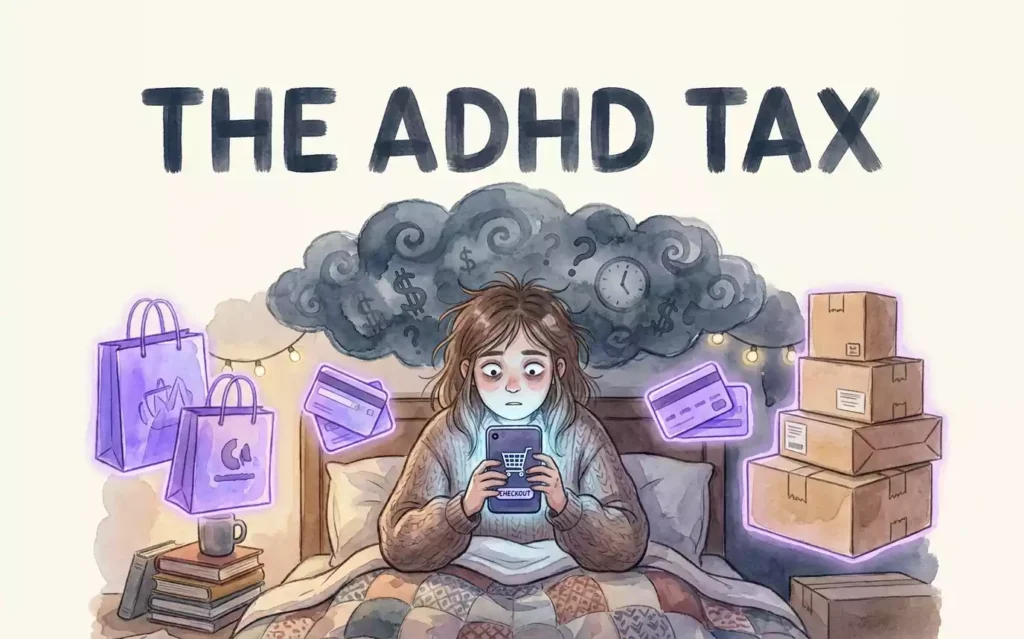
It’s 3:14 AM. Your phone glows in the dark like a portal to another world. Your thumb hovers over “Complete Purchase.” The cart total reads $247.83. You don’t remember how you got here—one minute you were checking a single email, the next you’ve somehow bought a pasta maker, three mystery novels, and a subscription to a meditation app you’ll never open. This isn’t poor self-control. This isn’t laziness. This is the ADHD Tax—and it’s costing you far more than just money.
What Exactly Is the ADHD Tax?
The ADHD Tax isn’t a government levy or a line item on your bank statement. It’s the invisible financial, emotional, and psychological penalty you pay simply for having a brain that works differently. Coined by the ADHD community, the term describes the cumulative cost of forgotten bills, late fees, impulse purchases, lost items, missed appointments, and the countless other “small” expenses that pile up when executive function doesn’t cooperate.
Think about it: every late payment fee, every replacement phone charger you had to buy because you lost three others, every subscription you forgot to cancel, every impulse purchase at 3 AM that you barely remember making. That’s the ADHD Tax. And for many adults with ADHD, it amounts to thousands of dollars per year—not because they’re irresponsible, but because their brain’s reward system, working memory, and impulse control operate on a fundamentally different operating system.
Research and community surveys consistently show that adults with ADHD experience significantly higher rates of financial stress, credit card debt, and late payment penalties compared to neurotypical peers. One study published in the Journal of Attention Disorders found that adults with ADHD reported more impulsive buying behavior and greater difficulty managing money than control groups. The ADHD Tax is real, it’s measurable, and it’s profoundly unfair.
🧠 Key Insight: The ADHD Tax isn’t a character flaw. It’s a neurological difference that affects planning, foresight, and impulse regulation. Understanding this is the first step toward breaking the cycle.
The Neuroscience Behind 3 AM Impulse Buying
Why does your brain decide that 3 AM is the perfect time to purchase a ceramic cat figurine or a set of professional-grade kitchen knives? The answer lies deep within the neurobiology of ADHD—specifically in the interplay between dopamine, executive function, and circadian rhythm disruption.
🧩 The Dopamine Chase
At its core, ADHD is characterized by dopamine dysregulation. Dopamine is the neurotransmitter responsible for motivation, reward anticipation, and the feeling of “that was worth doing.” In ADHD brains, dopamine signaling is often weaker or less efficient. This means everyday tasks that might feel rewarding to a neurotypical person—paying bills, organizing, planning ahead—feel chronically understimulating to someone with ADHD.
Impulse buying provides a rapid dopamine spike. The anticipation of a new purchase, the excitement of finding a “great deal,” the click of the buy button—each step delivers a small hit of dopamine. At 3 AM, when your brain is tired, your inhibitions are lowered, and your executive function is running on fumes, that dopamine chase becomes nearly impossible to resist. Your brain isn’t asking, “Do I need this?” It’s asking, “Will this make me feel better right now?”
🌙 The Late-Night Circadian Factor
ADHD is strongly associated with delayed sleep phase syndrome—a circadian rhythm disorder where your natural sleep-wake cycle is shifted later. Many adults with ADHD don’t feel genuinely alert until late evening, and their brains often experience a “second wind” around 10 PM to 2 AM. During this time, you might feel more awake, more focused, and more mentally active than you did all day.
But here’s the catch: while your mind feels alert, your prefrontal cortex—the brain region responsible for impulse control, long-term planning, and weighing consequences—is running on depleted reserves. It’s been working all day, and it’s tired. Meanwhile, the limbic system, which drives emotion and immediate gratification, is still very much online. The result? A perfect storm where your desire for stimulation is high, but your ability to say “no” is critically low.
⏰ The Executive Function Gap
Executive function—the brain’s CEO—is responsible for planning, working memory, emotional regulation, and self-monitoring. These are precisely the skills that ADHD affects most. At 3 AM, after a full day of executive function depletion, your brain has essentially left the building. The mental energy required to think, “Wait, do I actually need this? Can I afford this? Where will I put this?” is simply not available. Your brain defaults to the path of least resistance: instant gratification.
The Hidden Costs of the ADHD Tax
The most visible cost of the ADHD Tax is the money that leaves your bank account. But the true cost runs much deeper. Let’s break down the layers:
Here’s a breakdown of common ADHD Tax scenarios and their real-world impact:
| ADHD Tax Scenario | Immediate Cost | Hidden Long-Term Cost | Prevention Strategy |
|---|---|---|---|
| Forgotten subscriptions | $12.99/mo | $155.88/year wasted on services you don’t use | Use a subscription tracker; set calendar reminders |
| Late bill payments | $35 late fee | Credit score damage, higher interest rates, loan denials | Set up auto-pay for all recurring bills |
| 3 AM impulse purchase | $50–$300 | Clutter, guilt, financial stress, potential debt | Implement a 24-hour waiting rule |
| Losing important items | $20–$100 replacement | Time cost, stress, missed opportunities | Designate specific “homes” for essential items |
| Missed appointments | $50–$200 fee | Health consequences, professional reputation | Use multiple reminders; schedule buffer time |
| Overdraft fees | $35 per occurrence | Banking relationship damage, restricted accounts | Set up low-balance alerts; keep a buffer |
Studies estimate that the ADHD Tax costs adults with ADHD anywhere from $1,500 to $5,000+ per year in avoidable expenses. Over a lifetime, this can amount to hundreds of thousands of dollars—a staggering penalty for a neurological condition that already makes life challenging enough.
Why 3 AM Specifically? The Perfect Storm
You might wonder: why is it always 3 AM? Why not 10 AM or 3 PM? The answer lies in a convergence of multiple factors that create the ideal conditions for impulse buying:
Executive Function Depletion: After a full day of masking symptoms, making decisions, and forcing focus, your brain’s executive function reserves are critically low. The prefrontal cortex—your impulse control center—is running on empty.
Reduced External Structure: At 3 AM, there’s no boss watching, no social pressure, no schedule to follow. The external scaffolding that helps you regulate during the day has been removed.
Smartphone Proximity: Your phone is within arm’s reach, and it’s loaded with apps specifically designed to make purchasing frictionless. One-tap checkout removes the last barrier between impulse and action.
Emotional Vulnerability: Late night is often when anxiety, loneliness, boredom, and rumination peak. Shopping becomes a form of self-soothing—a way to feel something positive when everything else feels heavy.
Altered Time Perception: ADHD already affects time perception, and at 3 AM this distortion is amplified. “This won’t matter in the morning” feels true because your brain can’t properly project future consequences.
The combination of these five factors creates what researchers call a “vulnerability window”—a period where your brain’s natural defenses against impulsivity are at their absolute lowest. Understanding this isn’t about making excuses; it’s about recognizing patterns so you can build systems that work with your brain instead of against it.
🧠 Your Brain Isn’t Broken—It’s Just Wired Differently
The ADHD Tax doesn’t have to be your forever. Understanding your unique ADHD profile is the first step toward breaking the cycle of 3 AM impulse buying, forgotten bills, and financial stress. Our comprehensive ADHD assessment gives you personalized insights into how your brain works, what triggers your impulsivity, and which strategies will actually stick for you. No shame. No judgment. Just science-backed understanding tailored to your brain.
✓ Free • ✓ Takes 10–15 minutes • ✓ Instant personalized results
Breaking the Cycle: Practical Strategies That Actually Work
Now for the part you’ve been waiting for: how to stop the 3 AM impulse buying and reduce your ADHD Tax. The key principle is simple—you can’t rely on willpower when your executive function is depleted. You need external systems that do the heavy lifting for you. Here are strategies designed specifically for the ADHD brain:
🛡️ The 24-Hour Rule (Non-Negotiable)
This is the single most effective strategy for curbing impulse purchases. Before buying anything that isn’t a genuine necessity, impose a mandatory 24-hour waiting period. Add the item to your cart, close the app, and walk away. If you still want it 24 hours later—and you can afford it—then consider purchasing. In most cases, the urge will pass. The dopamine spike from “almost buying” fades, and your rational brain regains control.
💡 Pro Tip: Create a “Wish List” folder on your phone. Add impulse items there instead of your cart. Review the list once a month—you’ll be surprised how few items you still want.
🔒 Make It Harder to Buy
Every extra step between impulse and purchase is a chance for your rational brain to catch up. Here’s how to add friction:
- Delete shopping apps from your phone—use the mobile browser instead, where checkout is slower
- Remove saved payment methods from Amazon, Apple Pay, and other one-click checkout systems
- Use a separate card for online purchases with a low spending limit
- Set app blockers (like Freedom or Opal) that block shopping sites between 11 PM and 7 AM
- Charge your phone outside the bedroom to reduce the 3 AM browsing temptation
⏰ Automate Your Financial Life
Your ADHD brain shouldn’t have to remember to pay bills, transfer savings, or cancel trials. These are perfect candidates for automation:
🌅 Address the Root: Sleep and Stimulation
If 3 AM is your impulse buying hour, one of the most powerful interventions is improving your sleep schedule. When you’re actually asleep at 3 AM, you can’t impulse buy. Easier said than done with ADHD, but these strategies help:
- Get morning sunlight exposure within 30 minutes of waking to reset your circadian rhythm
- Implement a digital sunset—no screens 60–90 minutes before your target bedtime
- Try a wind-down routine that gives your brain a clear “we’re transitioning to sleep” signal
- Consult your doctor about melatonin or ADHD medication timing—many people with ADHD benefit from adjusting medication schedules to support sleep
🧠 Work With a Professional
If the ADHD Tax is significantly impacting your life, professional support can be transformative. Cognitive Behavioral Therapy (CBT) adapted for ADHD has been shown to reduce impulsive behaviors. An ADHD coach can help you build systems tailored to your specific challenges. And proper medication management—when appropriate—can address the underlying dopamine dysregulation that drives impulsivity in the first place.
Frequently Asked Questions About the ADHD Tax & Impulse Buying
Late-night impulse buying in ADHD results from a combination of factors: depleted executive function after a full day of managing symptoms, reduced external structure and accountability, the dopamine-seeking behavior inherent to ADHD, and smartphone apps designed to make purchasing frictionless. At 3 AM, your brain’s impulse control center (prefrontal cortex) is exhausted while your reward-seeking system remains active, creating a vulnerability window where self-control is at its lowest.
The ADHD Tax is both a real financial phenomenon and a metaphorical framework. It’s backed by research showing that adults with ADHD experience significantly higher rates of financial difficulties, including impulsive spending, late payments, and debt. Studies have found that ADHD is associated with lower credit scores, higher likelihood of bankruptcy, and more difficulty managing money. The “tax” metaphor captures the cumulative, often hidden costs of living with ADHD in a world designed for neurotypical brains.
Estimates vary, but community surveys and financial analyses suggest that adults with ADHD lose anywhere from $1,500 to $5,000+ per year to ADHD Tax expenses—late fees, impulse purchases, forgotten subscriptions, replacement items, and missed appointment fees. Over a 40-year working life, this could amount to $60,000 to $200,000 or more. This doesn’t include the opportunity cost of money not invested or the indirect costs of stress and time lost.
Yes, for many people. ADHD medications—particularly stimulants like methylphenidate and amphetamine-based medications—work by increasing dopamine and norepinephrine availability in the brain. This can improve impulse control, working memory, and executive function, making it easier to pause before acting on an impulse. However, medication is most effective when combined with behavioral strategies, environmental modifications, and healthy habits. Always consult with a qualified healthcare provider about medication options.
The fastest immediate intervention is the 24-hour rule: add the item to your cart, then close the app and wait 24 hours before deciding. Also, physically putting your phone in another room overnight eliminates the trigger entirely. For a quick in-the-moment pause, try the “STOP” technique: Stop, Take a breath, Observe your thoughts and feelings, and Proceed mindfully. Ask yourself: “How will I feel about this purchase tomorrow morning?” Most impulse urges pass within 15–20 minutes if you can create distance.
It depends on the individual. Some people with ADHD develop better coping strategies and self-awareness as they age, leading to reduced impulsivity. Others may find that life stressors—financial pressure, career demands, family responsibilities—exacerbate symptoms. What we know from research is that ADHD is a lifelong neurodevelopmental condition, and symptoms can fluctuate based on stress, sleep, health, and life circumstances. The key is building robust systems that work regardless of your fluctuating executive function levels.
Final Thoughts: Reclaiming Your Financial Power
Living with ADHD means your brain operates on a different operating system—one that’s brilliant at creativity, hyperfocus, and out-of-the-box thinking, but challenged by impulse control, time management, and long-term planning. The ADHD Tax isn’t a punishment for being “bad with money.” It’s a predictable consequence of a neurological condition that affects executive function. And like any predictable pattern, it can be interrupted.
The strategies outlined here—the 24-hour rule, adding friction to purchasing, automating your finances, addressing sleep, and seeking professional support—aren’t about willpower. They’re about working with your brain instead of against it. They’re about recognizing that you can’t white-knuckle your way through executive function depletion, but you can build systems that protect you when your defenses are down.
Most importantly, understanding your unique ADHD profile is the foundation for everything else. You can’t fix what you don’t understand. A comprehensive ADHD assessment gives you the self-knowledge to identify your specific triggers, vulnerabilities, and strengths. It transforms the ADHD Tax from an invisible force draining your bank account into a measurable challenge you can actually address.
Ready to understand your brain on a deeper level? Take our free ADHD assessment and discover how your unique wiring affects your decisions, your spending, and your life. Because once you understand the pattern, you hold the power to break it.