
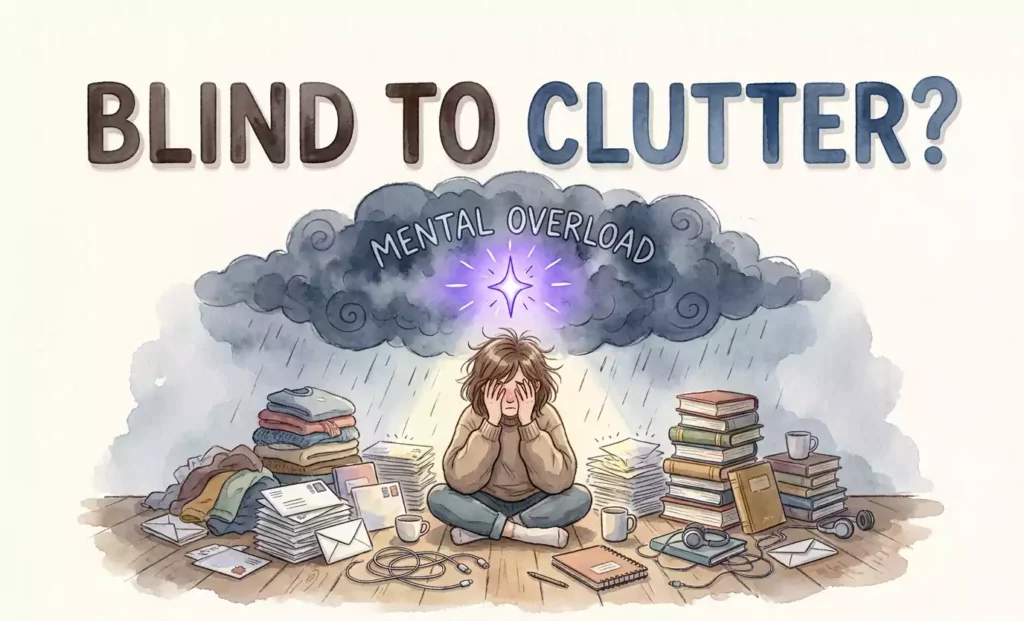
You walk past that stack of papers on the corner of your desk for what feels like the hundredth time. The pile has been sitting there for weeks — maybe months. It started as a single unopened envelope, then quietly absorbed a receipt, a random cable, two sticky notes, and a coffee mug that somehow migrated there. Now it’s a small mountain range in the corner of your room. And here’s the strange part: you know it’s there. You know you should deal with it. But every time your eyes sweep past it, your brain just… skips over it. Like it’s not even there. If this sounds deeply familiar, you’re not alone — and you’re not broken. You may be experiencing what many adults with attention differences call the “Doom Pile” phenomenon.
What Exactly Is a Doom Pile?
A doom pile is a physical collection of items — papers, mail, clothes, random objects, charging cables, receipts — that accumulates in a specific spot and becomes increasingly invisible to the person who created it. The name comes from that heavy feeling of dread (the “doom”) that washes over you when you finally confront the pile. It’s not laziness. It’s not a character flaw. And it’s definitely not the same as hoarding, which involves an intense emotional attachment to possessions and an inability to discard anything.
Doom piles are different. They’re not about wanting to keep things. They’re about not being able to process them in the moment. Each item in the pile represents a micro-decision that was deferred: “I’ll deal with this later.” “This goes somewhere, but I don’t know where right now.” “I might need this, so I’ll leave it here.” One deferred decision becomes two, then five, then twenty. Before you know it, the pile has its own gravitational pull.
What Makes Doom Piles Different from Normal Clutter?
Everyone has cluttered areas sometimes. The difference with doom piles is the invisibility factor. A person without attention differences might see a pile and think, “I should clean that up” — and then actually do it. For someone whose brain struggles with executive function, the pile becomes background noise. It fades into the visual landscape. Your brain literally stops registering it as something that requires action. The pile becomes wallpaper.
This isn’t a willpower problem. It’s a brain wiring difference in how attention, task initiation, and spatial organization work together. And understanding this distinction is the first step toward breaking the cycle.
| Type of Doom Pile | What It Contains | Why Your Brain Creates It |
|---|---|---|
| 📄 The Paper Mountain | Mail, receipts, bills, documents, school papers | Each item requires a decision: keep, toss, file, act on. Too many micro-decisions overload the brain. |
| 👕 The Chair Collection | Clothes that are “not dirty enough for laundry” but “not clean enough for the closet” | The binary system of clean/dirty doesn’t fit how your brain categorizes items. A third category is needed but never gets created. |
| 🔌 The Cable Nest | Chargers, headphones, random tech accessories, batteries | These items don’t have an obvious “home.” Your brain needs a designated spot to exist first, but creating one feels like a project. |
| 🎒 The Bag Vortex | Everything that gets shoved into a bag, backpack, or tote when you’re in a hurry | When time pressure hits, your brain defaults to “out of sight, out of mind.” The bag becomes a temporary holding cell that never gets emptied. |
Why Your Brain Makes Clutter Invisible
To understand why doom piles form — and why they become invisible — we need to look at how attention and executive function work in brains that process information differently. This isn’t about intelligence. Many highly intelligent, creative, and successful people live with doom piles. It’s about how the brain manages initiation, prioritization, and spatial attention.
The Attention Filter Problem
Your brain has a built-in filtering system. It constantly scans your environment and decides what’s relevant and what can be ignored. This is essential — without it, every visual detail would demand equal attention, and you’d be completely overwhelmed. But in brains with attention differences, this filter works differently. Sometimes it’s too porous (everything demands attention at once). Other times, it’s too aggressive about filtering out things that have been present for a while.
When a pile sits in the same spot for days or weeks, your brain’s filtering system starts categorizing it as “permanent fixture” rather than “action item.” It’s the same reason you might not notice a picture frame that’s been on your wall for years. The difference is that the picture frame is supposed to be there. The doom pile is not — but your brain can’t tell the difference anymore.
The Executive Function Connection
Executive function is your brain’s “project manager.” It handles task initiation (starting things), planning, organization, working memory, and impulse control. When executive function is taxed — which happens constantly for people with attention differences — the brain conserves energy by avoiding tasks that feel complicated or open-ended.
Here’s the thing about doom piles: they’re not a single task. They’re dozens of micro-tasks stacked on top of each other. That single pile of papers might contain a bill that needs paying, a form that needs filling out, a receipt that needs scanning, a coupon that might still be valid, and a card from someone you care about that needs responding to. Your brain sees all of those steps at once, feels the overwhelm, and decides to skip it entirely. The pile becomes invisible because your brain is protecting you from the overwhelm of processing it.
Dopamine, Motivation, and the “Now vs. Later” Problem
Motivation isn’t just about wanting to do something. It’s heavily influenced by brain chemistry — particularly dopamine, the neurotransmitter associated with reward, anticipation, and task engagement. Brains with attention differences often have altered dopamine signaling, which means the “reward” signal from completing a boring, repetitive, or low-stimulation task is much weaker.
Cleaning up a doom pile offers very little immediate reward. It’s tedious, it involves many small decisions, and the payoff (a clean space) feels abstract and distant. Compare that to scrolling on your phone, starting a creative project, or doing something new and interesting — those activities provide immediate stimulation. Your brain naturally gravitates toward the more rewarding option. The doom pile stays put not because you don’t care, but because your brain’s reward system doesn’t register it as worth the energy.
Each of these factors reinforces the others. Visual scanning differences make it hard to even notice the pile’s growth. Task breakdown challenges make cleaning it feel impossible. Time blindness makes you underestimate how long it would actually take. And decision fatigue makes every item in the pile feel like a mountain. The result? The pile grows, becomes invisible, and the cycle continues.
Is Your Brain Wired This Way?
If you recognize yourself in these patterns — the invisible piles, the deferred decisions, the overwhelm when you try to start — you might be experiencing attention differences that go beyond just “being messy.” Understanding how your brain works is the first step toward building systems that actually work for you, not against you.
The Emotional Weight of Doom Piles
Doom piles aren’t just physical clutter. They carry emotional weight that can be heavier than the pile itself. Every time you notice the pile (on the rare occasions your brain lets you), you might feel a flash of shame, frustration, or self-criticism. “Why can’t I just deal with this? It would take five minutes.” But here’s what’s really happening: your brain isn’t being lazy. It’s overwhelmed by the complexity of the task, not by the physical effort required.
The emotional cycle often looks like this: you notice the pile → you feel guilty → you avoid the pile because it triggers guilt → the pile grows → you feel even guiltier → you avoid it more. This is a shame spiral, and shame is not a good motivator for brains that already struggle with initiation. Shame actually makes task initiation harder, not easier, because it increases the emotional cost of engaging with the task.
Reframing the Narrative
The first step toward breaking free from doom piles isn’t a cleaning system. It’s a mindset shift. Instead of asking “Why can’t I just deal with this?”, try asking “What is my brain telling me about how this task is structured?” The answer is usually one of these:
- The task has too many steps and your brain doesn’t know where to start
- The task lacks a clear enough reward to feel worth doing right now
- There’s no designated “home” for the items in the pile, so even if you clean it, there’s nowhere to put things
- You’re experiencing decision fatigue and every item in the pile requires a decision
- The pile has been there so long that it’s triggered a freeze response — your brain literally doesn’t know how to begin
None of these are character flaws. They’re structural challenges in how the task is organized and how your brain processes it. And structural challenges have structural solutions.
Breaking the Cycle: Practical Approaches That Actually Work
Traditional organization advice often fails for brains with attention differences because it assumes a level of executive function that may not be consistently available. “Just spend 15 minutes a day tidying” sounds reasonable, but it doesn’t account for the fact that starting is the hardest part, not the doing. Here are approaches that work with your brain instead of against it.
The “One Item” Method
When a doom pile feels overwhelming, the goal isn’t to clean the whole pile. The goal is to touch one item. Just one. Pick up one piece of paper. That’s it. You don’t have to decide what to do with it. You don’t have to sort anything. Just pick up one item and put it somewhere — anywhere. This breaks the freeze response and tells your brain, “Oh, this task is actually possible.” Often, once you’ve handled one item, the next one feels slightly easier. And the next. But if you stop after one? That’s still a win. You’ve broken the invisibility barrier.
Create “Homes” Before You Clean
One of the biggest reasons doom piles form is that items don’t have a designated place. If you don’t know where something goes, you can’t put it away — so it goes into the pile. Before you attempt to tackle a doom pile, spend a few minutes (on a different day, ideally) creating clear “homes” for the categories of items in the pile. A tray for papers that need action. A box for receipts. A hook for the bag. A shelf for cables. When items have homes, the task of cleaning becomes mechanical rather than decision-heavy.
The Timer Strategy (With a Twist)
The standard advice is “set a timer for 15 minutes and clean.” But for attention-different brains, 15 minutes can feel like an eternity when the task is low-dopamine. Try this instead: set a timer for 3 minutes. Just 3 minutes. That’s shorter than most songs. Your only goal is to handle items from the pile until the timer goes off. When it does, you can stop completely — no guilt, no obligation. Three minutes of sorting is infinitely better than zero minutes. And often, the hardest part is the first 30 seconds. Once you’re in motion, you might keep going. But if you don’t? You still made progress, and you proved to your brain that this task is startable.
Make It Stimulating
Doom pile cleaning is boring. There’s no way around that. But you can borrow dopamine from other sources to make the task more engaging. Put on a podcast you love. Listen to upbeat music. Call a friend and chat while you sort. Watch a show on your phone while you handle papers. Body doubling — having someone else in the room doing their own task — can also provide enough social stimulation to keep you going. The key is to pair the low-stimulation task with a high-stimulation activity so your brain stays engaged.
The “Reduce Future Piles” Principle
The best way to deal with doom piles is to prevent them from forming. This doesn’t mean being perfectly organized all the time — that’s unrealistic. It means creating systems that reduce the likelihood of piles accumulating. A designated “incoming” tray for mail. A hook by the door for bags. A small bowl for keys and pocket items. These are landing zones — places where items naturally go when you walk in the door or finish using them. The goal isn’t perfection. It’s reducing the number of deferred decisions that lead to pile formation.
Frequently Asked Questions
Moving Forward: Understanding Your Brain
Doom piles are not a sign that you’re failing at life. They’re a signal from your brain about how you process information, make decisions, and manage task initiation. When you understand the “why” behind the piles, you can stop fighting against your brain and start working with it. The goal isn’t to become someone who never creates clutter — that’s not realistic for most people. The goal is to understand your patterns, reduce the shame, and build systems that help you function at your best.
If you’ve been living with doom piles, invisible clutter, and the weight of feeling like you “should” be more organized, you might be experiencing attention differences that are worth exploring further. Understanding how your brain works is not just about labels — it’s about finding strategies that actually work for you and releasing the guilt that’s been holding you back.
Ready to Understand Your Brain Better?
If the patterns in this article resonate with you, you might benefit from a deeper look at how your attention and executive function work. Our comprehensive free test can help you identify patterns and understand your brain’s unique wiring — no judgment, no pressure, just insight.
Understanding your brain is the first step. You’re not broken — you’re wired differently. And that’s okay.