
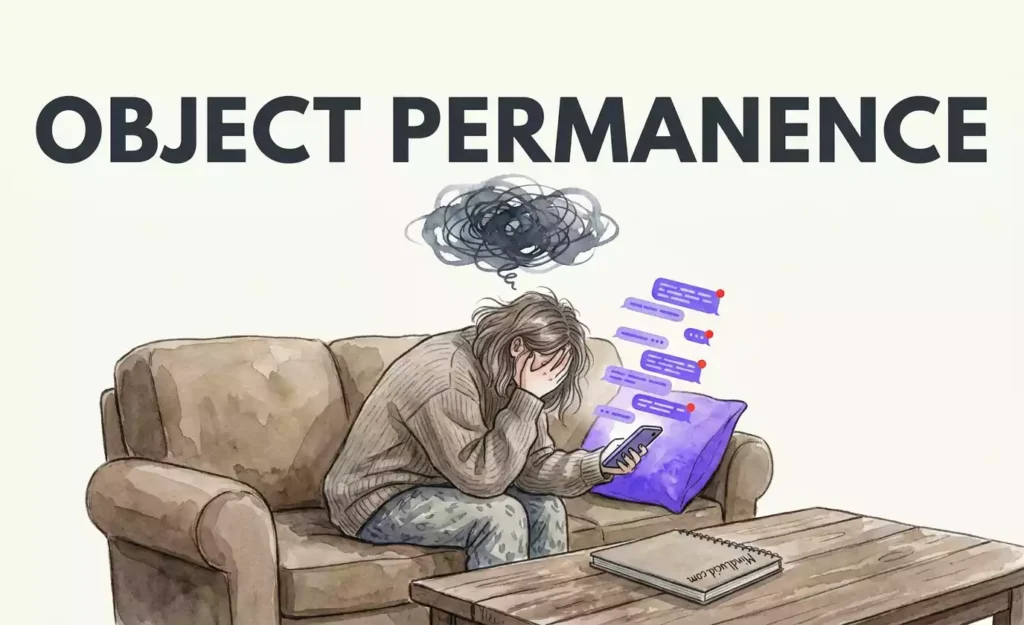
You open your messages and see a text from three days ago. From someone you genuinely love. Your stomach drops. You meant to reply — you really did — but somehow three days passed in what felt like a blink. You’re not mad at them. You’re not avoiding them. You just… forgot they existed for a moment. If this sounds familiar, you’re not broken. You might be experiencing what many in the ADHD community call the “object permanence glitch” — and understanding it could change everything about how you see yourself.
What Is Object Permanence in the Context of ADHD?
The term “object permanence” originally comes from developmental psychology, describing how babies learn that objects continue to exist even when they can’t see them. But in the ADHD and neurodivergent community, the phrase has taken on a broader, more relatable meaning: the experience of “out of sight, out of mind” when it comes to people, tasks, and responsibilities.
For many individuals navigating ADHD, this isn’t about literally forgetting that someone exists. It’s about the brain’s attention and working memory systems struggling to hold onto things that aren’t immediately present. When a person, conversation, or obligation isn’t right in front of you, your brain doesn’t automatically keep it active. It’s like having a browser with dozens of tabs open — but some of those tabs quietly close themselves without warning.
This experience extends far beyond physical objects. It affects relationships, friendships, work deadlines, appointments, and even self-care routines. The people you love most can slip into the background of your awareness, not because they matter less, but because your brain’s filing system works differently.
The “Out of Sight, Out of Mind” Reality
Imagine your attention as a flashlight. When you point it at something, everything within the beam is vivid and real. But whatever falls outside that beam? It fades into darkness. This is what many people with ADHD describe as their daily experience. When a friend, family member, or partner isn’t actively in your environment — no text notification, no shared space, no current conversation — your brain may not generate the internal reminder to reach out.
💡 Key insight: This is not a reflection of how much you care. It’s a reflection of how your brain manages attention. The love is there — but the automatic retrieval system that would normally prompt you to act on it isn’t firing the same way.
Here’s where it gets tricky: the world around you doesn’t understand this internal experience. From the outside, it looks like you’re distant, forgetful, or even indifferent. But on the inside, you’re often feeling confused, guilty, and frustrated with yourself. This gap between how you’re perceived and what you’re actually experiencing is one of the most painful parts of navigating ADHD in relationships.
How the Object Permanence Glitch Plays Out in Relationships
When it comes to the people you love, the object permanence glitch can show up in several heart-wrenching ways. Let’s explore the most common patterns:
The Unanswered Text Spiral
You see a message, read it, and think, “I’ll reply in a minute when I can give it proper attention.” Then a minute becomes an hour, an hour becomes a day, and suddenly you’re staring at a thread that’s three days old. You feel terrible. The other person feels ignored. But the delay had nothing to do with how you feel about them. Your brain simply moved on to other things and never looped back.
The “I Just Realized We Haven’t Talked” Moment
Weeks go by and you suddenly realize you haven’t spoken to someone you genuinely love and miss. It hits you like a wave — how could so much time have passed? The answer isn’t a moral failing. It’s that your brain doesn’t automatically maintain social connections without active engagement. Without a scheduled call, a shared activity, or a visible reminder, relationships can drift into the background.
The Guilt Gap
You’re not avoiding anyone. You’re not angry. You’re not holding a grudge. But the other person doesn’t know that — and sometimes, neither do you. This “guilt gap” — the space between what you intended and what actually happened — can be exhausting. You carry a constant low-level hum of shame about messages unanswered, calls not returned, and connections neglected. But the truth is, you’re not lazy or uncaring. You’re working with a brain that processes time and attention differently.
Why Your Brain Does This: The Science Behind the Disconnect
The object permanence glitch in ADHD isn’t a character flaw — it’s rooted in how the brain’s executive function systems operate. Executive functions are the brain’s “management team,” handling things like planning, initiating actions, and holding information in working memory.
In ADHD, these systems often work at a different pace. The brain has difficulty with sustained attention to things that aren’t immediately stimulating. If something isn’t urgent, novel, or right in front of you, it may not generate the internal “signal” needed to trigger action. This isn’t about not caring — it’s about the brain’s activation threshold being different.
Think of it like this: most brains have a calendar app that sends automatic notifications. Your brain? It has the calendar, but the notifications are sporadic. Sometimes they fire perfectly. Sometimes they don’t fire at all. This inconsistency isn’t a choice — it’s a variation in how your neural systems communicate.
The good news? Understanding this is the first step toward building strategies that work for your unique brain. You don’t have to “fix” yourself — you need to work with your brain, not against it.
💜 Do You Recognize These Patterns in Yourself?
If the “object permanence glitch” resonates with your experience — the forgotten messages, the time that slips away, the guilt about connections you want to maintain — you might benefit from gaining deeper insight into your own patterns. Our comprehensive ADHD assessment was designed to help you understand your unique brain better, with no pressure and no judgment.
Common Signs You’re Experiencing the Object Permanence Glitch
Not sure if this applies to you? Here are some telltale signs that many people navigating ADHD describe when it comes to object permanence in their relationships:
- You genuinely forget people exist when they’re not in your immediate environment — not in a callous way, but in a “my brain doesn’t hold them in active awareness” way
- Time feels slippery. Three days and three weeks can feel nearly identical when you’re not actively tracking them
- You’re often surprised by how much time has passed since you last spoke to someone you care about
- You feel intense guilt and shame about unanswered messages, but still can’t seem to respond promptly
- Out of sight really is out of mind — when you visit someone or see them, the connection feels immediate and real, but it fades when you’re apart
- You rely heavily on external reminders (sticky notes, alarms, calendar alerts) just to maintain basic social connections
- You’ve been called “distant” or “aloof” by people who don’t understand that you’re actually just struggling with attention management
If several of these resonate, you’re not alone. Many people navigating ADHD describe exactly these experiences. And more importantly — there are ways to work with your brain to build stronger, more consistent connections.
Object Permanence Glitch vs. Intentional Avoidance
One of the most painful misunderstandings is when others assume your silence is intentional. Here’s a breakdown of the key differences:
| ADHD Object Permanence Glitch | Intentional Ghosting or Avoidance | |
|---|---|---|
| Motivation | You genuinely want to connect, but your brain doesn’t generate the reminder or activation to do so | You’re actively choosing not to engage, often due to discomfort or conflict |
| Emotional Response | Guilt, shame, frustration with yourself, confusion about “where the time went” | Relief, indifference, or active avoidance of the person |
| When You Realize | Sudden realization that weeks have passed — often accompanied by genuine surprise | You’re aware you’re avoiding and have made a choice to do so |
| Upon Reconnecting | Warmth, gratitude, and genuine happiness to be back in touch | Awkwardness, distance, or continued avoidance |
| Pattern | Inconsistent — sometimes responsive, sometimes not, across all relationships | Targeted toward specific people or situations |
The critical difference is intent. With the object permanence glitch, the desire to maintain the relationship is there — it’s the activation that’s missing. Understanding this distinction can help release some of the guilt you’ve been carrying.
Why It’s Not About Not Caring
This is the message that needs to be said loud and clear: struggling with object permanence in relationships does not mean you don’t care. In fact, many people who experience this report caring deeply — often more than others realize.
When you internalize this truth, something shifts. The shame starts to lift. You stop calling yourself “flaky” or “a bad friend.” Instead, you begin to see your experience for what it is: a brain difference, not a character defect. This reframing is powerful — it allows you to approach relationships with curiosity and problem-solving energy instead of self-criticism.
Here’s another important perspective: many people with ADHD are known for their intensity and depth of feeling. When you are present with someone, you’re often fully present — engaged, enthusiastic, and deeply connected. The challenge isn’t the quality of your connection. It’s the consistency. And consistency can be built with the right strategies.
Practical Strategies to Stay Connected
Now for the part you’ve been waiting for: what can you actually do about this? Here are strategies designed to work with your brain, not against it:
- Externalize your relationships. Create a visible reminder system — a photo wall, a recurring calendar alert for each important person, or a “people to check in with” list. Make your connections visible so your brain doesn’t have to hold them in working memory.
- Schedule connection time. Instead of relying on spontaneous reach-outs, set recurring times to text, call, or meet with the people who matter. A weekly Sunday catch-up call, a monthly dinner date, a standing video chat.
- Use the “two-minute rule.” If you think of someone and you have two minutes, send a quick text right then. “Thinking of you!” is enough. You don’t need to write a novel — just a signal that you’re present.
- Create environmental triggers. Put a sticky note on your mirror, set a phone wallpaper, or place a meaningful object somewhere you’ll see it daily — anything that reminds you of the people you want to stay connected with.
- Be honest with the people you love. You don’t need to overshare, but a simple “I sometimes struggle with time passing quickly, and it has nothing to do with how I feel about you” can prevent so much hurt and misunderstanding.
- Use technology to your advantage. Set recurring reminders, use messaging apps with scheduled messages, create calendar events for “check in with [name]” — let technology do the remembering for you.
- Practice self-compassion. When you realize you’ve let time slip, don’t spiral into guilt. Acknowledge it, reach out, and move forward. Guilt doesn’t create connection — action does.
These strategies aren’t about “fixing” yourself. They’re about creating external supports that compensate for the areas where your brain’s automatic systems may not fire the same way. It’s not weakness — it’s smart adaptation.
Frequently Asked Questions
The term “object permanence” is borrowed from developmental psychology, and in the ADHD community, it’s used informally to describe the “out of sight, out of mind” experience. While it’s not a formal clinical term, the underlying experience — difficulty maintaining attention and awareness of things that aren’t immediately present — is very real and widely reported by people navigating ADHD. What you’re experiencing is valid, regardless of the label used.
This happens because your brain’s attention system works on what’s called an “activation threshold.” If something isn’t urgent, novel, or immediately present, your brain may not generate the internal signal that says “respond to this now.” It’s not about love or caring — it’s about how your brain prioritizes and activates on tasks. Many people with ADHD describe this exact experience.
Absolutely. The key is to stop relying on your brain’s internal reminder system and start using external supports. Scheduled check-ins, visible reminders, technology-based alerts, and open communication with your loved ones can all make a significant difference. It’s about working with your brain’s natural tendencies rather than fighting against them.
Start with a simple, honest statement: “I really value our relationship, and I sometimes struggle with time passing without me noticing. It’s not about you — it’s something I’m working on.” Most people respond well to genuine vulnerability. You don’t need to explain the neuroscience unless they’re interested. The key is reassuring them that your silence isn’t a reflection of your feelings.
It’s related but more specific. Being “bad at texting” is a behavior — this is about the underlying reason for that behavior. When you understand that it’s rooted in attention and working memory differences, not laziness or disregard, it changes how you approach the problem. You can develop strategies that actually work for your brain.
Moving Forward: Understanding Your Unique Brain
The object permanence glitch is just one piece of a larger picture. If you recognize yourself in these descriptions — the forgotten messages, the time that slips away, the guilt, the confusion — there’s a good chance you’re navigating ADHD in ways you haven’t fully explored yet.
Understanding your unique patterns is the foundation for building a life that works for you, not against you. Whether it’s in relationships, work, school, or daily routines, knowing how your brain processes attention, time, and connection can transform how you approach every aspect of your life.
You are not broken. You are not lazy. You are not a bad friend, partner, or family member. Your brain just works differently — and with the right understanding and strategies, you can build the connections and life you want.
💜 Ready to Understand Your Brain Better?
Take our comprehensive ADHD assessment to gain deeper insight into your unique patterns and experiences. It’s free, takes just a few minutes, and could be the first step toward a clearer understanding of yourself.